

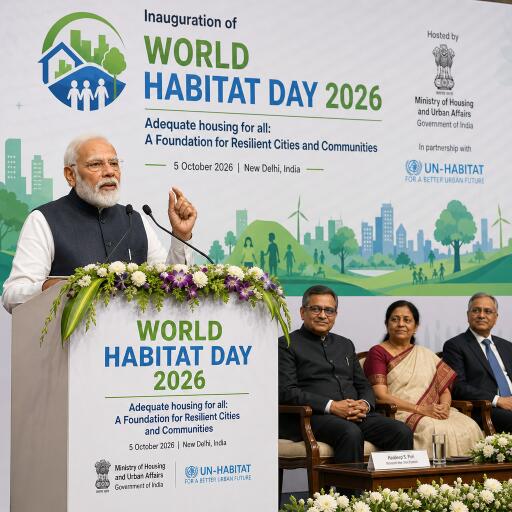
PM inaugurates World Habitat Day 2026
Bangladesh marked World Habitat Day 2026 with a nationwide call to make cities livable for all, as Prime Minister Tarique Rahman formally opened the main programme at the Hall of Fame of the Bangladesh–China Friendship Conference Centre. This year’s theme—“Universal Housing, Sustainable Urbanisation”—spotlights the dual imperative of ensuring shelter for every household while steering urban growth onto a climate-safe pathway.
Setting a tone of stewardship, the prime minister planted a golden champa sapling on the conference centre grounds before entering the venue—an emblematic gesture underscoring the role of urban greenery in cooling overheated neighborhoods, improving air quality, and enhancing biodiversity. The ceremony then commenced with readings from multiple faith traditions, followed by the screening of a documentary on this year’s observance and the unveiling of a commemorative publication.
Housing, resilience, and the urban transition
At the heart of this year’s agenda is a powerful proposition: universal access to adequate housing is inseparable from climate-resilient urbanisation. As Bangladesh’s towns and cities expand, the stakes rise—affordability crises push low-income families to climate-exposed fringes, while heatwaves, floods, and waterlogging test the limits of urban infrastructure. Planners and policymakers increasingly converge on solutions that link shelter to resilience: efficient land use, nature-based flood management, safe densities near transit, and building standards that reduce heat stress and energy demand.
To translate vision into practice, a three-day housing fair opened in the conference centre lobby, featuring 157 stalls from across the urban ecosystem. Exhibitors include real estate developers and builders, banking and financial services, Rajdhani Unnayan Kartripakkha (Rajuk), the Department of Architecture, the Public Works Department, urban planning organisations, and various agencies under the Ministry of Housing and Public Works. The fair aims to connect households with financing options, showcase low-carbon materials and design, and promote inclusive planning tools that can curb sprawl and cut emissions.
Policy dialogue and next steps
A high-level discussion session placed equity, safety, and climate adaptation squarely on the policy agenda. Housing and Public Works Minister Zakaria Taher chaired the meeting, with a welcome by Ministry Secretary Md Obaidur Rahman. Special guests included Environment, Forest and Climate Change Minister Abdul Awal Mintoo, Housing and Public Works State Minister Ahammad Sohel Monzoor, and the UN Resident Coordinator in Bangladesh, Carol Flore-Smereczniak. Speakers underscored that universal housing is achievable only with integrated planning—linking land policy, public transport, energy efficiency, water-sensitive design, and resilient livelihoods.
Key priorities raised for the coming year include:
- Scaling affordable housing through public–private partnerships that embed energy efficiency and passive cooling.
- Expanding green and blue infrastructure—urban forests, wetlands, canals, and permeable surfaces—to buffer storm surges and urban flooding.
- Upgrading informal settlements with secure tenure, climate-resilient services, and safe building standards.
- Aligning housing finance with resilience outcomes, including incentives for low-carbon materials and rooftop solar.
- Centering women, youth, and low-income community voices in planning decisions to ensure benefits are equitably shared.
A global observance with local urgency
World Habitat Day has been observed annually since the United Nations designated the first Monday of October for the occasion in 1985. The inaugural observance took place in Nairobi in 1986 under the banner “Shelter is My Right,” a principle that continues to resonate as cities worldwide confront intertwined crises of affordability, climate risk, and infrastructure shortfalls. Each year’s theme reframes the global conversation, urging governments and communities to reimagine urban futures that are safe, inclusive, and sustainable.
Why “universal housing” and “sustainable urbanisation” must move together
Meeting housing needs without locking in carbon-intensive patterns is a decisive challenge of this decade. In practical terms, that means designing compact, transit-served neighborhoods; elevating buildings and services above flood thresholds; enhancing ventilation and shading to cut cooling demand; and deploying decentralized renewables to stabilize energy access. When paired with fair financing, resilient land use, and strong building codes, these measures can lower long-run costs for households while reducing emissions and disaster losses.
The day’s events in Dhaka served as both milestone and mandate. The sapling planted at the outset is a reminder that urban transformation grows from many small actions: a shaded street that stays cooler by several degrees; a retention pond that keeps a neighborhood dry during heavy rain; a mortgage product that brings an efficient home within reach. Threaded together, such steps can deliver on the promise of this year’s theme—homes for all, and cities that thrive within planetary boundaries.



Leave a Reply