

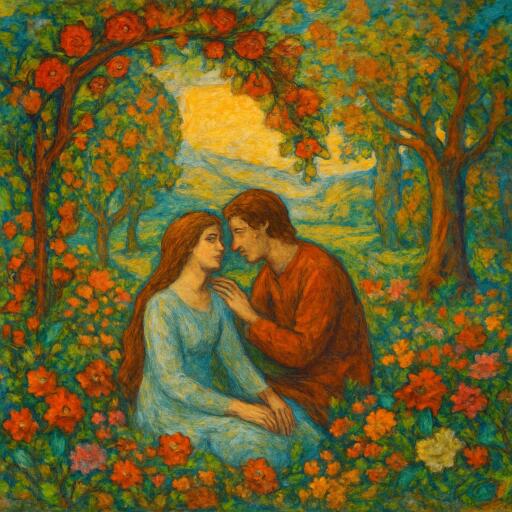
Jeanne Bucher Jaeger explores love, nature and the idea of paradise in Garden of Love
At Jeanne Bucher Jaeger in Paris, Garden of Love turns the idea of affection into something far larger than a bond between two people. The exhibition imagines love as a force that also connects human beings to landscapes, animals, memory and the fragile systems that sustain life. On view from October 3 to December 19, 2026, the show proposes the garden as both a real place and a symbol: a cultivated space where care, desire, ecology and imagination can take root together.
Conceived by guest curator Guillaume Logé, the exhibition draws on a wide range of eras and cultures to explore how gardens have long served as images of harmony, fertility and longing. Rather than treating paradise as a distant fantasy, the project asks whether it might be built through acts of attention, reciprocity and stewardship. In this sense, the garden becomes more than scenery. It is presented as a model for living, one that depends on patience, balance and a willingness to share the world with other forms of life.
The exhibition brings together ancient works, modern figures and contemporary artists in a deliberately wide-ranging conversation. Visitors encounter pieces by André Bauchant, Pierre Bonnard, André Breton, Raoul Dufy, Max Ernst, Fernand Léger, André Masson, Maria Helena Vieira da Silva, Ossip Zadkine, Eikoh Hosoe, Yang Jiechang, Antonella Zazzera and Lin Zhipeng, known as No. 223. These works appear alongside objects from African, Egyptian, Indian and pre-Khmer traditions, creating an environment where visual languages from different centuries and geographies speak to one another.
At the heart of the exhibition is Yang Jiechang’s monumental Tale of the Eleventh Day – Red Autumn (2014-2024), a silk work stretching more than 14 meters across. Created with ink and mineral pigments using the refined Gongbi technique, the ten-panel composition unfolds as a lush vision of an early world inhabited by humans and animals sharing the same space. The painting imagines coexistence not as domination, but as exchange.
The title points to a literary thought experiment. Inspired by the structure of Boccaccio’s Decameron, the work envisions what might happen beyond the original ten days of storytelling. In this imagined “eleventh day,” a new social and ecological order comes into view. Species boundaries appear softer, and the landscape suggests a world shaped by mutual respect rather than hierarchy. It is a vision of paradise, though not a passive one. It asks what kind of work, ethics and sensitivity would be required to make such a world possible.
That tension between beauty and responsibility runs through the entire exhibition. Here, the garden is never reduced to ornament. It is shown as a carefully made environment, one that reflects labor, discipline and care. References to the garden traditions of Persia, India, China, Mesopotamia and Egypt widen the historical frame, revealing how many civilizations have imagined planted spaces as sites of spiritual order, pleasure and political meaning. Across these traditions, tending the garden often mirrors tending human relationships: both require commitment, vulnerability and attentiveness to change.
Garden of Love also resonates strongly with present-day concerns. Without becoming didactic, the exhibition places ecological instability, climate anxiety and technological upheaval in the background of its reflections. In a time shaped by artificial intelligence, digital acceleration and environmental strain, the show asks what forms of intimacy remain possible. Its answer is not nostalgic. Instead, it suggests that future ideas of connection may depend on rethinking humanity’s position within the living world rather than above it.
Several works highlighted in the exhibition materials deepen this perspective. Fernand Léger’s La femme à la rose (1930) brings the flower into dialogue with the human figure, while Pierre Bonnard’s photograph Marthe debout près d’une chaise (1900) captures intimacy in a more private register. Lin Zhipeng’s Yang Color Releasing (2020) introduces a contemporary visual language of sensual freedom, and an early 18th-century Indian scene of lovers in a garden among peacocks reinforces the enduring association between cultivated nature, desire and ritualized beauty. Together, such works show how artists have repeatedly used the garden as a stage on which longing, embodiment and the more-than-human world meet.
What gives the exhibition its force is its refusal to follow a single linear story. Instead, it layers objects, images and references so that viewers can trace their own pathways. A modernist drawing may echo an ancient object; a contemporary photograph may revive an old symbolic code. Through this method, the show transforms art history into an ecosystem of forms and ideas, one where meaning emerges through proximity and relation.
Ultimately, Garden of Love argues that love should not be understood only as an emotion exchanged between individuals. It can also be seen as a mode of attention directed toward the world itself. In that expanded sense, paradise is not a lost realm but a fragile possibility—something cultivated through empathy, imagination and care for what is alive around us. At Jeanne Bucher Jaeger, the garden becomes a fitting metaphor for that ambition: a place where beauty survives only if it is nurtured.



Leave a Reply