

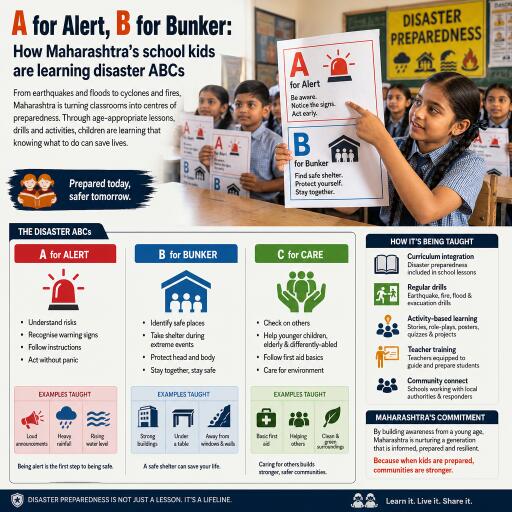
A for Alert, B for Bunker: How Maharashtra’s school kids are learning disaster ABCs
Across a growing number of government classrooms in Maharashtra, the ABCs now double as a crash course in survival. Instead of Apple and Ball, children meet Alert and Bunker, alongside Cyclone, Evacuation, Mitigation, and Search and Rescue—concepts that once felt distant but are becoming essential as the climate warms and weather grows more extreme.
A poster born from a parent’s worry—and a planner’s foresight
The seed for this colourful chart was planted in Palghar, a coastal district frequently tested by monsoon extremes and high tides. A district disaster management officer there began sketching an alphabet for his toddler, then realized it could be scaled into a learning tool for schools. By mid-2025—timed with a national day of remembrance—the alphabet was formally introduced in classrooms.
While short and simple, the vocabulary is deliberate. The curator drew on global climate and disaster glossaries to select age-appropriate terms that still communicate the seriousness of risk. The idea was to build muscle memory through repetition and visuals, and to anchor new words in stories from children’s own surroundings—flooded lanes, cyclone warnings, heat alerts, and crowded train stations where public address systems matter.
What the kids actually learn
Each letter pairs a keyword with a bite-sized explanation. Together, the 26 letters create a map of how hazards form, who responds, and what individuals can do.
Natural hazards and a changing climate
- F is for Flood and L is for Landslide, both increasingly common during intense monsoon bursts.
- C is for Cyclone, a reminder that the Arabian Sea’s warming waters can supercharge storms.
- G is for Glacier Melting, linking distant mountains to downstream floods and water stress.
- Z is for Seismic Zone, teaching that some regions face higher earthquake risk.
- E is for Environmental Degradation, showing how damaged forests, soils, and rivers magnify disasters.
People, tools, and systems that save lives
- N stands for the National Disaster Response Force—specialists who deploy during major emergencies.
- O is for Operation Centre, the hub that coordinates action as a crisis unfolds.
- P is for Public Address System, crucial in crowded places when seconds count.
- Q is for Quick Response Team, those first on the scene.
- V is for Very High Frequency radios, the fallback when phones fail.
- W nods to global meteorological bodies that track storms and issue warnings.
Preparedness as a habit, not an event
- D is for the Disaster Management Cycle—prepare, respond, recover, reduce risk.
- H is for Hazard, M for Mitigation, and R for Risk Reduction—core ideas behind safer schools and neighbourhoods.
- K is for Know Your Strengths, encouraging children to act within their abilities, seek help, and keep themselves and others safe.
Specific scenarios that spark curiosity
- I is for Isolation Ward—how infection control protects communities during outbreaks.
- J is for Jumping Net—used in rescues from heights.
- X is for Xylene—an entry point into chemical safety and why labels matter.
- Y is for Yachting Accident—boating basics on life jackets and alerting for help.
Not in the syllabus—and that’s the point
The chart isn’t a formal textbook chapter. Teachers weave it into the day, using Marathi explanations and local examples. The approach is light-touch: a poster on the wall, a quick daily pick-a-letter discussion, small assignments that turn vocabulary into action—locating the nearest safe shelter, mapping a family evacuation plan, or rehearsing how to call for help.
From one district to many
After debuting in Palghar, the alphabet has begun traveling. In Parbhani, for instance, disaster management officials have distributed the chart to dozens of Zilla Parishad primary schools. Children receive simple homework based on the letters, and those who demonstrate strong understanding are publicly appreciated—an incentive that makes safety knowledge something to be proud of.
Why this matters now
Maharashtra sits at the crossroads of multiple climate pressures: hotter heatwaves, more erratic monsoons, cyclones skirting the west coast, and urban flooding that clogs transport and classrooms alike. In such a setting, early “risk literacy” can be as fundamental as reading itself. The chart reframes safety as a daily practice—knowing when to stay alert, where a bunker or safe room is, why sirens matter, and how to avoid panic.
Children who learn these basics often carry them home, turning kitchens and courtyards into micro-classrooms. Parents hear new words, map exits, and swap tips. Over time, this creates a culture of readiness that aligns with global disaster-reduction goals: anticipate hazards, communicate clearly, protect the most vulnerable, and rebuild smarter after a shock.
The bigger lesson
Teaching disaster preparedness through the alphabet isn’t just clever—it’s equitable. It reaches children regardless of test scores or technology access, and it respects the realities of life where a sudden downpour can flood a settlement or a power cut can darken an entire block. In 26 small steps, it makes the language of safety speak to everyone.



Leave a Reply