

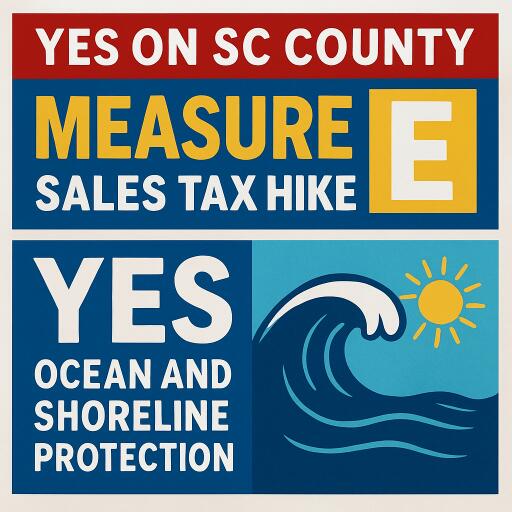
Editorial | Yes on SC County Measure E sales tax hike; Yes on Measure D, ocean and shoreline protection
When higher levels of government pull back from core services, communities face a stark choice: watch essential care unravel or step in. Santa Cruz County now confronts that moment with two ballot measures that would sustain critical health and safety programs and safeguard the coast. Both deserve a Yes.
Measure E: A focused, five-year boost to protect vital services
Measure E proposes a half-cent increase to the county sales tax for five years. County leaders advanced this temporary step to blunt an estimated $200 million reduction in state and federal safety-net funding. The increase is projected to raise about $27 million annually, with every dollar kept under local control.
What would that support? Frontline health and human services: hospitals and emergency rooms, safety-net clinics, behavioral health, and food and housing stability programs. This local lifeline is especially urgent as eligibility changes mean many Medi-Cal enrollees risk losing coverage in the coming year; in Santa Cruz County, more than 30% of residents rely on Medi-Cal.
Measure E is a general tax, requiring a simple majority (50% plus one) to pass and set to expire after five years. Because it flows to the general fund, critics worry it could be redirected to any governmental expense, such as raises or pension costs, rather than strictly to emergency and healthcare services. They also argue that county government should first squeeze inefficiencies, reform contracting, and correct past missteps before asking residents for more.
These concerns are real. Sales taxes are regressive, and cost-of-living pressures here are intense. Yet the alternative is to allow care and prevention to erode precisely when needs are greatest. California’s sales tax generally exempts most groceries and prescriptions, modestly cushioning the impact on everyday necessities. More importantly, Measure E is time-limited and transparent in its intent: to steady essential services while intergovernmental funding gaps persist.
Voters can and should demand clear reporting, independent audits, and visible budget priorities that align with Measure E’s stated goals. But the immediate question is whether to keep hospital doors open, preserve mental health care, and maintain the safety net that prevents greater human and fiscal costs down the line. On balance, a small, temporary tax to stabilize life-saving services is a responsible bridge through a turbulent period.
Vote Yes on Measure E.
Measure D: Keep coastal decisions in the hands of voters
Measure D asks whether any land-use or zoning changes that enable onshore facilities for deep-sea or seabed mining should require approval by a majority of county voters. This measure updates and strengthens protections first put in place by voters in 1986, which required public approval for onshore infrastructure tied to offshore oil and gas drilling. Those local safeguards helped form a decades-long, coastwide backstop against industrialization of sensitive shorelines.
Why update now? Federal policy discussions have revived interest in offshore extraction, including critical mineral mining framed as a national security imperative. If offshore operations are pursued, they only function with onshore support—pipelines, processing, storage, or transport hubs. Measure D closes a loophole for deep-sea mining not contemplated in 1986 and modernizes the ordinance to better withstand current legal tests under state and federal law.
The environmental case is straightforward. Deep-sea mining is poorly understood and potentially high risk: sediment plumes can travel far beyond extraction zones, acoustic disturbance threatens marine life, and the deep ocean stores carbon and nurtures biodiversity we are only beginning to comprehend. On land, coastal industrial buildout invites new spill risks and is increasingly vulnerable to sea-level rise and erosion—hardly a recipe for resilience. Santa Cruz County’s economy and identity rest on healthy beaches, fisheries, research, recreation, and tourism. Community consent should be a prerequisite for any zoning shift that could place those at risk.
Measure D doesn’t decide a project’s fate; it decides who gets to decide. Requiring voters to approve any land-use change for onshore facilities supporting deep-sea extraction keeps ultimate authority local, visible, and democratic. At the time of this writing, there is no organized local opposition—an indication that entrusting these big choices to the public resonates across constituencies.
Vote Yes on Measure D.
Two votes for care and coastline
Together, Measures E and D reflect a simple ethos: protect people and place. Measure E shores up essential health and human services while higher-level funding falters. Measure D ensures that any move to industrialize the shoreline proceeds only with explicit voter approval. These are prudent, community-first choices that align with a just, climate-smart future for Santa Cruz County.
Yes on E. Yes on D.



Leave a Reply