

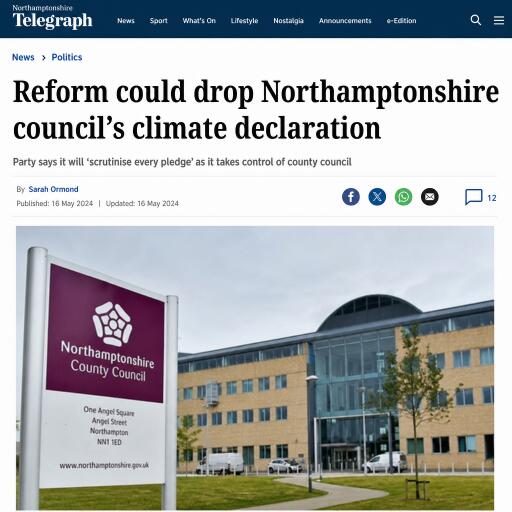
Reform could drop Northamptonshire council’s climate declaration
North Northamptonshire Council is set to weigh a proposal from Reform UK councillors to withdraw its 2021 “climate and environment emergency” declaration. The move has sparked criticism from Conservative, Labour and Green members, who argue it risks weakening the area’s climate ambition and sending the wrong signal to residents and businesses.
How the council got here
The council, created in 2021, initially under Conservative leadership, declared a climate emergency soon after it was formed and set a local aim to be carbon neutral by 2030. That timeline was tightened to drive faster action on cutting emissions from council operations, procurement and local energy use.
Last year, the council’s Reform-led executive voted unanimously to push the local carbon-neutral goal back to 2050. Supporters of that change said it aligned with the national net zero timetable, which requires the UK to balance greenhouse gas emissions with removals by mid-century.
What the new motion argues
The proposed motion contends that effective environmental stewardship—such as conserving nature, improving energy efficiency and using public funds responsibly—does not rely on maintaining an “emergency” label. Its backers say the language of emergency sits uneasily alongside a multi-decade timetable, and that resources should be focused on practical measures where the council has clear influence, including buildings, transport, waste, and land management.
Political reaction
Opposition councillors from across the chamber have criticised the plan ahead of scheduled discussions, warning that removing the declaration could slow momentum and dampen accountability. They argue that, while the term is symbolic, it has helped concentrate attention on emissions cuts, resilience planning and funding bids tied to climate action.
What would actually change?
Climate emergency declarations do not, by themselves, create new legal duties. They typically act as a public commitment to accelerate policy and investment—often shaping procurement rules, fleet replacement, building retrofits, tree planting, and nature recovery projects. Rescinding the declaration would not unwind national requirements, but it could alter local priorities, timelines, and the framing used to justify budget choices.
In North Northamptonshire, the key pivot already occurred when the 2030 carbon-neutral target for council operations was moved to 2050. The current motion would further shift the narrative from an “emergency” footing to a long-term management approach. Whether that reduces or refocuses action will depend on the detail of forthcoming plans, budgets and performance reporting.
The wider context
Across the UK, many councils adopted climate emergency declarations between 2019 and 2021 to reflect growing evidence of rapid warming and the increasing costs of extreme weather. While these declarations vary in scope, they often support local strategies on home insulation, renewable energy, active travel, bus services, and nature restoration—areas that can deliver emissions cuts and improve public health, energy security and biodiversity.
Nationally, the UK remains bound by law to reach net zero by 2050. Net zero means any greenhouse gases still emitted must be balanced by absorption or removal—through natural systems like forests and soils, or engineered solutions. Major scientific assessments have concluded that reaching net zero carbon dioxide is essential to stabilise global temperatures.
What’s next
The proposal to drop the emergency declaration is expected to be debated this week, before being taken forward for a decision by the full council at a later meeting. If approved, council leaders will need to spell out how environmental goals—on energy, transport, waste and nature—will be delivered without the emergency framing, and how progress will be measured against the 2050 timetable.
For residents and local businesses, the practical questions remain the same: how quickly will buildings become cheaper to heat, how reliable and clean will transport options be, and how well will local nature be restored and protected? The answers will hinge on the council’s next set of detailed plans—and the resources committed to make them real.



Leave a Reply