

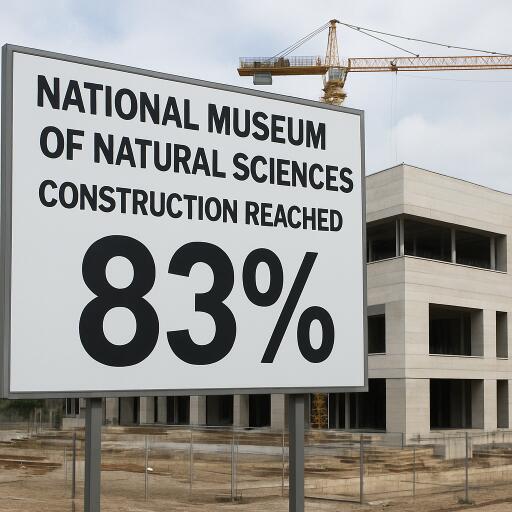
National Museum of Natural Sciences Construction Reached 83%
Mongolia’s future National Museum of Natural Sciences is moving steadily toward completion, with construction now reaching 83 percent. During a recent site inspection in Ikh Tengeryn Am, officials emphasized the need to finish the project to a high standard, reflecting its importance as a long-term national investment in science, culture, and public education.
The museum is being developed on a 6.6-hectare site and will span roughly 45,000 square meters. When finished, it is expected to become Mongolia’s first large-scale museum dedicated to natural sciences and one of the largest institutions of its kind in Asia.
The project began in 2024 and consists of five building blocks. Completion of the main construction is scheduled for next year, after which work will focus on interior finishing and the installation of exhibitions. Planning for those exhibitions is already far advanced, with experts from major academic and scientific institutions collaborating on the content and layout.
The museum is being designed as more than a repository for specimens. It aims to function as a modern learning environment, combining research, preservation, and public engagement. Organizers are prioritizing international-level standards for exhibition design, collection storage, conservation systems, and educational programming. Attention is also being directed toward training skilled specialists who can manage the museum’s scientific and technical operations in the years ahead.
A major feature of the new institution will be its use of digital and immersive technology. The museum is expected to include seven permanent exhibition halls equipped with virtual reality, multimedia systems, interactive screens, and dynamic installations. These tools are intended to make topics such as geology, paleontology, biodiversity, and ecology more accessible to visitors, especially younger audiences.
In addition to its permanent galleries, the complex will contain a temporary exhibition hall, amphitheater, library, conference space, restaurant, coffee shop, gift store, and parking for about 500 vehicles. Visitor flow has been carefully considered in the design: the museum should be able to host between 2,500 and 3,000 people at one time, with daily attendance potentially reaching 3,500 to 5,000 visitors.
The institution’s educational mission is broad. Its galleries are expected to explore the living world, the development of humanity, landscapes, fossils, ecosystems, and the evolution of life on Earth. By presenting these subjects through both scientific displays and interactive experiences, the museum is positioned to become a key destination for children, students, families, and researchers.
Beyond science communication, the museum is also expected to support environmental awareness. Its long-term role will likely extend into ecological education, encouraging visitors to better understand Mongolia’s natural heritage and the challenges facing ecosystems under climate pressure. In that sense, the building represents not only a cultural landmark but also a platform for promoting sustainability, conservation, and lifelong learning.
The broader significance of the project is also tied to land use and public access. The museum site was returned to public ownership following a government decision to reclaim land previously used outside its intended purpose. That move paved the way for a public-facing institution meant to serve both national identity and scientific advancement.
Mongolia already has a long history of natural history collections and research. Over the decades, those efforts have evolved through reorganizations and institutional growth, eventually forming the foundation for today’s museum sector. Existing collections include thousands of natural science exhibits and specimens, and the new museum is expected to build on that legacy with expanded display, preservation, and research capacity.
Once opened, the National Museum of Natural Sciences is set to become a flagship institution where technology, ecology, and education intersect. Its progress at 83 percent signals that Mongolia is approaching a major milestone in creating a scientific and cultural center intended to inspire public curiosity and deepen respect for the natural world.



Leave a Reply