

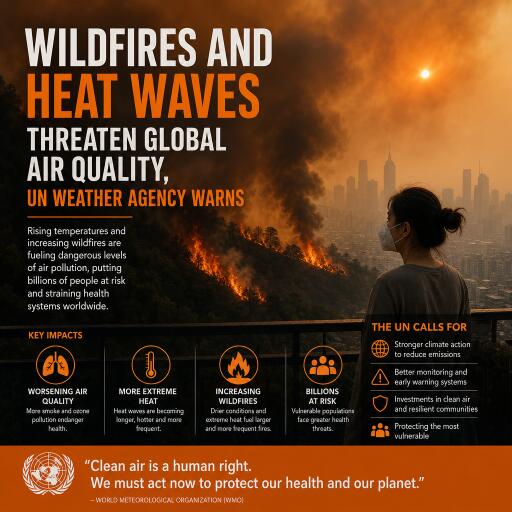
Wildfires and heat waves threaten global air quality, UN weather agency warns
Explosive wildfire seasons and relentless heat waves are pushing air pollution to dangerous new heights, the UN’s meteorological experts caution, urging countries to prepare for a future where climate extremes routinely degrade the air we breathe.
A feedback loop of heat and smoke
Rising temperatures and more frequent heat waves are amplifying pollution in two powerful ways. Prolonged heat traps stagnant air, accelerating the chemical reactions that produce ground-level ozone—an irritant that inflames lungs and stresses the heart. At the same time, vast wildfires inject thick plumes of smoke into the atmosphere, rich in fine particulate matter that can travel hundreds or even thousands of kilometers, fouling air far from the flames.
UN weather specialists warn that even regions with relatively clean local emissions can experience sudden, severe pollution when smoke drifts in from distant fires. As climate change drives longer, hotter, and drier seasons, these feedbacks are expected to intensify, compounding risks for populations already exposed to urban smog or industrial emissions.
Invisible threats: PM2.5, ozone, and poorly tracked pollutants
The growing hazards at the center of this warning are fine particulate matter (PM2.5) and ground-level ozone. PM2.5—microscopic particles small enough to penetrate deep into the lungs and enter the bloodstream—is linked to heart attacks, strokes, asthma, and a range of chronic diseases. Ozone at the surface, formed when sunlight “cooks” a mix of precursors from traffic, industry, and fires, can trigger breathing difficulties and reduce lung function even in healthy people.
The agency also highlights significant gaps in tracking pollutants such as black carbon and microplastics. Both are increasingly present in the air but remain inconsistently monitored. Black carbon darkens snow and ice—accelerating melt—and worsens respiratory disease, while microplastics have been detected in remote environments and urban centers alike, raising questions about long-term health effects.
Global reach, mounting toll
Research referenced by the agency indicates that extreme smoke events from fires have roughly tripled worldwide since the 1990s. These intense episodes may have been associated with nearly 100,000 additional deaths each year between 2010 and 2018, underscoring how quickly air quality can deteriorate during major fire seasons.
In Europe, recent months brought scorching temperatures and destructive fires from Spain to France and Greece, illustrating how multiple hazards can converge: heat primes landscapes to burn, fires spread rapidly, and smoke spikes pollution across borders. According to the UN weather service, episodes of extreme heat are becoming more frequent, more intense, and longer-lasting as the planet warms, setting the stage for further air-quality setbacks.
Why clean-air rules need a climate upgrade
Traditional air-quality management, built around local emissions and predictable seasonal patterns, is being upended by climate volatility. The UN warns that without integrating climate risk into air-pollution strategies, countries will struggle to shield people from acute exposure during heat waves and wildfire outbreaks. Meeting stringent air-quality guidelines will likely become more difficult as extreme fires become more common.
The agency calls for a new generation of strategies that blend climate science, public health planning, and real-time observation. Priorities include:
- Early-warning systems that fuse weather forecasts, fire behavior models, and smoke-transport projections to alert communities before air quality crashes.
- Expanded monitoring networks to better track PM2.5, ozone, black carbon, and microplastics, paired with accessible public dashboards.
- Coordinated cross-border responses, recognizing that smoke and ozone precursors routinely traverse national boundaries.
- Emission reductions across sectors—energy, transport, industry, and land use—to curb both greenhouse gases and the pollutants that create ozone and particulates.
- Heat-health and clean-air action plans that prioritize protection for vulnerable groups, including outdoor workers, children, older adults, and those with chronic conditions.
A narrowing window to breathe easier
Air pollution and climate change are interlinked crises. Strategies that reduce fossil fuel combustion and prevent landscape-scale fires can deliver immediate health benefits while cutting climate-warming emissions. Conversely, inaction deepens a cycle in which hotter, drier conditions breed more fires and stagnation, seeding the next wave of pollution spikes.
As wildfires intensify and heat waves stretch longer into the calendar, the message from the UN weather community is blunt: safeguarding air quality now requires treating climate extremes as a central driver, not a background variable. The sooner governments integrate climate-risk forecasting with air-quality management, the more lives and livelihoods can be protected when the next plume of smoke or surge of ozone arrives.



Leave a Reply