

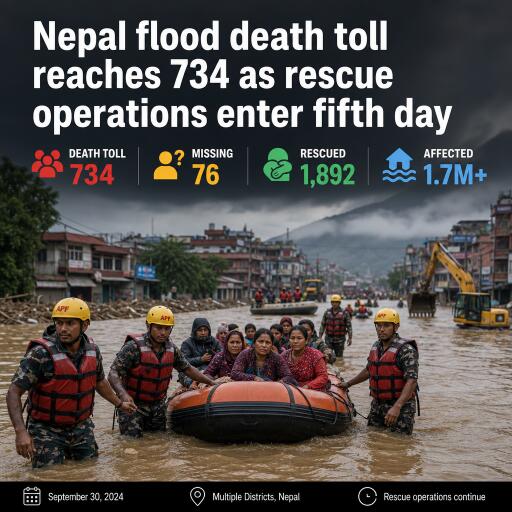
Nepal flood death toll reaches 734 as rescue operations enter fifth day
As search and rescue operations stretch into a fifth day, Nepal’s disaster authority reports at least 734 confirmed deaths and 2,498 people still missing after a catastrophic surge of ice, rock, and floodwater roared through Himalayan valleys near the border with Tibet. Across the frontier, officials confirm 16 deaths and 546 missing in Tibet, pushing the combined toll to 750 dead and 3,044 unaccounted for in one of the region’s most devastating cross-border disasters in recent years.
Rescues underway, but numbers of missing continue to rise
Emergency teams in Nepal have rescued 8,186 people to date, including 227 foreign nationals. Yet the number of those unaccounted for continues to climb, and the roster of missing in Nepal now includes 589 foreigners, an increase from previous tallies. The list also identifies 933 employees working on hydropower sites along the river corridor struck by the torrent—critical infrastructure that has faced mounting exposure to climate- and glacier-related hazards.
In India, authorities say seven bodies have been recovered from rivers flowing out of Nepal. These are believed to be flood victims, though they are not currently included in Nepal’s official toll.
Foreign nationals among the missing in Tibet
On the Tibetan side, officials say 261 foreign nationals from 23 countries remain out of contact. Preliminary figures indicate the largest number of missing foreigners are from Nepal, followed by India, Latvia, the United States, and the United Kingdom. Authorities have notified diplomatic missions as identification efforts proceed.
Local police in the border district report that both residents and rescue workers have relocated to higher ground after a sharp rise in the Trishuli River, a signal that secondary surges remain possible even as response teams continue their work.
Glacier instability and a warming Himalaya
Initial assessments attribute the disaster to glacier destabilization exacerbated by long-term warming—a pattern increasingly recognized across the high Himalaya and Tibetan Plateau. The sequence likely involved a rapid collapse of ice and slope materials that transformed into a debris-laden flood, accelerating down steep valleys and entraining sediment, boulders, and infrastructure along its path. Investigators say the torrent took just six to seven minutes to reach the Gyirong border crossing, illustrating how little warning communities often have when high-elevation hazards cascade downslope.
Scientists have warned for years that the Himalayan cryosphere is entering a volatile phase: thinner and retreating glaciers, expanding proglacial lakes, thawing permafrost that weakens slopes, and more frequent compound events that couple landslides with sudden floods. These dynamics can overwhelm river systems and infrastructure designed for historical extremes, not today’s rapidly shifting baselines.
Cross-border response and relief
Authorities describe an exceptionally complex rescue environment spanning remote terrain and damaged transport routes. More than 2,100 emergency personnel have been mobilized on the Tibetan side, with funds allocated for relief and recovery. Support to Nepal includes emergency cash assistance, relief supplies, satellite imagery and hydrological data, and deployment of tunnel-rescue specialists to help clear blocked corridors and assess unstable slopes.
Officials from both countries say they are coordinating to identify the missing—locals and foreign nationals alike—and to strengthen joint protocols on disaster prevention, early warning, and climate adaptation across shared watersheds.
Communities in peril and infrastructure at risk
With rivers still running high and slopes unsettled, authorities caution that additional slides or surges are possible. Surveillance footage from the border zone has shown walls of debris and water engulfing buildings within minutes, underscoring the need for rapid-alert systems that can reach communities and work crews far downstream.
The region’s hydropower corridor—vital for energy security and livelihoods—has emerged as a focal point of vulnerability. Many projects sit along narrow gorges where debris flows can arrive with little notice. Experts say layered defenses are needed: real-time glacial lake and slope monitoring, automated river-stage alarms, evacuation drills, hazard-aware construction standards, and climate-informed redesigns of dams, diversions, and access roads.
Humanitarian agencies estimate that more than 90,000 people may have been affected, a figure that includes those displaced, injured, or cut off by damaged roads and communications. Mountain communities—already contending with erratic monsoons and shrinking seasonal snow—now face prolonged recovery as fields, homes, and local economies absorb the impact.
What comes next
As the search continues for thousands still missing, priority remains on locating survivors, restoring access routes, and stabilizing slopes where possible. In the longer term, the disaster is likely to accelerate calls for binational early-warning systems that integrate satellite data, drones, river gauges, and community sirens, and for cross-border drills that reflect the reality that glacial hazards do not stop at political boundaries.
For residents of the high Himalaya, this event is a stark reminder: warming temperatures can transform ice and rock into sudden, lethal floods. Planning, cooperation, and investment—guided by the latest climate science—will determine how often such tragedies repeat, and how many lives can be saved when they do.



Leave a Reply