

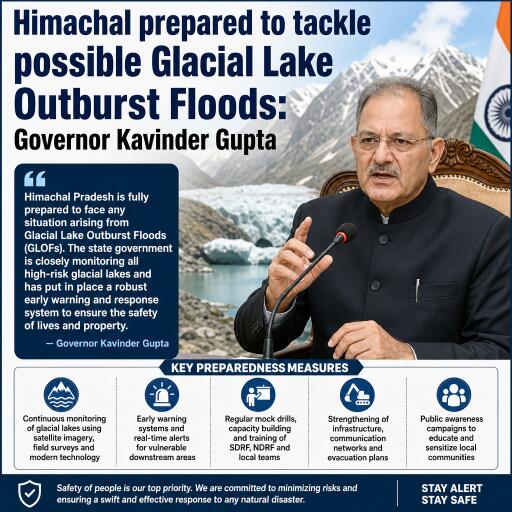
Himachal prepared to tackle possible Glacial Lake Outburst Floods: Governor Kavinder Gupta
Amid fresh alarm over Himalayan flood risks, Himachal Pradesh Governor Kavinder Gupta has underscored the state’s readiness to confront potential Glacial Lake Outburst Floods (GLOFs). Pointing to recent devastation from flash floods in the Nepal–Tibet region, he described the accelerating impacts of climate change as a global challenge and stressed the urgency of preparedness across the mountain belt.
Gupta said the state’s disaster management apparatus has been primed for rapid response, with authorities monitoring vulnerable catchments and planning for worst-case scenarios. His remarks follow a new academic assessment highlighting heightened GLOF risk in Himachal and neighboring Himalayan states—a warning rooted in the rapid expansion of glacial lakes and more frequent extreme weather linked to a warming climate.
Preparedness steps and early warning
According to the Governor, departments across the state have been instructed to coordinate on early warning, evacuation, and rapid relief. This includes mapping high-risk lakes, strengthening hydrometeorological networks, and improving communications to reach remote communities at short notice. He emphasized that mock drills, stockpiles of essential supplies, and standardized incident command protocols are being prioritized so that responders can act swiftly if a lake shows signs of breaching.
Authorities are also focusing on public awareness—ensuring that residents living along river valleys know evacuation routes, can recognize flood cues, and understand how to respond if sirens or alerts are issued. Gupta signaled that local administrations have been tasked with keeping evacuation corridors clear and ensuring safe shelters are accessible, even during landslides or heavy rain.
Regional alarm after recent Himalayan floods
The recent flash floods across the Nepal–Tibet region have reverberated through the Himalaya, where steep terrain and fragile geology amplify hazard. Gupta called the incident a stark reminder that climate-driven extremes are straining both ecosystems and infrastructure. He expressed hope that such disasters do not recur but said the only responsible path is planning and vigilance tailored to high-mountain realities.
Focus on families and frontline communities
Beyond infrastructure and technical measures, the Governor highlighted the need to support families bearing the brunt of disaster. He welcomed the prompt assistance extended by the Union government and said that relief, compensation, and livelihood restoration must move in tandem with long-term resilience—such as safer housing sites, diversified income sources, and climate-proofed services like health, water, and education.
Why GLOFs are becoming more frequent
GLOFs occur when natural dams—often loose moraine ridges left behind by retreating glaciers—fail suddenly, unleashing vast volumes of water and debris downstream. Several triggers can tip these lakes into catastrophe: intense or prolonged rainfall, rapid snow or ice melt during heatwaves, calving of glacier ice into a lake that creates a surge wave, slope failures, or seismic activity. Climate change raises the odds by thinning glaciers, expanding lakes, and stacking the deck toward heavier downpours and heat extremes.
In Himachal Pradesh, densely settled valleys, roads, and hydropower projects share narrow river corridors. That overlap of exposure and hazard elevates risk, making advance planning critical. Scientists note that even lakes considered stable can evolve quickly; continuous monitoring and contingency planning are essential.
The road ahead
Gupta’s message aligns with a broader Himalayan agenda: invest in science-based risk mapping; design early warning systems that are affordable, redundant, and multilingual; and embed local knowledge into response planning. Terrain-appropriate engineering—such as selective lake drainage where feasible, reinforcement of vulnerable berms, and flood-safe siting of new infrastructure—can cut risk before an emergency strikes.
He also pointed to the wider climate imperative: reducing emissions globally to limit further glacier retreat, while simultaneously accelerating adaptation at home. In practical terms, that means river-basin planning that respects natural floodplains, robust building codes in hazard zones, and recovery projects that “build back better” rather than reinstalling past vulnerabilities.
For now, the Governor’s bottom line is clear: while no one can eliminate the threat of sudden mountain floods, preparedness can save lives. With coordinated action—from state agencies to panchayats, from scientists to first responders—Himachal aims to meet the growing GLOF risk with vigilance, rapid response, and support for the communities on the front lines.



Leave a Reply