

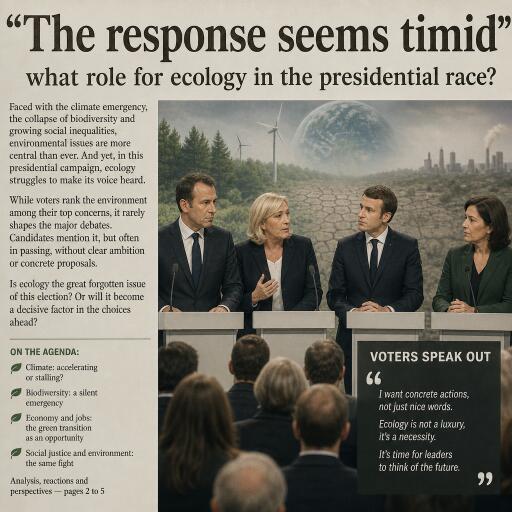
“The response seems timid”: what role for ecology in the presidential race?
After a season of wildfires, blistering heat, and deepening drought, France is entering the presidential race with climate front and center—at least in public opinion. Yet the political response remains cautious, fragmented, and, according to many experts, far short of what the situation demands.
A country battered by extremes
From the Gironde to the Landes and the Var, vast areas of forest burned this summer while heatwaves arrived in relentless waves. Agriculture struggled under severe water stress. Only months earlier, a chain of winter storms drenched the country, triggering major floods in multiple regions. The climate signal is no longer abstract: it is playing out in homes, farms, and hospitals, with cascading effects on health, food security, and local economies.
Scientists have warned for years that such extremes would intensify. A decade ago, major international assessments already concluded that warming was unequivocal and historically rapid. The unsettling truth is that the window for incrementalism has closed; adapting—quickly and at scale—now sits alongside the urgent task of cutting emissions.
Public worry, policy inertia
Recent surveys suggest a country on edge. A majority report fear or anxiety for their loved ones during the latest heatwaves, and nearly half for their own health. Strong majorities expect government-led solutions—heatwave shelters, cooling plans for cities, reinforced healthcare services, and support for vulnerable households.
Eco-anxiety is no longer a marginal phenomenon. Studies estimate millions of people show moderate symptoms, with a substantial number experiencing chronic distress that can spill into daily life. For many, what feels intolerable is not only the climate threat itself but the sense that politics is moving too slowly to match reality.
Environmental groups argue that successive governments have not prepared the country for the impacts now arriving: water scarcity, fire risks, overheated cities, and stressed infrastructure. Analysts describe a political class that still treats climate as a secondary file—important, yes, but perpetually outranked by short-term concerns.
Debating symptoms, not causes
Election seasons can paradoxically sideline ecology. Candidates often focus on the spectacle of disasters rather than the systems that drive them. The result, say campaign watchers, is an avalanche of commentary on the weather—and a comparative silence on the fossil fuels that lock in dangerous heat and amplify extremes. Without confronting energy dependence, proposals risk sounding like disaster management rather than a plan to change course.
Several prominent voices note a persistent disconnect: programs acknowledge climate impacts but skirt the structural measures—rapid energy savings, deep cuts in oil and gas demand, mass renovation of buildings, public transport expansion, and agricultural transitions—that would make a dent.
Campaign calculations and contradictions
On the center-right and right, adaptation is often framed as technocratic housekeeping rather than a core political mandate, while other topics dominate rallies and airwaves. On parts of the left, platforms more closely mirror current scientific assessments, though critics detect a dose of electoral calculus as parties compete for green-leaning voters. Across the spectrum, inconsistencies abound: pledges to decarbonize sit alongside signals that would maintain high energy consumption, or measures that delay near-term emissions cuts.
The far right’s green turn—on paper
The far right has adopted greener rhetoric, but observers say the solutions floated are frequently simplistic or fiscally and technically shaky—for instance, leaning on energy-intensive cooling without a comprehensive strategy to reduce heat exposure and demand. Analysts describe a pattern of opportunism: prioritizing whatever dominates headlines, now climate among them, without integrating environmental constraints into the party’s economic and social blueprint.
Critics also point to the circulation of misleading narratives that resonate with public frustration—particularly around measures like low-emission zones—slowing or watering down policies designed to protect health and cut pollution. The risk, they warn, is a political climate that stigmatizes environmental advocates and pushes workable solutions further from reach, even as impacts grow more tangible.
What a credible pivot would look like
With the election calendar ticking, the gap between lived experience and campaign rhetoric is becoming a central democratic issue. A serious platform would tackle causes and consequences together, with five immediate pillars:
- Cut fossil fuel demand fast: accelerate home insulation and heat pump deployment, phase out oil and gas heating, electrify mobility, and expand reliable public transport.
- Make heat-safe cities: cool roofs and façades, urban tree canopies, shaded public spaces, night-time ventilation strategies, and emergency cooling centers.
- Protect water and forests: strategic water allocation, drought-resilient crops, soil moisture conservation, and firebreaks with community-led prevention.
- Shield health and livelihoods: robust heat-health plans, worker protections, support for farmers through climate-resilient practices, and disaster insurance reform.
- Finance and fairness: targeted aid for low-income households, climate budgeting across ministries, and predictable investment streams for local authorities.
None of this is partisan by nature; it is a response to physics and to public demand for safety and stability. The choice before candidates is whether to level with voters about the scale of change already underway—and to chart a path that protects people while reshaping the economy for a hotter, more precarious century.
For now, the mood among many climate analysts is blunt: the country is living climate disruption in real time, but the campaign trail still treats it as an optional chapter. If the next presidency is to meet the moment, timid gestures will not suffice.



Leave a Reply