

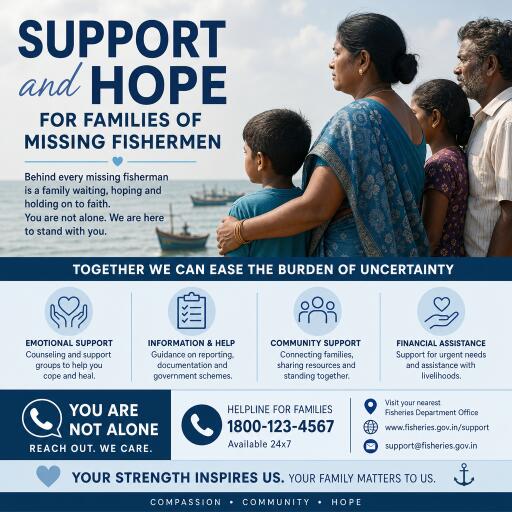
Support families of missing fishermen
When a fishing boat vanishes beyond the horizon, the silence that follows is not only grief—it is a bureaucratic void. Families of fishers who go missing on the sea or rivers often receive no financial relief, no legal clarity, and no path to rebuild, even as compensation frameworks may trigger for confirmed fatalities. This gap is intolerable for communities already living on the edge of climate and economic precarity.
Community records in Patharghata upazila of Barguna suggest that at least 196 fishers have disappeared over the past 33 years. Each disappearance is more than a statistic—it is a stalled inheritance, a child pulled from school, a spouse thrust into debt, and a family caught in an administrative limbo because no death certificate can be issued. Without that paper, property cannot be transferred or sold, loans cannot be regularized, and survivors are trapped in uncertainty for years.
Globally, fishing is recognized as one of the most dangerous occupations; international estimates suggest roughly 32,000 fisher fatalities every year. As climate change intensifies, so do the hazards. In the Bay of Bengal, erratic monsoons, stronger cyclones, storm surges, and rapidly shifting weather windows have made navigation and forecasting more difficult, increasing the risk of boats going missing. What was once a seasonal gamble now feels like a year-round cliff edge.
In Bangladesh alone, more than a million people across at least 19 coastal districts depend on marine and river fisheries. Yet there is no comprehensive, publicly accessible national database tracking those who go missing at sea each year. Their names live on primarily in family lore and community memory. In the absence of government support, households often make wrenching choices: children leave the classroom for the docks; women shoulder nets and oars while also battling social stigma; elderly parents forgo medical care as savings evaporate.
What must change—now
- Recognize “missing at sea” as a formal status: Create a clear, time-bound legal pathway that provides interim benefits soon after a disappearance and a route to presumed death certification after due diligence. This would unlock inheritance, property transfers, and insurance claims without forcing families to wait indefinitely.
- Build a national registry of missing fishers: An open, searchable database—linked to fisheries authorities, coast guard, local governments, and disaster management agencies—would guide policy, enable faster response, and offer transparency.
- Provide emergency social protection: Deliver rapid cash assistance, food support, tuition waivers for children, and psychosocial services to families of the missing. Include debt moratoriums and legal aid to prevent predatory lending and asset loss.
- Make insurance work for the vulnerable: Establish subsidized life and accident insurance tailored to small-scale and artisanal fishers, with provisions for payouts in cases of disappearance following defined procedures.
- Invest in safety and navigation: Equip boats with reliable VHF radios, GPS, distress beacons, and affordable vessel monitoring where appropriate. Expand community weather bulletins and early warning systems. Critically, build and maintain lighthouses and other navigational aids along strategic coastal corridors so lost fishers can find their way home.
- Strengthen search and rescue: Improve coastal radar coverage, ensure dedicated rescue vessels and trained personnel in high-risk zones, and formalize a 24/7 distress hotline integrated with local communities and fishing cooperatives.
- Channel climate finance to fisher safety: Direct adaptation funds toward safer harbors, cyclone-resilient boats, green infrastructure like mangrove restoration that buffers storm surge, and modern landing sites with shelters and communication hubs.
- Count what matters: Publish annual data on accidents, disappearances, rescues, and payouts. Evidence-based policy will save lives.
- Support women and children: Offer gender-responsive allowances, childcare, and education stipends so that the disappearance of a breadwinner does not cascade into generational poverty.
- Ensure accessible legal help: Provide pro bono or subsidized legal services for property, guardianship, and compensation claims tied to missing cases.
Why this is urgent
Stakeholders on the coast report that disappearances are rising with worsening weather volatility and heightened storm intensity. The window for safe voyages is narrowing, yet the pressure to fish—amid rising costs, declining catches in some areas, and limited livelihood alternatives—pushes crews farther and longer into dangerous waters. Without a safety net, families pay the highest price for a climate crisis they did not create.
Filling the policy vacuum will save lives and livelihoods. A registry guides smarter patrols and warnings; communication gear and lighthouses shorten search times; insurance and interim benefits stop a tragedy from becoming an economic freefall. These are not luxuries. They are the minimum standards of a just society facing a warming world.
A humane, climate-ready social contract
Coastal families have long fed the nation through skill, courage, and sacrifice. They should not be abandoned to endless uncertainty when a loved one vanishes at sea or on a river. Recognizing missing fishers within social protection systems, modernizing safety infrastructure, and aligning rescue and legal processes with climate reality are practical steps that honor both human dignity and national resilience.
Let us replace silence with support, and uncertainty with a clear, compassionate path forward. No family should have to fight the tide alone.



Leave a Reply