

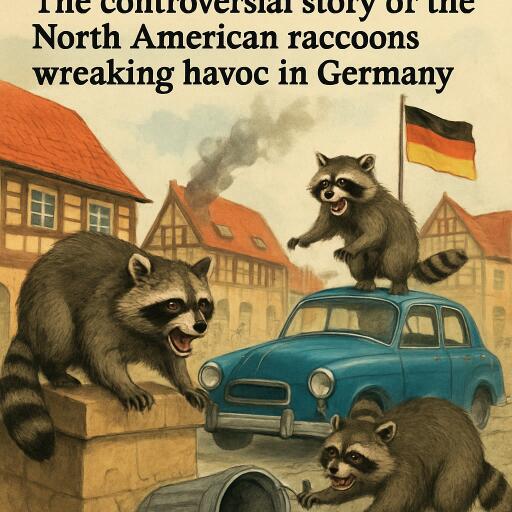
The controversial story of the North American raccoons wreaking havoc in Germany
In Germany, the raccoon has become both a curiosity and a nuisance. The masked mammal, native to North America, is now firmly established across large parts of the country, turning up in attics, gardens, zoos, hospitals and even electrical facilities. To admirers, raccoons are intelligent and oddly charming. To critics, they are destructive intruders that seem almost impossible to control.
Part of the animal’s notoriety comes from the stories that surround its arrival. For years, a dramatic tale circulated claiming that a senior figure from the Nazi era personally arranged the release of raccoons into the German countryside. That version proved persistent, repeated in local conversations and public commentary. But historical records paint a much less sensational picture.
Research into old forestry files indicates that one of the earliest known releases happened in central Germany in the 1930s near the Edersee region, not as a grand ideological project, but as a mundane administrative decision linked to game and wildlife management. Documents suggest a few animals were released to “enrich” local fauna, a concept that was far more common at the time than it would be today. The legend of direct involvement by powerful political figures appears to have grown later, fed by rumor more than evidence.
That early release helped establish one of the best-known raccoon populations in Europe. The city of Kassel, in particular, has become famous for its raccoon density, with the animals now a familiar sight in residential neighborhoods. Their success is tied to a set of traits that urban ecologists know well: they are adaptable, highly dexterous, excellent climbers and unafraid to exploit human environments. Roof spaces, bins, chimneys and garden sheds offer food, warmth and shelter.
Yet the story does not begin and end with one release. Genetic studies on raccoons collected from different parts of Germany show that the modern population likely came from several separate introductions. In addition to the central German group, other populations appear to trace back to releases or escapes elsewhere, including from fur-farming operations and captive facilities. That helps explain why raccoons spread so effectively despite what seemed, at first glance, to be only a tiny founder group.
Over the past decades, raccoons have expanded far beyond their original footholds. They have crossed borders into neighboring countries and appeared in new regions across Europe. Their talent for escape has also played a role, with occasional breakouts from captivity adding to the problem. Once established, raccoons can thrive in forests, wetlands and densely settled towns alike.
Their behavior has made them irresistible to tabloids and local news reports. In German cities, raccoons have been blamed for raiding food stalls, damaging roofs, pulling apart insulation and creating latrine sites in buildings. They can be bold enough to enter places people would never expect wildlife to reach. Their curious nature, nimble paws and willingness to forage almost anywhere make them highly visible offenders.
As a result, public opinion is sharply divided. Some residents feed them and see them as charismatic urban wildlife. Others view them as costly pests that leave behind mess, noise and repair bills. Wildlife rescuers, hunters, conservationists and researchers often disagree over how serious the problem really is and what should be done next.
The biggest controversy centers on ecology. Raccoons are widely described as an invasive species, but scientists do not all agree on how severe their impact is in Germany. Some long-term field research in protected areas has found little evidence that raccoons are causing major, measurable damage to native biodiversity on the scale often claimed in public debate. That has led some experts to argue that the animal has become a convenient villain in a landscape where many pressures on wildlife already exist, from habitat loss to intensive agriculture.
Still, other researchers warn against underestimating them. Raccoons are omnivores and opportunists. They can prey on eggs, amphibians and other vulnerable animals, especially in wetlands and nesting sites. Their climbing and swimming skills give them access to habitats many predators struggle to reach. There is also concern about disease and parasites that can affect animals and, in some cases, pose risks to people.
These competing interpretations have shaped a fierce policy debate. In Germany, raccoons are hunted extensively, and the number killed each year has risen dramatically. Yet despite sustained hunting pressure, the population keeps growing in many areas. Critics of current policy say this shows that large-scale culling alone is not solving the problem. Supporters of hunting respond that without it, numbers could rise even faster and impacts on sensitive species could worsen.
Some wildlife groups are calling for a more mixed strategy. That could include trapping, sterilisation in specific urban hotspots, barriers to keep raccoons away from vulnerable conservation areas, stricter management of waste and food sources, and targeted protection for rare species. The broader idea is not total eradication, which now appears unrealistic, but reducing conflict and protecting ecosystems where raccoons may do the most harm.
Climate trends may further complicate the picture. As temperatures rise and seasons shift, the species could find suitable conditions in even more parts of Europe. A mild climate, abundant food and fragmented human-dominated landscapes create ideal circumstances for an animal so comfortable living on the edge of civilization.
For now, one fact is beyond dispute: raccoons are no longer a novelty in Germany. They are a permanent part of the country’s wildlife drama, provoking fascination, frustration and scientific argument in equal measure. Their story is not just about an imported mammal causing trouble. It is also about how myths spread, how ecosystems absorb newcomers, and how modern societies struggle to decide whether a successful animal is a wonder, a menace, or both at once.



Leave a Reply