

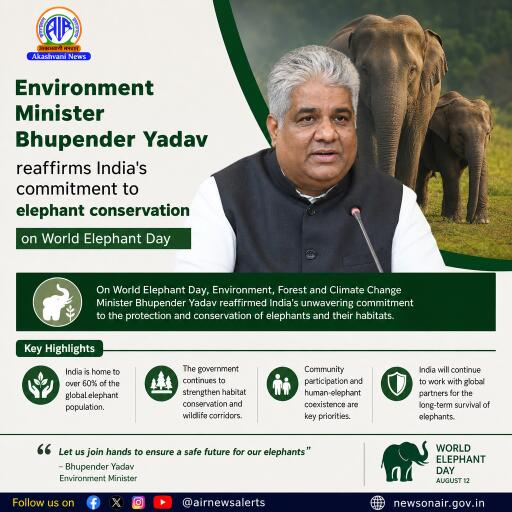
Environment Minister Bhupender Yadav reaffirms India’s commitment to elephant conservation on World Elephant Day | Akashvani News
Marking World Elephant Day, Environment, Forest and Climate Change Minister Bhupender Yadav reiterated India’s resolve to secure a future where elephants and people can thrive together. He emphasized that the nation is strengthening protections for the Asian elephant through a blend of scientific planning, habitat connectivity, and community-centered approaches.
India’s elephant conservation framework spans 33 notified Elephant Reserves across 14 states, forming a vast safety net for the species and the landscapes they anchor. Supporting these reserves are 150 scientifically recognized corridors that allow herds to move between habitats—an essential function for foraging, breeding, and resilience in the face of climate and land-use change. Authorities are also upgrading population assessment techniques and expanding efforts to reduce human-elephant conflict, a central challenge in shared spaces where agriculture, settlements, and forests intersect.
Yadav underscored a simple ecological truth: safeguarding elephants safeguards forests. As keystone megaherbivores, elephants disperse seeds, open clearings that stimulate new growth, and help maintain the health and diversity of tropical ecosystems. Their wellbeing is tightly linked to the vitality of watersheds, the stability of soils, and the capacity of forests to store carbon—benefits that reach well beyond protected areas to support livelihoods and climate resilience.
A science-led approach to protection
Conservation planners are increasingly turning to robust, standardized monitoring to guide interventions. Enhanced surveys, camera-trapping, and other data-driven tools are refining estimates of elephant populations and mapping seasonal movement patterns. This evidence base helps prioritize habitat restoration, identify pinch points along corridors, and measure the effectiveness of conflict-mitigation strategies over time.
Keeping corridors open and functional
The designation of 150 corridors reflects progress in maintaining landscape connectivity, but it also signals ongoing responsibility. Long-term success hinges on curbing fragmentation: integrating corridor protection into land-use decisions, promoting compatible agriculture and forestry practices near movement routes, and, where necessary, establishing safe passage solutions to navigate roads and rail lines. The goal is continuity—ensuring that herds can travel safely without becoming isolated in shrinking habitat islands.
Reducing conflict, supporting coexistence
Human-elephant conflict remains a sensitive frontline in conservation. Current measures focus on early warning and rapid response, from alert networks and patrols to physical barriers designed with animal behavior in mind. Community-led initiatives—such as coordinated crop-guarding, adoption of less palatable crops along forest edges, and timely compensation or ex-gratia support—help reduce losses and build trust. Education campaigns and training for local teams further strengthen preparedness and promote safe practices that protect both people and wildlife.
A public call to protect a shared heritage
The Minister called on citizens to be active partners in conservation: to give elephants space when encountered, follow guidelines in and around forest areas, report sightings to local authorities where appropriate, and support responsible tourism and habitat restoration initiatives. He also highlighted the role of state agencies, researchers, and community groups in aligning conservation with development, ensuring that ecological needs are integrated into infrastructure planning and rural economies.
On World Elephant Day, India’s message is clear: by investing in connectivity, science, and coexistence, the country aims to keep elephants moving freely through forests and rural mosaics for generations to come. In protecting these giants, India is also protecting the living systems that sustain its biodiversity, culture, and climate security.



Leave a Reply