

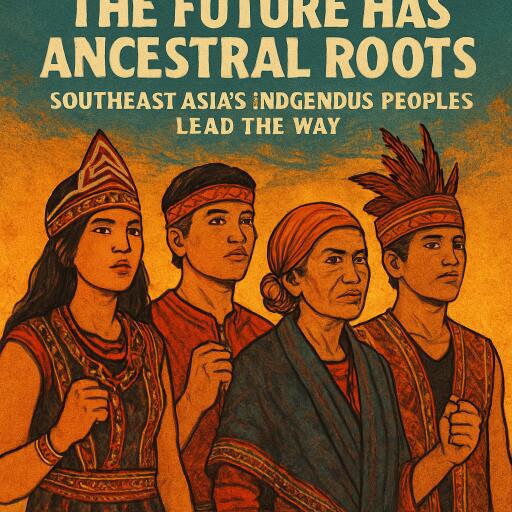
The Future Has Ancestral Roots: Southeast Asia’s Indigenous Peoples Lead the Way
Every year on August 9, global attention turns to Indigenous communities whose cultures, knowledge systems, and stewardship practices have shaped entire landscapes for centuries. In Southeast Asia, these communities are not symbols of the past. They remain active guardians of forests, rivers, coasts, languages, and artistic traditions, offering lessons that are increasingly vital in an age of climate disruption and ecological decline.
Across the region, tens of millions of people identify as Indigenous, though exact figures vary because each country uses different legal terms and categories. In some places, communities are formally recognized; in others, they are grouped under broader labels such as ethnic minorities. These distinctions are not merely administrative. Recognition often determines whether a people can defend ancestral land, participate in development decisions, or protect natural resources from outside exploitation.
That struggle over recognition matters because Indigenous territories frequently overlap with some of Southeast Asia’s richest ecosystems. From the rainforests of Borneo to the marine biodiversity of the Coral Triangle, many of the region’s most ecologically important areas have long been managed through customary laws and collective practices. These systems are increasingly being understood not as folklore, but as sophisticated environmental governance.
In many parts of Southeast Asia, Indigenous land management has slowed deforestation and helped conserve biodiversity more effectively than conventional top-down approaches. Communities have developed rules that regulate when forests may be entered, when fishing grounds must be left undisturbed, and how farming cycles can restore soil rather than exhaust it. Such methods are rooted in observation, memory, and responsibility across generations.
One well-known example is the practice of temporarily closing off certain marine or forest areas to allow recovery. Elsewhere, rotational farming systems make use of long fallow periods, seed diversity, and community agreements that keep agricultural activity in balance with the surrounding ecosystem. These approaches challenge the common assumption that traditional livelihoods are inherently destructive. In reality, many were designed around restraint, renewal, and adaptation.
Coastal and sea-oriented Indigenous peoples also carry knowledge that is indispensable for marine conservation. Communities who have lived for generations among reefs, mangroves, and shifting currents understand spawning sites, seasonal changes, and species behavior in ways that scientific management alone cannot replicate. Their expertise can strengthen conservation efforts, but only if they are treated as equal partners with rights, rather than as populations to be displaced in the name of protection.
Culture is another arena where Indigenous leadership continues to shape the future. Weaving, carving, music, ritual, and oral tradition are more than forms of identity; they are also systems for storing ecological knowledge and social values. Designs may encode stories of migration, protection, kinship, or relations with the natural world. Songs and ceremonies often carry guidance about planting seasons, water, animals, and sacred places.
These traditions are not frozen in time. Across Southeast Asia, younger generations are bringing ancestral culture into contemporary formats through film, digital archives, illustration, music production, and community-based tourism. Technology has opened new possibilities for language revitalization and access to wider audiences. At the same time, it has created new risks, including the unauthorized use of motifs, the commercialization of sacred symbols, and the detachment of cultural expression from the people who created it. Respect, consent, and fair benefit-sharing are critical if visibility is to support survival rather than exploitation.
The biggest threat remains control over land and water. Industrial logging, mining, plantations, large infrastructure projects, and poorly planned tourism frequently encroach on ancestral territories. Even conservation initiatives can become harmful when they exclude Indigenous communities from areas they have responsibly managed for generations. When collective tenure is weak or unrecognized, people can lose not only their homes and livelihoods, but also the institutions that sustain ecological balance.
This is why the future of Indigenous knowledge cannot be separated from rights. Environmental wisdom survives best where communities have secure access to their territories, the freedom to govern them, and a meaningful voice in decisions that affect them. Climate strategies that ignore land rights may talk about sustainability while undermining the very people already practicing it.
Across the region, Indigenous organizations continue to push for stronger legal recognition, territorial mapping, protection of environmental defenders, and direct participation in climate and biodiversity policy. Their advocacy has made clear that consultation is not enough if decisions are already predetermined. Development and conservation projects must begin with genuine consent, transparency, and respect for customary authority.
Governments have an opportunity to move beyond symbolic celebration by accelerating land recognition, supporting mother-tongue education, and ensuring Indigenous representation in environmental planning. Businesses, cultural institutions, and travelers also have responsibilities: support community-owned enterprises, credit makers properly, and avoid turning sacred knowledge into a marketable spectacle.
Southeast Asia’s Indigenous peoples are not waiting for validation from the outside world. They are restoring ecosystems, defending territories, renewing languages, and reimagining heritage for a changing century. Their example shows that innovation does not always come from breaking with the past. Sometimes, the most durable path forward begins with remembering how to live well with land, sea, and community.



Leave a Reply