

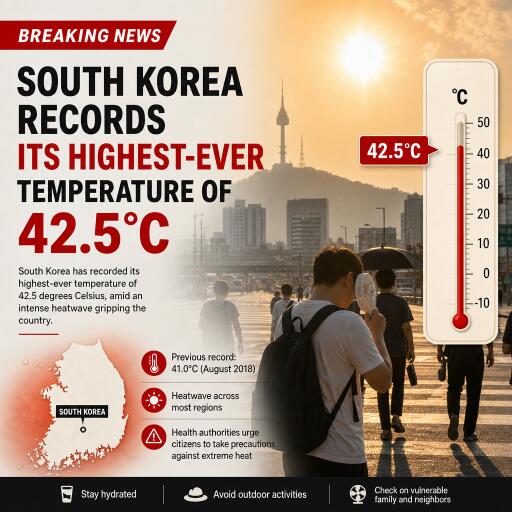
South Korea records its highest-ever temperature of 42.5 degrees Celsius
South Korea has entered uncharted territory in its climate history. On Sunday, the southeastern city of Yangsan registered 42.5 degrees Celsius at 1:26 p.m., the country’s highest temperature since systematic observations began more than a century ago, according to the national weather service. The reading caps a searing stretch in which Yangsan has topped 40 C for five consecutive days, the most intense run of heat the city has recorded.
Authorities extended heat warnings across much of the country as thermometers climbed into the high 30s from coastal towns to inland basins. More than 20 local jurisdictions were placed under emergency heat wave alerts, a new category created this year to escalate warnings when conditions cross dangerous thresholds. Under this system, an emergency alert is triggered if an area is expected to reach a perceived temperature of 38 C or an actual temperature of 39 C for a single day—levels at which heat stress, particularly for outdoor workers, older adults, and people with underlying health issues, can rapidly intensify.
Breaking long-term patterns
Recent data from the Korea Meteorological Administration paint a stark picture: the average number of heat wave days—defined as days with a maximum temperature of at least 33 C—has more than doubled to 19 per year over the past five years, compared with just eight in the 1970s. Nights are getting hotter too. So-called “tropical nights,” when temperatures do not fall below 25 C, are becoming more frequent, limiting the body’s ability to recover from daytime heat and pushing up health risks the following day.
These shifts in the baseline are crucial. What once counted as rare extremes are now increasingly common, and incremental warming raises the ceiling for record-breaking events. The Yangsan milestone is not only a single point on a chart; it signals a climate that is stacking the odds toward more frequent, longer, and more intense heat waves.
Why this matters: climate and compounding risks
Scientists have long warned that as the planet warms due to human-caused greenhouse gas emissions, the likelihood and severity of extreme heat increase. Heat waves that were once expected perhaps once in decades now arrive more regularly and with greater ferocity. Urban areas amplify this trend: concrete, asphalt, and limited vegetation trap heat and reduce overnight cooling, turning cities into heat reservoirs. When days repeatedly exceed 35–40 C and nights stay warm, the cumulative strain becomes a public health emergency—affecting cardiovascular and respiratory systems, disrupting sleep, and elevating risks for heat exhaustion and heatstroke.
Beyond health, heat of this magnitude reverberates through daily life. Power demand spikes as air-conditioning units work overtime, challenging grid stability. Outdoor labor—from agriculture to construction—faces heightened danger, often requiring schedule shifts or mandated rest. Crops endure heat stress that can reduce yields, while livestock suffer reduced productivity and increased mortality risks. Schools and public events may alter hours or close to protect students and attendees. These cascading effects underscore how extreme heat is not merely a weather story; it is an infrastructure, economy, and equity story.
A new alert architecture for a hotter era
South Korea’s decision to introduce an emergency heat alert tier this year reflects a recognition that yesterday’s warning systems are inadequate for today’s climate realities. The framework integrates perceived temperature—a measure that factors in humidity and wind, approximating how hot it actually feels to the human body—with absolute temperature thresholds. This approach helps public agencies and residents better gauge risk and respond, whether by opening cooling shelters, adjusting work practices, or prioritizing outreach to vulnerable neighbors.
Clear definitions also guide planning:
- Heat wave day: maximum temperature of at least 33 C.
- Tropical night: overnight low temperature of 25 C or higher.
As these conditions stack up over consecutive days, cumulative exposure becomes the critical concern. That is why meteorologists and public health officials emphasize both daytime peaks and nighttime lows when assessing risk and deploying resources.
Yangsan at the center of an intensifying summer
Yangsan’s extraordinary string of 40-plus degree days highlights how localized geography can interact with broader climate trends. Inland valleys can trap heat, while limited sea breezes and stagnant high-pressure systems reinforce warmth and suppress cloud cover. When such atmospheric patterns persist, they act like a lid, cooking the lower atmosphere and magnifying the impacts on the ground.
Elsewhere across the country, cities recorded highs in the upper 30s, extending the heat’s reach to millions of people. With broad swaths under warnings or emergency alerts, local governments urged residents to avoid midday exertion, hydrate frequently, and check on those who are isolated or heat-sensitive. Even brief periods outdoors can become hazardous without shade, water, or rest.
What comes next
The record at 42.5 C serves as a new marker—and a warning. As the climate warms, it raises the baseline from which extremes launch. That means communities must adapt: expanding tree canopy and reflective surfaces to cool neighborhoods, improving building standards to keep interiors safe during heat surges, and refining alert systems to reach people quickly in multiple languages and formats.
For now, meteorologists will closely monitor the persistence of high daytime temperatures and warm nights, along with humidity levels that can dramatically change how heat is experienced. Additional updates from the weather service are expected as conditions evolve. The message is clear: extreme heat is no longer an exception in South Korea’s summers; it is an increasingly defining feature.



Leave a Reply