

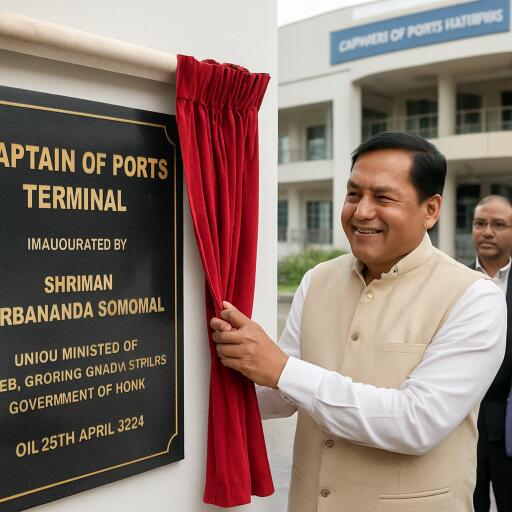
Union Minsiter Sonowal inaugurates Goa’s new Captain of Ports Terminal building, announces phase-I priority for Goa water metro
Goa’s river transport network received a major boost as Union Minister Sarbananda Sonowal opened a new Captain of Ports Terminal on the Mandovi riverfront and placed the proposed Goa Water Metro on phase-I priority, signaling an accelerated push toward cleaner, water-based urban mobility.
A river-inspired landmark for a maritime state
Conceived by the Goa State Infrastructure Development Corporation, the G+3 terminal spans more than 4,400 square metres and replaces the department’s outgrown headquarters. Its silhouette, modeled on a vessel docked along the riverbank, is designed to double as a working hub and a statement of Goa’s centuries-old maritime identity.
Built on a pile foundation with a composite steel-and-reinforced-concrete structure, the facility is engineered for durability in a dynamic riverine setting. Beyond administrative offices for the Captain of Ports Department, the terminal features modern passenger amenities, a double-height public lobby, conference rooms, marine and hydrographic offices, navigational control infrastructure, a radio communications center, and improved public facilities. A rooftop amphitheatre with around 450 seats, an indoor restaurant, and an open terrace will enable public and maritime events while creating additional revenue streams for operations and upkeep.
Sonowal, joined by Goa Chief Minister Pramod Sawant and senior leaders from state and central ministries, described the terminal as a marker of people-centric modernization. He framed the project as both a nod to heritage and a step toward a more resilient, service-oriented maritime system.
Goa Water Metro moves to the front of the line
In a key development, the minister announced that the Goa Water Metro has been brought under phase-I implementation priority. The initiative aims to harness the state’s waterways to ease congestion, expand last-mile connectivity, and improve travel times for commuters and visitors, with the added benefit of shifting trips from road to water—an approach that can reduce emissions and energy use when planned holistically with efficient vessels and shore facilities.
Recent investments by the Captain of Ports Department—such as floating jetties, upgraded passenger terminals, and enhanced navigational safety—lay the groundwork for a functional waterborne network. Together, these elements set the stage for a cleaner, more reliable public transport option that also supports tourism.
Momentum in India’s maritime modernization
Sonowal highlighted a broader national trajectory of reform and capacity-building across the maritime sector over the past decade-plus. Port capacity has nearly doubled, average vessel turnaround time has fallen from about 95 hours to roughly 41 hours, and India’s seafaring workforce now exceeds 3.23 lakh. Coastal cargo movement has more than doubled, cruise passenger numbers have grown more than fourfold, and the count of operational National Waterways has expanded from three to 32—collectively signaling a shift toward more efficient and diversified water transport.
He also underscored India’s status as the world’s leading nation by gross tonnage in ship recycling—an area with significant environmental implications, where responsible practices and international compliance are essential to minimizing ecological harm while recovering valuable materials.
Goa’s policy lead and green port ambitions
Goa has emerged as an early mover on regulatory reform by becoming the first state to implement the Inland Vessels Act, 2021. Forthcoming measures such as the proposed Goa Maritime Board, the Goa Shipbuilding and Ship Repair Policy, and a Maritime Master Plan are expected to strengthen governance, catalyze industry, and improve safety standards across inland and coastal operations.
At Mormugao Port Authority, projects exceeding Rs 1,300 crore have been completed since 2014, with more than Rs 2,000 crore currently underway. Key works include the redevelopment of Berth No. 9, the Vasco Bay project with a new fishing harbour, capital dredging for deep-draft berths, and a modern Seafarers’ Club. Mormugao has also become India’s first Green Port and the first to roll out Green Ship Incentives—signals of a growing push to cut emissions intensity and improve environmental performance at the waterfront.
Skills, safety, and the blue workforce
The launch of the Goa Institute of Maritime Excellence is positioned to nurture the next generation of professionals for inland waterways, vessel operations, safety, and water sports. Such training pipelines are vital as demand grows for specialized skills—from hydrography and navigation control to port logistics and sustainable ship operations—ensuring that infrastructure investments translate into safer, more efficient services on the water.
Why this matters for climate-smart mobility
Water-based transport, when integrated with bus, rail, and non-motorized links, can reduce pressure on roads, improve air quality, and lower transport emissions, especially as fleets adopt cleaner propulsion and terminals deploy energy-efficient systems. By pairing the new terminal’s multi-use design with an expanded network of jetties and safety systems, Goa is better positioned to pilot low-carbon commuting options that also enhance the visitor experience.
What comes next
The Captain of Ports Terminal is set to become the operational nerve center for river navigation in Goa and an architectural focal point along the Mandovi. The initiative aligns with national strategies such as the Sagarmala Programme and Maritime India Vision 2030, which focus on port-led development, stronger coastal connectivity, logistics efficiency, and sustainable economic growth. With phase-I priority for the Goa Water Metro now on the table, the state has an opportunity to turn its waterways into a climate-forward backbone for daily travel and maritime enterprise alike.



Leave a Reply