

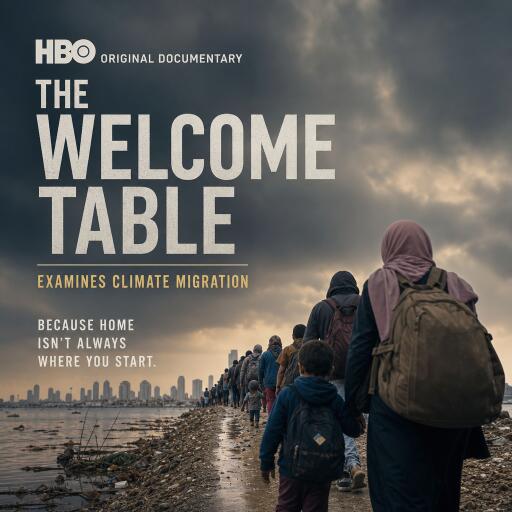
HBO Documentary The Welcome Table Examines Climate Migration
A new HBO documentary invites viewers to sit with the defining human story of the climate era: the steady movement of people as heat, storms, fire, and rising seas remake the map. The Welcome Table, now streaming on HBO and HBO Max, approaches climate migration through music, performance, and collective ritual, turning abstraction into lived experience.
Rather than leading with charts and forecasts, the film focuses on people navigating upheaval in real time. Families pack up memories, neighborhoods reassemble in unfamiliar places, and cultures stretch to hold grief and hope at once. Researchers warn that a growing share of the world’s population will face pressures to relocate over the coming decades, from coastal inundation to extreme heat and water stress. The documentary’s core assertion is simple: behind every statistic is a face, a song, a story worth hearing.
The camera travels across six continents, tracing different expressions of resilience. Some communities rebuild on higher ground, others scatter and weave new networks elsewhere. The film lingers on gestures—hands passing plates, children learning new routines, a melody carrying across a street—suggesting how belonging can be reassembled even when geography is lost.
New Orleans serves as a narrative anchor. The city’s deep memory of displacement after Hurricane Katrina shapes the film’s language of recovery and reinvention. On the Mississippi River levee, a striking centerpiece unfolds: a thousand-foot-long communal table. Residents gather to eat, sing, and listen. It is both a feast and a thesis—a public act that insists connection can be engineered as deliberately as infrastructure, and that culture is a form of adaptation.
Music threads the documentary together, with the unmistakable pulse of New Orleans guiding the ear. The soundtrack, featuring John Boutté and other local luminaries, functions like a river under the narrative, carrying hard truths where conversation alone may falter. Occasional theatrical turns, including an appearance by John Cameron Mitchell, widen the film’s register beyond traditional reportage, underscoring how art can hold complexity without dulling its edges.
The production avoids the trap of treating those on the move as mere case studies. It dwells in kitchens and community centers, on sidewalks and stoops, where people reckon with loss, swap recipes and memories, and invent new rituals. The choice to center everyday life reframes migration not only as emergency, but also as an ongoing civic process—one that tests institutions, reshapes labor and housing markets, and forces hard conversations about equity and belonging.
At 135 minutes, the film gives these stories room to breathe. The pace privileges witness over prescription. There are no tidy solutions here; instead, the documentary offers a patient accounting of how individuals and communities adapt when the ground—literal and figurative—shifts. That restraint feels honest in a moment when policy frameworks lag behind the scale of change.
The filmmaker’s prior environmental investigations inform the approach: sharpen the camera on what extractive systems erase, and make invisible consequences visible. Here, the erasure is social rather than geological—the displacement that unfolds far from boardrooms and summits. By letting people narrate their own stakes, the film transforms “climate migrants” from a label into neighbors and hosts, caretakers and creators.
HBO’s distribution matters. Stories about climate and displacement too often circulate within narrow circles; placing this work on a mainstream platform widens the audience to those who might never seek out an environmental documentary, yet are already living its themes in quieter ways—through rising insurance costs, recurring floods, or new classmates arriving midyear from a storm-battered town.
The Welcome Table ultimately argues for a broader civic imagination. If movement is becoming a structural feature of the century, then hospitality, planning, and cultural work must be treated as infrastructure, not afterthoughts. The levee-length meal in New Orleans is more than a poetic flourish; it is a blueprint for the social architecture required to meet a hotter, wilder world with dignity.
By the final frames, what endures is not a sense of doom, but a clearer understanding of what solidarity can look like at street level: a chorus carrying stories forward, a neighborhood finding room at the table for those who’ve lost their place, and a public willing to see in migration not just departure, but the work of rebuilding together.



Leave a Reply