

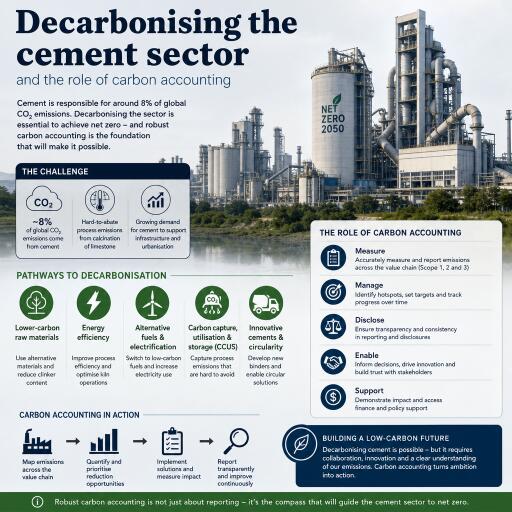
Decarbonising the cement sector and the role of carbon accounting
Cement underpins modern infrastructure, yet producing it releases large amounts of process CO₂ from limestone calcination—emissions that are impossible to eliminate through efficiency alone. To push the sector toward net zero, capturing and permanently storing this CO₂ is emerging as a cornerstone solution, paired with rigorous accounting that proves what has been avoided and where those benefits are allocated.
A first-of-its-kind capture plant
In June 2025, a landmark carbon capture facility began operating at a cement works in Brevik, Norway. The system is designed to trap about half of the site’s CO₂—roughly 400,000 tonnes per year. Captured CO₂ is liquefied and transferred for permanent storage in geological formations about 2.6km beneath the seabed as part of Norway’s full-chain carbon management infrastructure. This marked the first time a commercial cement plant integrated capture at this scale, offering a real-world example of how process emissions can be handled at source.
From captured molecules to low‑carbon cement
Building on this, a near‑zero cement product was launched for European markets, made possible by the Brevik capture system and a robust approach to carbon accounting. Rather than physically mixing captured and non-captured materials, the company uses a chain‑of‑custody model to attribute verified emissions reductions from the capture-equipped kiln to specific batches of cement sold across its network.
How the accounting works
The approach follows a free‑attribution mass balance: Environmental Attribute Certificates (EACs) represent measured reductions achieved at the capture site and can be assigned to designated cement volumes elsewhere. A secure “Carbon Bank” ledger records every deposit and withdrawal to maintain integrity and prevent double counting.
Deposits are made only when two conditions are independently verified: one tonne of clinker produced under carbon capture conditions, and the associated CO₂ permanently stored in geological formations. The ledger also nets out emissions from running the capture and handling equipment, ensuring the balance reflects real, additional reductions.
Withdrawals occur when customers receive product. For each tonne of cement physically shipped from Brevik to the UK, 652kg of CO₂ is retired from the Carbon Bank. This figure corresponds to the baseline global warming potential of CEM I at Brevik without capture (693kg CO₂e per tonne) minus 41kg CO₂e of residual Scope 2 and 3 impacts such as grinding electricity and internal logistics, as reported in the product’s environmental declaration.
To avoid shipping-related emissions for distant markets, a virtual option allocates the same verified reductions to locally produced cement. In the UK, for example, a Carbon Bank withdrawal sized to 804kg CO₂e per tonne can bring the declared footprint of standard CEM I to zero. Each allocation is fully traceable back to the reductions achieved at the capture facility, and every transaction generates an auditable product declaration for the buyer.
Scaling up capture
Lessons from the Norwegian plant are informing a new wave of projects targeting even higher capture rates. A prominent example is the cement works at Padeswood in north Wales, now under construction following a 2025 investment decision. The design aims to capture around 95% of on-site CO₂—about 800,000 tonnes annually. The compressed CO₂ will travel via underground pipeline to permanent storage beneath Liverpool Bay within a regional decarbonisation network. Commissioning is slated for 2029, positioning the site as one of Europe’s highest-capture cement facilities.
Why CCS and carbon accounting matter together
Because a large share of cement’s emissions stems from the chemistry of calcination, carbon capture and storage is increasingly viewed by policymakers and industry as essential for deep decarbonisation. Yet infrastructure alone is not enough. Credible accounting ensures that each avoided tonne is counted once, counted correctly, and documented in a way that supply chains can trust.
Certificate-based allocation, mass balance, and tamper‑resistant ledgers allow early capture projects to cut the footprints of cement used far from the capture site. This helps accelerate market uptake of near‑zero options while capture capacity scales and complementary measures—like clinker substitution, energy efficiency, alternative fuels, and electrification—continue to advance.
The result is a pragmatic, verifiable route to lower‑carbon construction today: capture CO₂ at the source, store it permanently, then transparently allocate those reductions to the cement that builders actually buy. With robust governance and third‑party assurance, this combination can turn pioneering projects into sector-wide progress.



Leave a Reply