

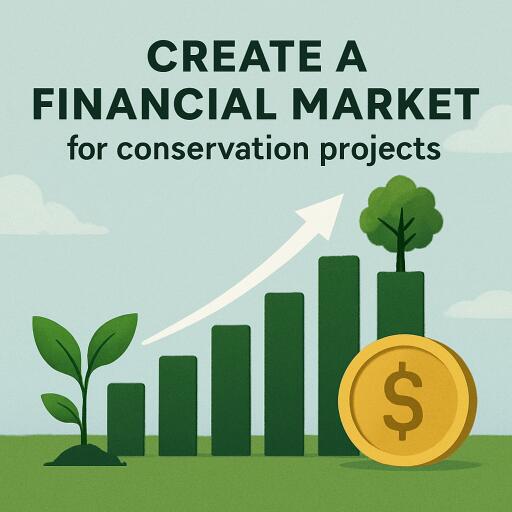
Landseed aims to build a new financial market for conservation projects
A new environmental technology venture is trying to change how conservation work is funded by turning ecological performance into a tradable financial asset. The company, Landseed, says its goal is to help land stewards and conservation groups generate recurring income by measuring the health of ecosystems in far more detail than traditional carbon-focused systems.
The idea behind the startup is simple but ambitious: nature provides many benefits beyond carbon storage, yet most financial mechanisms reward only a narrow slice of that value. Landseed wants to quantify a broader set of environmental outcomes and make them useful in markets.
Its approach combines field-based sensors, ecological monitoring, and structured data systems to capture what is happening across a landscape, including changes that cannot be seen from above. By doing so, the company hopes to support a market where biodiversity, water conditions, soil health, and other indicators of ecosystem integrity can be verified and financed.
Looking below the canopy
Much of today’s environmental monitoring relies heavily on satellite imagery, which is effective for providing large-scale views of forests, wetlands, and other habitats. But top-down imagery has limitations. It may show broad land-cover change, yet it often misses the finer ecological signals that determine whether an area is truly thriving.
Landseed’s model is designed to fill that gap. The company deploys sensors across a site in a connected network, allowing conservation managers to collect information directly from the landscape. These systems are intended to capture a much richer set of ecological data, ranging from wildlife presence to moisture conditions and freshwater quality.
The equipment records conditions at frequent intervals, creating a steady stream of evidence about how a landscape is functioning. Depending on the deployment, this can include readings tied to biodiversity, humidity, weather, soil moisture, water temperature, water quality, and soil carbon. The company is also developing acoustic monitoring, which could add another layer by tracking animal activity and environmental sound patterns.
This emphasis on direct measurement reflects a broader shift in climate and conservation technology: moving away from rough estimation and toward verifiable, site-level evidence. Falling hardware costs and improved sensing tools are making that model increasingly practical.
A broader alternative to carbon-only finance
Landseed’s business model is built in three parts. The first is the sensor platform used to monitor conditions on the ground. The second is a crediting system based on the ecological results those sensors document. The third is a data product that can be licensed to outside users such as insurers, investors, and research groups.
The crediting component is central to the company’s strategy. Rather than creating value from carbon sequestration alone, Landseed wants to issue environmental credits linked to a more complete profile of ecosystem health. These credits would belong to the conservation organizations or land managers operating the projects, who could then sell them into voluntary markets.
Potential buyers could include companies seeking stronger environmental claims, local governments interested in natural resource protection, and philanthropic institutions looking to direct capital toward measurable conservation outcomes. In theory, that could provide a more dependable source of funding for field projects that often struggle to secure long-term support.
The company’s pitch is that healthy landscapes generate multiple forms of value at once. A forest, for example, may store carbon, shelter wildlife, regulate water, protect soil, and improve resilience to climate stress. If markets only pay for carbon, much of that value remains invisible. Landseed wants to make those additional benefits count in financial terms.
Creating a new asset class for nature
One of the more notable aspects of Landseed’s strategy is its attempt to frame conservation outcomes as a distinct financial product rather than simply another offset mechanism. The company says it does not plan to trade the credits itself. Instead, it wants to focus on measurement quality, verification, and the creation of trusted environmental assets that project owners can bring to market.
That distinction matters in a sector where credibility is under constant scrutiny. Environmental credits have often faced criticism over weak baselines, inflated claims, and poor monitoring. By grounding value in continuous, on-site ecological data, Landseed is positioning itself as part of a more rigorous generation of nature-finance infrastructure.
The company also sees value in selling structured ecological intelligence beyond credits. Its data feed could be useful for insurance models, risk assessment, conservation planning, and investment analysis. In that sense, Landseed is not only trying to certify environmental outcomes; it is also betting that verified ecosystem data will become commercially valuable in its own right.
Funding pressures in conservation
The launch comes at a time when conservation organizations face a difficult financial landscape. Many projects depend on grants, donations, or short-term philanthropic contributions, which can make long-range planning uncertain. For groups managing protected areas or restoring ecosystems, unstable funding can directly threaten results on the ground.
Landseed’s proposition is that better measurement can unlock more durable financing. If conservation performance can be documented with greater precision, then it becomes easier to translate that performance into revenue-generating assets. That, in turn, could help projects move away from one-time fundraising and toward ongoing income streams tied to ecological stewardship.
The startup has begun attracting early backing, including support from impact-oriented funding sources. While still in an early stage, its emergence reflects growing interest in tools that connect environmental science, digital monitoring, and financial markets.
Why this matters
The broader context is impossible to ignore. Climate concerns have driven major investment into carbon technologies, but biodiversity loss, freshwater decline, and ecosystem degradation continue to intensify. Policymakers, investors, and environmental groups are increasingly searching for systems that value nature in a more complete way.
Landseed is entering that debate with a bold proposition: that conservation can become self-financing if ecological outcomes are measured well enough and trusted by markets. Whether that vision succeeds will depend on scientific credibility, market demand, and the ability to avoid the pitfalls that have troubled other environmental credit systems.
Still, the company’s approach points to an important shift. Conservation is no longer being framed only as a moral obligation or philanthropic cause. It is increasingly being treated as infrastructure that delivers measurable services, and potentially as an investable asset class.
If Landseed can prove that ecosystems can be monitored in a transparent, verifiable, and financially meaningful way, it may help reshape how conservation is funded in the years ahead.



Leave a Reply