

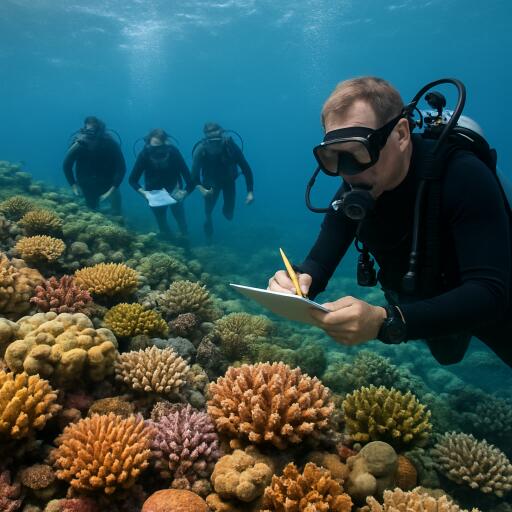
As Global Warming Threatens Corals Worldwide, Woods Hole Scientists Search for ‘Super Reefs’ That Can Take the Heat
As ocean temperatures climb and coral bleaching spreads across the tropics, a team of scientists from Woods Hole is racing to identify reefs that appear able to survive extreme heat. Their goal is not only to understand why some coral communities endure while so many others collapse, but also to use that knowledge to guide protection and future restoration across the Pacific.
In the lagoons of the Marshall Islands, that search has taken on new urgency. Coral reefs there are more than underwater ecosystems. They support fisheries, buffer waves and form the geological foundation of the low-lying atolls themselves. As climate change intensifies, safeguarding the toughest reefs could become essential for both biodiversity and human survival.
A global bleaching crisis
Since 2023, unusually intense marine heat waves have pushed reefs around the world into crisis. When water gets too warm, corals expel the microscopic algae that feed them and give them their vivid color. The result is bleaching: reefs turn pale, weaken and can die if temperatures remain high for too long.
Yet even during severe heat events, some reefs remain unexpectedly healthy. Marine scientist Anne Cohen has spent years tracking these exceptions. She and her collaborators describe them as “super reefs” — coral communities that either tolerate heat unusually well or benefit from local conditions that reduce thermal stress. If protected, these places may serve as reservoirs of resilience, producing larvae that can help replenish damaged reefs elsewhere.
What makes a reef “super”?
Not every healthy-looking reef qualifies. The standard is higher: researchers look for places that repeatedly perform well during hot periods and may pass on that resilience. In some cases, the explanation may lie in coral genetics. In others, currents, water movement or reef structure may create small refuges from heat.
That distinction matters because reefs already face pressure from far more than warming alone. Dredging can bury corals in sediment. Sewage, runoff and plastic pollution fuel disease and harmful algal growth. Destructive fishing methods and anchors can physically break apart reef habitat that took centuries to build.
The thinking behind the project is straightforward: if the world can identify coral strongholds and shield them from avoidable local damage, those reefs may buy time while broader climate action catches up.
Why the Marshall Islands matter
The Marshall Islands are among the places where this work is moving fastest. Spread across dozens of atolls and islands, the nation is deeply tied to coral. The land itself was built over geologic time by reef growth, and many communities sit only a few feet above sea level.
That makes climate change a double threat. Rising seas put infrastructure and homes at risk, while reef decline undermines fisheries and natural coastal protection. For many residents, coral loss is not an abstract environmental story. It is tied directly to food security, livelihoods and the future of island communities.
Local conservation groups and marine managers have also reported widespread bleaching in recent hot years, particularly during El Niño conditions, which often amplify ocean warming across the Pacific. Against that backdrop, the idea that some reefs might remain strong has attracted serious attention.
From computer models to coral coolers
To find the most promising reef sites around Majuro Atoll, Cohen’s team combined ocean modeling with field measurements. Working with fellow oceanographers, they simulated years of lagoon temperatures, currents and wave energy to identify areas likely exposed to the greatest heat stress. If corals were thriving in those hotspots, they could be especially valuable.
One area near the community of Laura stood out. Instruments placed in the water helped confirm that some reefs there were consistently warmer than other parts of the atoll.
Researchers then collected coral fragments from several sites and tested them in a makeshift field laboratory. Using coolers, heaters and temperature controls, they exposed samples to intense but realistic heat stress designed to mimic the hottest reef conditions. Some corals bleached quickly. Others showed far greater tolerance.
The strongest performers included corals from the Laura area, supporting the idea that this part of Majuro may host one of the atoll’s most climate-resilient reefs.
Science that communities can use
Finding a resilient reef is only the beginning. The next step is translating research into conservation that works for local people. In Laura, scientists and Marshallese partners have been sharing results with residents and leaders as part of a community-led planning process for a possible protected area.
That conversation is delicate. Fishing grounds are central to daily life, and restrictions can be sensitive in communities where many households depend on the sea. But supporters of the plan argue that protecting the toughest reef could help preserve fish habitat and strengthen nearby reefs over time.
Ocean current modeling adds to that case. The team’s results suggest larvae released from the Laura reef could disperse widely around Majuro, meaning one protected stronghold might aid recovery far beyond its immediate location.
The robot helping map reef resilience
To speed up the search, the Woods Hole team has turned to a bright yellow robotic surface vessel called Yellowfin. Originally designed for coastal mapping, it has been adapted to survey reefs by carrying cameras above coral habitat and collecting thousands of geotagged images in a single day.
That scale is difficult for human divers to match. Traditional monitoring covers only limited areas and takes enormous effort. Yellowfin can repeatedly scan the same reef sections year after year, allowing researchers to compare images and identify which coral colonies bleached, recovered or stayed healthy through heat waves.
The team is also training artificial intelligence tools to analyze the image sets more efficiently and building 3D reef models to understand how depth, angle and colony position may influence survival. In other words, resilience may depend not just on species, but on microhabitat and structure as well.
From discovery to restoration
The project could reshape how reef restoration is done. Around the world, many restoration efforts rely on replanting corals onto damaged reefs, but survival is often limited if those corals remain vulnerable to future heat stress. The newer strategy is to identify naturally heat-tolerant corals first, then use those hardier strains in restoration nurseries and outplanting programs.
In the Marshall Islands, early experiments are already exploring that possibility. If successful, resilient corals identified through testing could become the foundation for rebuilding reefs that have a better chance of enduring a warmer ocean.
A Pacific “blue corridor” for super reefs
Cohen’s long-term vision extends beyond a single atoll. She is proposing a network of protected and restored “super reefs” stretching across parts of the Central Pacific, linking sites in the Marshall Islands, Kiribati and Tuvalu. The concept is based on connectivity: if resilient reefs are positioned so that currents carry larvae between them, they may form a regional chain of recovery.
Such a corridor would require funding, political cooperation and strong community participation. It would also demand careful balancing of conservation with fishing rights and local needs. But the idea is gaining attention because it treats reefs not as isolated patches, but as connected living systems.
With another round of Pacific warming possible, the timeline is tight. Scientists want to be in the field during the next major heat event, sending Yellowfin across vulnerable reefs and tracking which corals hold out under pressure. In a rapidly warming ocean, those survivors may hold the clues to the future of coral conservation.



Leave a Reply