

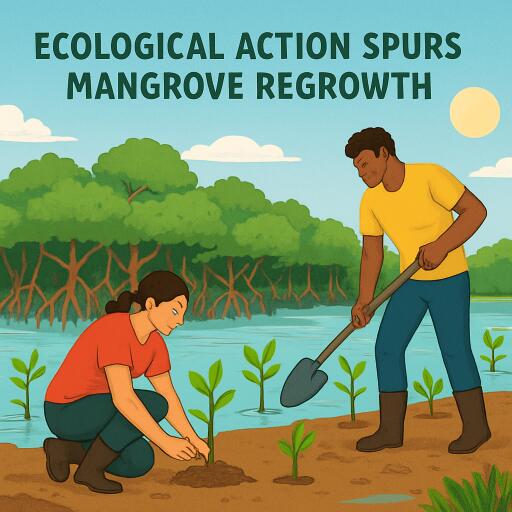
Ecological action spurs mangrove regrowth
After decades of pressure from land reclamation, aquaculture expansion and coastal construction, mangrove forests in China are making a notable comeback. A sustained restoration drive has helped reverse an earlier decline, turning the country into a rare example of large-scale mangrove recovery at a time when many coastal regions worldwide continue to lose these vital wetlands.
Official figures show mangrove coverage has risen sharply since the start of the century, climbing from roughly 22,000 hectares to about 31,700 hectares. This growth follows years of tighter environmental controls, including limits on tidal-flat reclamation, stronger legal protection for remaining mangrove stands and large restoration projects designed around local ecological conditions.
The change is especially visible in southern coastal zones, where communities that depend on fisheries and aquaculture are beginning to see practical benefits. In parts of Guangdong, farmers working near restored mangrove areas report cleaner water and healthier aquatic species. For those raising crabs, shrimp and fish, improved habitat quality can translate into better yields and stronger market prices.
Mangroves are uniquely adapted to life between land and sea. They grow in tropical and subtropical intertidal zones, where they are submerged during high tide and exposed when the water retreats. Their striking root systems, which rise above oxygen-poor mud, allow them to survive in harsh, salty conditions that few trees can tolerate. Some species even manage excess salt by expelling it through their leaves.
These forests do far more than line the shore. Their dense roots create shelter for juvenile fish, crabs and other marine organisms, making mangroves one of the most important nursery habitats in coastal ecosystems. They also slow water movement, trap sediment and help absorb nutrients and pollutants before they spread into open waters. In areas with intensive aquaculture, this filtering role can significantly improve coastal water quality.
Scientists also value mangroves for their extraordinary climate function. They rank among the world’s most efficient natural carbon sinks, storing large amounts of carbon in both vegetation and waterlogged soils. Protecting and restoring them is therefore seen as a powerful tool not only for biodiversity conservation, but also for climate mitigation.
Guangdong has become one of the central arenas for this ecological turnaround, as it holds the largest share of the country’s mangrove habitat. But restoring coastal wetlands there has required more than simply planting trees. Much of the shoreline once suitable for mangroves had been turned into aquaculture ponds, supporting many local households. That reality made it necessary to develop restoration methods that would not undermine livelihoods.
One solution has been the rise of integrated mangrove-aquaculture systems. Instead of clearing all vegetation for farming, or abandoning ponds entirely, some projects redesign pond landscapes to make room for mangrove growth while keeping production active. Soil removed from ponds can be used to form raised areas for tree planting, allowing water circulation and farming capacity to remain largely intact.
This blended approach offers benefits on both sides. Mangroves help shelter farmed species, reduce disease risks and improve water conditions. At the same time, nutrients from aquaculture operations can support plant growth when carefully managed. The result is a more balanced system in which wetland restoration and coastal income generation reinforce each other rather than compete.
Elsewhere, mangroves are being restored not just for biodiversity and fisheries, but also as a form of coastal defense. In Guangxi, degraded shoreline areas once marked by abandoned ponds have been transformed through ecological seawall projects that combine engineered structures with natural vegetation. Mangroves planted along the seaward edge work as a living buffer, weakening wave energy, stabilizing sediment and reducing erosion.
These nature-based defenses have shown their value during repeated typhoons. In one demonstration area, a layered seawall system that included mangroves, vegetation cover and ecological corridors has endured multiple major storms over the past decade. As the planted forests matured, the coastline gained not only stronger protection but also a greener, more diverse habitat.
Other coastal provinces are pursuing similar strategies. In Fujian, estuarine mangrove belts have been expanded. In Hainan, where mangrove biodiversity is especially rich, efforts have focused on habitat protection, research and the removal of invasive species. Across the southern coast, restoration targets have increasingly been woven into regional development planning, giving mangrove recovery a more permanent role in environmental governance.
The broader lesson emerging from these projects is that coastal restoration works best when it recognizes both ecological and human needs. Mangroves anchor shorelines, support wildlife, improve water quality and capture carbon, but they also sustain fisheries, reduce storm damage and help make coastal economies more resilient.
The country still holds only a small fraction of the world’s mangroves, yet its recent progress shows that damaged coastal ecosystems can recover when policy, science and local participation move in the same direction. What is unfolding along these shores is more than a tree-planting campaign. It is a rethinking of how coastlines are managed — one that treats wetlands not as empty land to be converted, but as living infrastructure essential to both nature and society.



Leave a Reply