

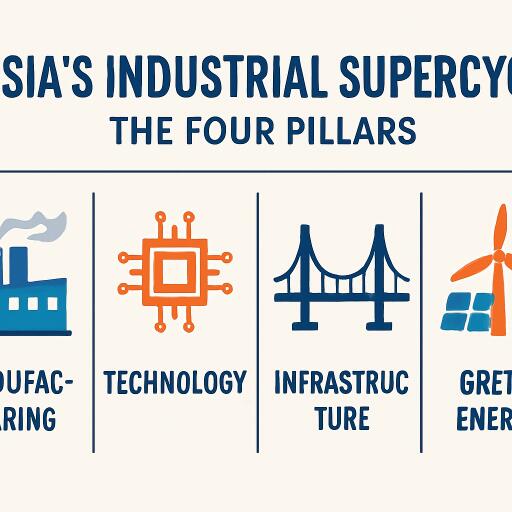
Asia’s Industrial Supercycle: The Four Pillars
Across Asia, four investment waves are converging into a single, self-reinforcing supercycle: AI infrastructure, energy systems, defence manufacturing, and a wholesale re-architecture of supply chains. Each pillar has its own tempo and risks, yet together they amplify demand for power, materials, and industrial capabilities in ways that extend well beyond a conventional boom.
Pillar I — Technology Infrastructure: The AI Compute Buildout
AI is catalyzing the largest voluntary capital-spending spree in corporate history, and much of the enabling hardware, materials, and engineering resides in Asia. Advanced logic chips are overwhelmingly fabricated in Taiwan; high-bandwidth memory is dominated by South Korean leaders; critical wafers, specialty gases, and photoresists are anchored in Japan and Korea; and advanced packaging clusters thrive across Taiwan and Southeast Asia.
- $700B+ global AI capex announced for 2025–2027
- 92% of advanced logic chips sourced from Taiwan
- 74% of high-bandwidth memory from South Korea
- 38 GW of new data-centre power demand expected by 2028
Beyond chips, the data-centre land rush is reshaping industrial geography. Singapore remains a regional hub despite land constraints, Malaysia’s Johor corridor is scaling rapidly, and Japan’s Osaka–Tokyo axis is building at its fastest pace in decades. The binding constraint is electricity: a state-of-the-art model-training cluster can draw 100–500 MW continuously. That reality forges a direct link between AI and power infrastructure—more copper, more transformer steel, more silicon carbide power electronics—and intensifies the pressure to deliver low-carbon megawatts at speed.
Pillar II — Energy Infrastructure: Transition as Industrial Strategy
Asia is both the workshop of the global energy transition and the stage on which its own electrification will play out. Export-oriented manufacturing of solar, wind, and batteries delivers scale and learning-by-doing, while fast-growing domestic demand compels grid expansion, firm low-carbon capacity, and storage.
- ~80% of global solar manufacturing capacity is in Asia
- $620B in Asian grid investment anticipated for 2025–2030
- Dozens of nuclear reactors under construction across the region
- ~65% of global EV battery capacity located in Asia
Electricity demand across Asia is rising roughly three to four percent annually—well above Western levels—driving a dual-track buildout: massive renewables plus firm capacity. Nuclear power, once written off by many after past crises, is seeing a measured revival with restarts and new builds in Japan and South Korea and sizable construction pipelines in China and India. Each reactor entails multi-billion-dollar spending, multi-year project timelines, and heavy demand for specialized alloys and precision components made within the region.
Meanwhile, transmission and distribution is the unglamorous backbone of the transition. High-voltage corridors to move wind and solar from resource-rich zones to urban demand centers require unprecedented volumes of copper, transformers, and grid automation. For AI-driven loads, grid reinforcement and demand management will be the hidden determinants of pace.
Pillar III — Defence and Security: The Reluctant Rearmament
Shifts in the strategic environment have triggered a durable increase in defence outlays. Unlike Europe’s procurement-heavy cycle, Asia’s emphasis is on building sovereign industrial capacity: designing, fabricating, and sustaining platforms and munitions at home. That focus taps into the same semiconductor, sensor, and advanced materials ecosystems powering AI.
- ~$640B in Asia-Pacific defence spending projected for 2025
- Japan targeting defence outlays of ~2% of GDP by 2027
- At least 19 countries in the region increasing defence budgets
- South Korea emerging as a major global arms exporter
Japan’s policy shift is particularly significant, mobilizing shipbuilding, aerospace, and electronics for dual-use output. South Korea’s cost-disciplined, technologically competitive manufacturers are scaling fast, while other economies deepen local content requirements and co-development programs. The common thread is electronics intensity—driving additional pull on chips, compound semiconductors, and precision engineering.
Pillar IV — Supply Chain Architecture: The Great Diversification
What began as “China plus one” has matured into “China plus many,” a deliberate distribution of manufacturing steps across an Asian network optimized for cost, capability, resilience, and proximity to markets. Rather than a simple migration, this is a redesign: where to fabricate, assemble, test, and package—each node chosen for strategic advantage.
- $85B in foreign direct investment into Vietnam in 2024
- Major electronics assembly in India advancing rapidly
- Indonesia’s FDI up sharply since 2021 on battery metals strategy
- India’s working-age population projected to expand by ~340M by 2035
India’s production incentives are drawing commitments from semiconductors to pharmaceuticals, reinforcing its demographic dividend with power, logistics, and legal frameworks that appeal to long-horizon manufacturers. Vietnam has become a critical electronics and footwear hub, leveraging proximity to Chinese suppliers. Indonesia is converting nickel reserves into a domestic battery ecosystem, while Malaysia is consolidating its role in advanced packaging and test. The outcome: a regionally distributed, specialization-driven lattice that proves far stickier than a single low-cost destination model.
Why the Cycle Endures: Interlocking Feedback Loops
The supercycle’s power lies in how these pillars interlock. AI data centres accelerate grid investment; grids require metals and power electronics sourced largely in Asia; defence electronics lean on the same chip and materials base that fuels AI; and diversified supply chains demand ports, roads, industrial zones, and reliable electricity. Each feedback loop sustains orders across construction, heavy industry, and advanced manufacturing, extending the cycle’s life.
Ecologically, the stakes are high. If AI loads are met with fossil-heavy power, emissions rise; if paired with rapid renewables, nuclear, storage, and efficiency, digital expansion can proceed within tightening climate constraints. Expect surging interest in clean power purchase agreements for data centres, aggressive grid-loss reductions, water-efficient cooling, battery and copper recycling, and life-cycle standards for components. The same industrial muscle that builds the future must also decarbonize it—Asia’s edge will be measured not just in capacity installed, but in how cleanly it is delivered.



Leave a Reply