

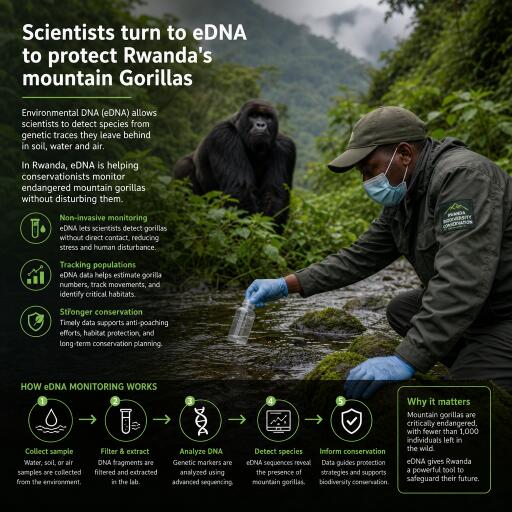
Scientists turn to eDNA to protect Rwanda’s mountain Gorillas
Rwanda is adding a powerful scientific tool to its wildlife protection efforts: environmental DNA, or eDNA. The technique allows researchers to detect animals by analyzing tiny traces of genetic material left behind in nature, offering a less intrusive way to study rare species in some of the country’s most difficult landscapes.
In the misty forests of Volcanoes National Park, where mountain gorillas and golden monkeys move through dense vegetation and steep slopes, tracking wildlife is never simple. Field teams often depend on direct sightings, ranger patrols, and motion-activated cameras. While these methods remain important, they can be slow, labor-intensive, and limited in places where visibility is poor and access is difficult.
That is where eDNA is beginning to change the game.
Instead of searching for animals themselves, scientists collect samples from the environment, such as water, mud, or soil. These samples can contain microscopic biological traces shed by wildlife, including skin cells, saliva, hair, or waste. In the lab, researchers examine that genetic material to identify which species have recently passed through an area.
The method is now being used in Rwanda as part of a broader push to improve biodiversity monitoring and strengthen conservation planning. By reading ecological clues hidden in streams, wetlands, and forest soils, researchers hope to assemble a clearer picture of what species are present and where protective action may be needed most.
For endangered animals like mountain gorillas, this offers a major advantage. Traditional monitoring can sometimes disturb wildlife, especially in fragile habitats. eDNA makes it possible to gather information with far less direct contact, reducing stress on animals while still helping conservation teams track ecosystem health.
The technology is also valuable because a single sample can reveal much more than one species. A vial of water collected downstream from a forest can provide evidence of mammals, birds, amphibians, and other organisms using the surrounding habitat. That makes eDNA especially useful for broad ecological surveys, where understanding the full mix of life in an area is just as important as locating one flagship species.
In Rwanda, conservation groups and public institutions are exploring how this approach can support habitat restoration as well. If a damaged ecosystem is being rehabilitated, eDNA can help show whether native species are returning. It may also provide early warning when invasive organisms appear, allowing managers to respond before those species become firmly established.
Another promising use is in guiding protection efforts on the ground. By identifying which landscapes are being used by vulnerable animals, conservation authorities can better focus patrols and management activities. In regions where poaching and habitat pressure remain ongoing concerns, better ecological intelligence can improve how limited resources are deployed.
Still, scientists emphasize that eDNA is not a complete replacement for traditional field methods. The technology is highly effective at showing whether a species has been present, but it cannot reliably tell researchers how many animals are in a given place. Nor can it always pinpoint the exact location of an individual or group.
That uncertainty comes from the very nature of environmental genetic traces. DNA can drift in waterways, persist in soil for a period of time, or be transported away from where an animal originally left it. As a result, a positive detection is a strong clue that a species is in the wider environment, but not a precise map of its movements.
There is also a technical challenge that is particularly important in Africa: reference data. To match an unknown DNA fragment to a species, scientists need robust genetic libraries for comparison. Many of the world’s best-developed DNA databases were built using species from Europe and North America, leaving significant gaps for African biodiversity.
To overcome that problem, researchers in Rwanda are working to expand regional genetic records so samples collected locally can be identified more accurately. Building these databases is essential if eDNA is to deliver its full potential for conservation across the continent.
Training is another major part of the effort. Rangers, technicians, and community members are being prepared to help gather samples correctly and support long-term monitoring programs. That local involvement could make the system more sustainable, while also strengthening ties between conservation science and the people living near protected areas.
The interest in eDNA reflects a broader shift in conservation, where advanced laboratory tools are being combined with boots-on-the-ground protection. In Rwanda’s mountain ecosystems, where biodiversity is both extraordinary and vulnerable, that combination could prove especially valuable.
As climate pressures, habitat disruption, and human activity continue to reshape natural landscapes, conservationists are racing to find faster and smarter ways to understand what is happening in the wild. For Rwanda’s iconic mountain gorillas and the many other species sharing their habitat, environmental DNA may become an increasingly important part of the protection toolkit.



Leave a Reply