

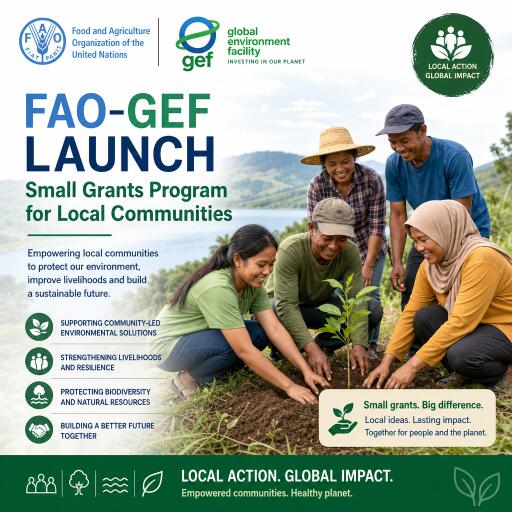
FAO-GEF Launch Small Grants Program for Local Communities
Community groups and civil society organizations across Indonesia can now apply for small grants of up to US$75,000 (about Rp1.2 billion) to advance locally led environmental solutions, with technical backstopping from the Food and Agriculture Organization (FAO). The initiative is part of the Global Environment Facility’s Small Grants Programme (GEF SGP), designed to pair grassroots innovation with practical support that strengthens both ecosystems and livelihoods.
Under the Eighth Operational Phase (OP8), FAO is partnering with the GEF SGP in 13 countries, including Indonesia, to scale up community action on biodiversity protection, climate resilience, and sustainable resource management. The program emphasizes inclusion of customary communities (Masyarakat Adat), women, youth, and persons with disabilities, ensuring they play a central role in shaping and delivering solutions on the ground.
In Indonesia, FAO will work with Yayasan Bina Usaha Lingkungan (YBUL), which has implemented GEF SGP nationally since 1997. The collaboration was formalized on May 13, 2026, through an Operational Partnership Agreement signed in Jakarta, signaling a renewed commitment to broaden the program’s reach across the archipelago.
FAO’s country leadership underscored that a bottom-up approach is essential to tackle today’s interlinked environmental and socioeconomic pressures. The organization will provide tailored technical assistance to help grantees strengthen project design, monitoring, and enterprise models, while preparing to extend support to more remote communities scattered across Indonesia’s islands.
For this phase, the program will concentrate efforts in Buleleng (Bali); Lombok (West Nusa Tenggara); and Labuan Bajo, Komodo National Park, Sumba, and Alor (East Nusa Tenggara). These landscapes and seascapes were selected through a participatory process involving national and local stakeholders, reflecting high biodiversity value, limited previous access to SGP financing, and urgent environmental challenges. Among the pressures identified are climate-related crop losses, erosion of traditional seed and livestock varieties, and constrained market access for local producers, even as regional tourism expands.
What the grants will support
Funding will prioritize initiatives aligned with Indonesia’s national development strategies and international commitments, as well as five thematic priorities under GEF SGP-OP8:
- Community-based conservation of threatened ecosystems and species
- Sustainable agriculture, fisheries, and food security
- Low-carbon energy access with co-benefits for communities
- Local-to-global coalitions for safer chemicals and waste management
- Sustainable urban solutions that reduce pollution and improve resilience
Beyond financial support, grantees will gain access to training, mentoring, and knowledge exchange, with FAO facilitating technical expertise. The program also encourages business-oriented approaches—helping community enterprises strengthen value chains, meet quality standards, and build partnerships with markets and the private sector to scale impact.
YBUL highlighted that the grants are an opportunity to translate Indonesia’s high-level environmental commitments—such as the FOLU Net Sink 2030 and the Kunming–Montreal Global Biodiversity Framework—into tangible local action by those who steward the country’s natural wealth.
Application timeline and inclusivity targets
A call for proposals is set to open in June. Successful projects are expected to deliver measurable environmental benefits while advancing poverty reduction, social inclusion, and gender equality. Over 2026–2029, the program aims to reach more than 14,000 direct beneficiaries, including approximately 7,200 women, 2,300 youth, and 2,300 persons with disabilities. At least 30 percent of grants will be awarded to women-led groups, 10 percent to youth-led groups, and 5 percent to customary communities to ensure diverse leadership and participation.
Environmental outcomes at scale
Projects supported under OP8 are expected to restore more than 6,400 hectares of degraded land, improve management across roughly 110,000 hectares of terrestrial landscapes and 8,000 hectares of seascapes, and mitigate an estimated 640,000 tonnes of CO2-equivalent emissions. Progress and outcomes will be tracked through FAO’s GEF SGP online portal to promote transparency and shared learning.
Transparent governance
An 11-member National Steering Committee—comprising representatives from civil society, government, and the private sector—has been established to oversee impartial project selection and to reinforce national ownership of the program. This multi-stakeholder mechanism is intended to ensure that funds reach initiatives with strong community backing, sound sustainability plans, and clear pathways to long-term impact.
What local groups can propose
The grants are suited to a wide range of community-driven solutions, for example:
- Restoring coral reefs and mangroves, protecting coastal fisheries, and establishing community-managed no-take zones
- Agroforestry and climate-resilient farming that revive traditional crop varieties and improve food security
- Village-scale renewable energy systems that power livelihoods while cutting emissions
- Pollution reduction and circular economy models that improve waste management and create green jobs
- Nature-positive tourism that strengthens conservation finance and local value chains
How to prepare a strong proposal
- Demonstrate community leadership and inclusive governance, including participation by women, youth, and persons with disabilities
- Show clear environmental baselines, measurable targets, and a practical monitoring plan
- Align with one or more OP8 thematic priorities and relevant national strategies
- Build realistic budgets and sustainability plans, including market or co-financing opportunities where possible
- Document traditional knowledge and equitable benefit-sharing arrangements
With dedicated financing and hands-on technical support, the FAO–GEF partnership is positioning local and indigenous communities at the forefront of Indonesia’s efforts to protect biodiversity, enhance climate resilience, and secure sustainable livelihoods—turning ambitious national goals into concrete action on the ground.



Leave a Reply