

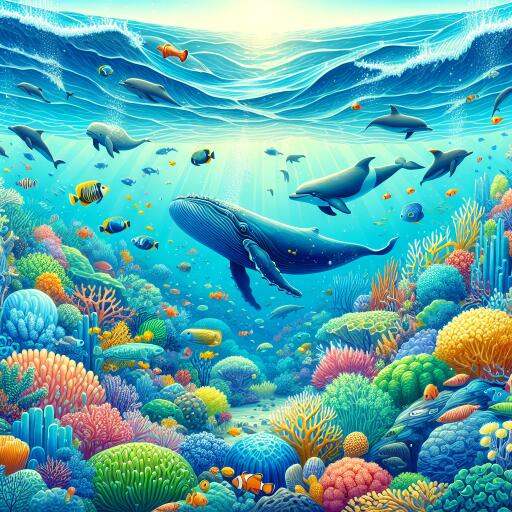
Learn more about our oceans for Mother Ocean Day, May 9
Each year on May 9, Mother Ocean Day invites us to pause and appreciate the living system that makes our planet habitable. The ocean is more than a vast expanse of blue; it is Earth’s beating heart, circulating heat, moisture, nutrients, and life. Understanding how it works—and how much we still don’t know—is essential to safeguarding climate, wildlife, and communities.
The planet’s blue heart
About 71% of Earth’s surface is cloaked in water, and nearly all of it—roughly 96.5%—is held in the global ocean. Yet, compared with the volume of the entire planet, the total amount of water is surprisingly small. Visualized as a single sphere, all the water on Earth would form a ball only about 860 miles across, with a volume near 332 million cubic miles. It’s enough to cover the contiguous United States to a depth of around 107 miles—immense, but still a thin film at planetary scale.
The ocean’s chemistry is just as striking. If all the dissolved salts in seawater were spread evenly across the world’s land, they would create a crust more than 500 feet thick. That saline brew supports a vast marine web of life, from microscopic plankton to blue whales.
Climate’s pulse and planetary balance
Ocean currents function like a global circulatory system, redistributing heat and moisture and shaping weather and climate far from the coasts. Warm and cold streams in the Atlantic and Pacific, and basin-spanning climate patterns such as the El Niño–Southern Oscillation, can nudge rainfall, drought, storm tracks, and even fisheries thousands of miles away. Tracking these shifts helps communities prepare for extreme weather, anticipate sea-level changes, and protect livelihoods.
The unknown majority
Despite its central role, most of the ocean remains a mystery. The deep sea—waters below about 200 meters—accounts for more than 90% of the ocean’s volume and is perpetually dark, cold, and under crushing pressure, making it difficult to study. While mapping technology has advanced quickly, only about a third of the seafloor has been charted in high resolution. Direct visual exploration is even scarcer: less than a thousandth of the deep seafloor has been seen with cameras or submersibles. The largest habitat on Earth is still largely unobserved.
How we map the deep
Sound is the primary tool for revealing the seafloor. Active sonar sends sound pulses into the water; the time it takes for echoes to return from the bottom indicates depth and shape. Passive systems listen for sounds in the ocean, helping characterize habitats and marine life. Piecing together high-resolution maps at every depth is a monumental task—so large that it has been estimated a single research vessel would need close to a millennium to finish the job alone. That’s why an international push is underway to assemble a complete, high-quality map of the seabed by 2030, drawing on data from ships, autonomous vehicles, and satellites.
Why better maps matter
- Safer coasts: Detailed seafloor topography sharpens models for storm surge, tsunamis, and sea-level rise, improving risk planning.
- Smarter climate forecasts: Bathymetry influences how currents flow and where heat is stored, refining global climate predictions.
- Stronger conservation: Knowing where submarine canyons, reefs, and upwelling zones are located helps target protections and rebuild fish populations.
- Scientific discovery: Maps guide submersibles to places most likely to harbor unique species, mineral formations, or hydrothermal vents.
Life at crushing depths
The seafloor’s deepest known point, the Challenger Deep in the Mariana Trench of the western Pacific, plunges to about 7 miles (nearly 11,000 meters). Drop Mount Everest into that abyss and its summit would still lie around 7,000 feet underwater. Even there, life persists—from hardy single-celled organisms to complex communities thriving on chemical energy instead of sunlight. Across the ocean as a whole, scientists estimate there may be between 700,000 and 1 million species, many yet to be described. Each new expedition reveals organisms with unexpected adaptations, broadening our understanding of how life copes with extremes.
What you can do this Mother Ocean Day
- Cut plastic at the source: Choose reusable bottles, bags, and utensils; avoid products with microbeads; support businesses that minimize packaging.
- Choose seafood wisely: Favor species from well-managed fisheries or responsible aquaculture, and diversify choices to ease pressure on popular stocks.
- Protect blue habitats: Back efforts that create or strengthen marine protected areas and restore coastal wetlands, mangroves, and reefs.
- Support ocean science: Advocate for sustained ocean observation, mapping, and climate research that underpin early warnings and smart policy.
- Join local action: Participate in beach or river cleanups, report marine wildlife sightings to community science projects, and help track shoreline change.
- Lower your carbon wake: Use public transit, cycle or walk when possible, improve home efficiency, and choose clean energy where available.
- Share the story: Teach ocean literacy in classrooms and at home—how currents, climate, and biodiversity connect to everyday life.
The ocean moderates our climate, feeds billions, and sustains an intricate web of life. On Mother Ocean Day, let’s honor that gift not just with awe, but with action—so future generations inherit seas that are healthier, more resilient, and better understood than they are today.



Leave a Reply