

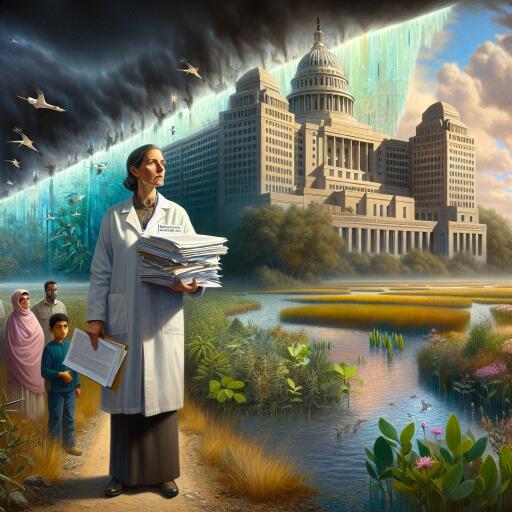
Ignorance or Ideological Extremism? The Kast Government’s War on Wetlands Conflicts with Science, Treaties, and Family Safety
Chile’s wetlands have become a political battleground. What looks like a series of offhand remarks and piecemeal decisions is better understood as a coherent program: dismantling environmental safeguards in the name of growth, even when the science, international obligations, and basic flood safety point in the opposite direction.
An agenda that sidelines nature—and risk prevention
Before assuming office, the current administration framed “radical environmentalism” as a threat to democracy, casting nature’s protection as a rival to the “centrality of the person.” That framing now underpins efforts to loosen ecosystem safeguards. On the campaign trail, vows to do away with environmental guidelines were cheered by business audiences, and conservation was belittled as a tangle of bureaucratic whims—reducing living ecosystems to mere paperwork. The implications are concrete: if wetlands are treated as dispensable, flood control and water security are treated as optional.
Valdivia as a flashpoint
The controversy erupted anew when the housing portfolio blamed Chile’s Urban Wetlands Law (N° 21.202) for protracted delays in housing construction in Valdivia, suggesting an eight-year hold-up. Although the tone was later moderated, the critique of the law persisted, with promises to “fix” it to speed building.
The president then backed the thrust of that argument, adding that there are “areas that are objectively not wetlands” and asserting a people-first approach. Left out of that framing is a critical fact: Valdivia earned international recognition as a “Wetland City” in 2025—acknowledgement that its urban fabric is interlaced with floodplains, marshes, and peat-rich soils that naturally hold and slowly release water.
Scientists and former environmental officials quickly pushed back: the wetlands in question have had protections since 2021, so they cannot explain an eight-year delay. More importantly, they stressed that building on urban wetlands has repeatedly amplified flooding—an outcome documented in municipal planning instruments that, since the late 1980s, have mapped many of these zones explicitly as natural flood areas.
Hydrological modeling for southern Chile shows the pattern with stark clarity: the greater the loss of wetlands, the higher the flood peaks and the longer the water lingers over neighborhoods. Concepción offers a textbook case. Decades of urbanization on wetland soils have increased flood exposure; recent approvals for large residential projects atop wetland complexes drew warnings from civil society about cumulative impacts and biodiversity loss, even as regional authorities heralded the projects’ green lights.
Promises to build fast vs. the reality of water
Pitting housing against wetlands is a false choice. Wetlands are part of the city’s infrastructure, whether planners acknowledge them or not. Drain them and you inherit their functions: storing water during storms, recharging aquifers, filtering pollutants, buffering coasts from storm surges, and moderating heat. Ignore those functions and the bill arrives later—in flooded homes, emergency spending, insurance losses, and disrupted livelihoods.
There is a better path. Prioritize safer, well-drained sites; invest in compact, transit-served neighborhoods; integrate green–blue corridors; and enforce no-build buffers around saturated soils. That approach delivers roofs over heads without shunting stormwater into living rooms.
Treaty obligations aren’t optional
Chile joined the Ramsar Convention in 1981 and, since 2025, has represented the region on its Standing Committee. The treaty’s core duty is “wise use” of wetlands—protecting their ecological character while enabling sustainable development. Sweeping deregulation that invites building on flood-prone wetlands pulls against both the letter and spirit of those commitments.
Why wetlands are public safety infrastructure
- They soak up stormwater and blunt floods—nature’s retention basins.
- They cleanse water and air, protecting public health.
- They store vast amounts of carbon, slowing climate change.
- They sustain fisheries, grazing, tourism, and cultural practices—over a billion people worldwide depend directly on them.
And yet, the world has lost roughly 35% of its wetlands in the last half-century, mostly to intensive farming, sprawling urbanization, pollution, over-extraction, and a warming climate that scrambles water cycles. The costs are mounting everywhere.
The Chilean picture: richness under pressure
Chile hosts a mosaic of wetlands—from high Andean bofedales and vegas to coastal marshes, estuaries, and extensive peatlands in Chiloé and Patagonia. Sixteen sites are listed under Ramsar, covering more than 361,000 hectares. National mapping in 2017 estimated around 18,000 wetlands totaling 1,460,400 hectares, with the largest areas in:
- Aysén: 444,200 ha
- Magallanes: 288,600 ha
- Los Ríos: 129,300 ha
Additional concentrations include:
- Chiloé Island: 29,500 ha
- Valparaíso Region: 6,600 ha (the smallest total and under intense coastal real estate pressure)
Chile has not stood still—N° 21.202 extended vital shields to urban wetlands. But rural systems remain vulnerable to extractive industries and parceling for development, while cities continue to squeeze remaining marshes, peat soils, and floodplains. Data gaps on extent and condition hamper protection, and legal maneuvers can swiftly roll back safeguards.
Ideology can’t outvote gravity
The administration’s rhetoric—casting environmental rules as obstacles and dismissing wetland science—travels poorly against physics. Water will reclaim lowlands regardless of political slogans. Building on wetlands doesn’t erase them; it converts them into recurrent disaster zones. Framing this as a choice between homes and habitats misleads families into risk and saddles the public with avoidable costs.
Chile’s choice is clear: honor its treaty obligations, treat wetlands as life-support and safety infrastructure, and plan housing with hydrology in mind. Or repeat the world’s worst mistakes—only to discover that ignoring wetlands doesn’t save money, it multiplies losses. Science, international commitments, and the safety of communities all point in the same direction. The country should, too.



Leave a Reply