

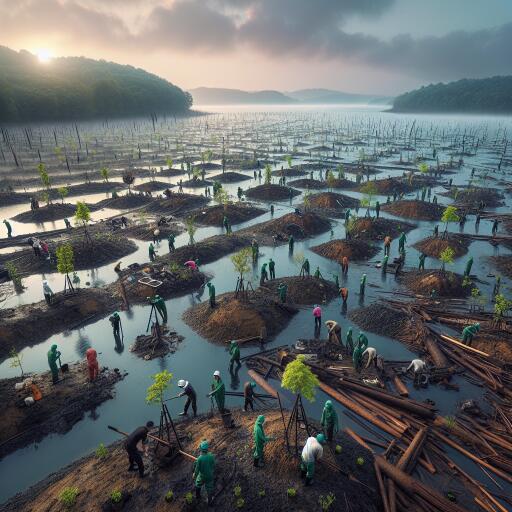
Wular Lake revival: 5 Sq Km reclaimed, massive ecological restoration underway
In a sweeping push to restore one of Asia’s most important freshwater bodies, North Kashmir’s Wular Lake is undergoing a data-driven makeover that has already recovered about five square kilometres of clogged wetland. The effort, led by the lake’s conservation authority and partnering agencies, is reversing years of siltation and invasive growth, and reshaping the waterbody’s ability to buffer floods, support biodiversity, and anchor local livelihoods.
Rebuilding a lake’s capacity, one dredger at a time
The restoration team has removed an estimated 7.843 million cubic metres of silt from the lakebed—among the largest desiltation exercises for a wetland in the region. By carving out long-silted channels and clearing choke points, the project has substantially increased Wular’s water-holding capacity, a key step toward rebalancing its hydrology and ecological functions.
To shield both the ecosystem and surrounding settlements from encroachment and seasonal surges, protective bunds have been strengthened along roughly 15 kilometres of the most vulnerable perimeters. These low-profile embankments are designed to stabilise shorelines while accommodating the lake’s seasonal rise and fall.
Mapping, monitoring, and modern oversight
Technology is central to the revival. The lake’s legally recognised boundary—spread across about 130 square kilometres—has been physically marked using 1,159 geo-referenced RCC pillars. Each pillar’s coordinates were fixed through GPS and remote sensing, creating a tamper-evident perimeter that reduces ambiguity and helps deter future encroachments.
On-the-ground protection is being tightened, too. Two watchtowers equipped with CCTV are already operational, with more surveillance layers being added to improve round-the-clock monitoring and rapid response.
Selective willow clearance to restore wetland character
Decades of unmanaged willow spread had throttled water flow, trapped sediment, and altered the lake’s native wetland mosaic. Under a Comprehensive Management Action Plan, managers are selectively and gradually clearing willows only from identified blocks where they most disrupt hydrology. The aim is ecological correction, not blanket tree felling.
Wular’s willow inventory is estimated at 1.9 to 2.1 million trees. In the first phase, about 130,000 have been removed from priority stretches, a process that has also generated approximately ₹31.95 crore in revenue. To ensure a net ecological gain, the operation is paired with compensatory planting and erosion control in the lake’s catchments.
Greening the catchment to stop silt at source
Keeping sediment out of the lake is as crucial as dredging it from within. Since 2012, nearly 1.9 million saplings have been planted in the broader catchment under public investment programmes, helping stabilise slopes, knit soils, and dampen runoff. In the Bandipora catchment alone, more than 2,900 hectares have been treated through afforestation and soil conservation, reducing the sediment load that would otherwise drift into Wular.
Low-impact access and a gentler tourism footprint
Recognising that people and wetlands thrive together when access is carefully designed, the authority has laid a 2.5-kilometre non-motorable walkway at Banyari–SK Payeen. With cycling tracks and viewing points, it channels visitor movement away from sensitive habitats while offering wide-angle views of the water and birdlife.
Multiple eco-parks are being developed to distribute footfall and create community assets: Delta Park at Baniyari, Gurura Park, and an eco-park at Ningli, Sopore. These nature-friendly spaces, backed by multi-crore investments, aim to diversify local income—guiding, crafts, light hospitality—without loading the lake with new pressures.
Why this matters
- Hydrology restored: Reclaimed wetland and desilted channels re-open the lake’s natural flow paths and storage, improving resilience to high-water events.
- Biodiversity boost: Reviving open water and marsh mosaics supports fish nurseries, waterbirds, and native aquatic vegetation.
- Community safety: Reinforced bunds and better surveillance reduce risks from flooding and encroachment.
- Sustainable livelihoods: Carefully planned eco-tourism expands income options while protecting the lake’s core ecology.
- Future-proofing: Geo-referenced demarcation and continuous monitoring make the restoration durable and enforceable.
The road ahead
Wular’s comeback is being built in phases: dredge and de-choke; protect and police; replant and retain. By coupling selective willow removal with catchment greening, managers are tackling both symptoms and sources of ecological decline. The early gains—reclaimed area, stronger shorelines, clearer channels—are tangible signs that a scientifically guided, tech-enabled approach can turn back the clock on a stressed wetland.
As construction of eco-parks progresses and surveillance expands, the emphasis will remain on balance: maintaining the lake’s ecological pulse while opening up measured, low-impact ways for communities and visitors to engage with it. If the momentum holds, Wular could emerge as a flagship for how large freshwater systems across the Himalayas can be revived—rooted in evidence, guarded by technology, and shared with care.



Leave a Reply