

To climb trees, cicadas look to the shadows – Archyde
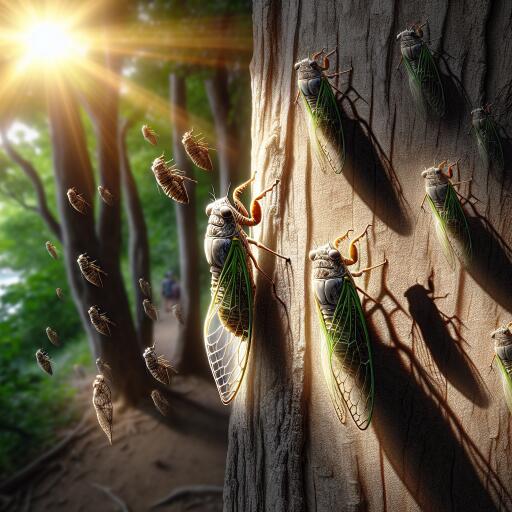
When periodical cicadas erupt from the soil in their billions, they face a simple but urgent problem: how to find a tree trunk fast. Their solution is elegantly primitive. Cicadas are drawn toward darkness, a behavior known as skototaxis. By keying in on stark silhouettes—dark trunks against a bright sky—they cut through visual clutter and make a beeline to the vertical highways that lead them to food, mates, and safety.
How shadows become road signs
Their compound eyes, packed with thousands of tiny lenses called ommatidia, excel at detecting contrast rather than fine detail. When a cicada sees a strong boundary—say, the edge of a shaded trunk against a sunlit background—its visual system amplifies that edge through lateral inhibition, a neural process that boosts differences between light and dark. The result is a crisp “map” of shadowy targets.
From there, the pathway is astonishingly direct: the contrast cue triggers motor circuits that steer the insect toward the darker zone. That’s taxis—purposeful movement toward or away from a stimulus—as opposed to kinesis, which is more of a random scurry modulated by intensity. It’s fast, it’s frugal, and it minimizes the time cicadas spend exposed on the ground, where predators abound.
Plain-language takeaways
- Shadow-seeking 101: Skototaxis is an instinctive pull toward darker areas; for cicadas, that usually means “head for the trunk.”
- Contrast, not color: They’re not recognizing “tree-ness” but detecting a hard edge between dark and bright.
- Lean intelligence: Simple visual triggers can drive complex movements, saving time and energy.
Light pollution and the risk of ecological traps
In natural woodlands, this rule-of-thumb works brilliantly. In cities awash with Artificial Light at Night (ALAN), it can fail. High-intensity LEDs cast hard shadows on buildings, poles, or parked vehicles, creating decoy silhouettes that lure cicadas to the wrong places. When insects cluster around these artificial dark zones, their chances of reaching the canopy drop—disrupting feeding and mating, and altering where their nutrient-rich bodies return to the soil after they die.
These shifts ripple outward. Local nutrient cycling can be skewed away from trees, and the chorus of males—already loud—may concentrate near light fixtures, aggravating noise exposure for residents. It’s a vivid example of an evolutionary shortcut colliding with modern infrastructure.
Inside the circuitry: from pixels to steps
Viewed through a neurobiological lens, skototaxis is a masterclass in signal triage. The visual system filters environmental “noise” and elevates a single, reliable cue—edge contrast. Lateral inhibition sharpens that cue, producing a binary light-versus-dark landscape that’s easy to interpret. That compressed representation hands off to motor neurons with minimal computation, enabling decisive movement with low energy cost.
How it compares to other guidance systems
Skototaxis is a navigational strategy alongside a broader family of sensory drives. Phototaxis draws organisms toward light; chemotaxis follows scent plumes; geotaxis orients to gravity. By prioritizing darkness, cicadas use the inverse of the moth’s famed attraction to lamps—leveraging shadow as a stand-in for vertical structure.
Public-health notes during mass emergences
- Allergies and irritants: A small subset of people may develop skin irritation or respiratory symptoms after contact with cicadas or fungi that sometimes infect them. Seek medical help for hives, swelling, or breathing difficulty.
- Sound sensitivity: Choruses can exceed conversation levels. Those with hyperacusis or migraine sensitivity may benefit from ear protection and quiet indoor spaces.
- Pesticide caution: Avoid heavy chemical use to “control” cicadas; these ephemeral insects don’t persist, and broad-spectrum pesticides can harm people, pets, and pollinators.
What experiments suggest—and their limits
Controlled studies that manipulate light and shadow indicate that visual contrast, not scent, is the primary driver of trunk-finding during emergences. Many of these experiments come from temperate forests, where canopy density and light conditions fit cicadas’ ancestral playbook. Caution is warranted when generalizing to regions with different light regimes—open deserts, dense tropical understories, or urban cores drenched in LEDs. Much of the work draws on public and academic funding focused on basic biology, reducing commercial conflicts of interest, though ecological context remains a key variable.
Design lessons for medicine and machines
There’s a direct technological echo here. Devices that must make rapid, reliable decisions—without burning watts on heavy computation—can borrow from skototaxis. Edge-first sensing can guide surgical tools that distinguish tissue boundaries more cleanly, sharpen contrast in medical imaging, or help small robots navigate cluttered spaces with minimal hardware. The principle is timeless: prioritize the most informative feature, then act.
Final thought
The cicada’s rush to darkness isn’t just insect lore; it’s a blueprint for efficient perception. In a forest, the rule is flawless. In a city of hard lights and harder shadows, it can mislead. Recognizing both the elegance and the fragility of this strategy can help ecologists, urban planners, and engineers design environments—and technologies—that work with biology’s shortcuts, not against them.



Leave a Reply