

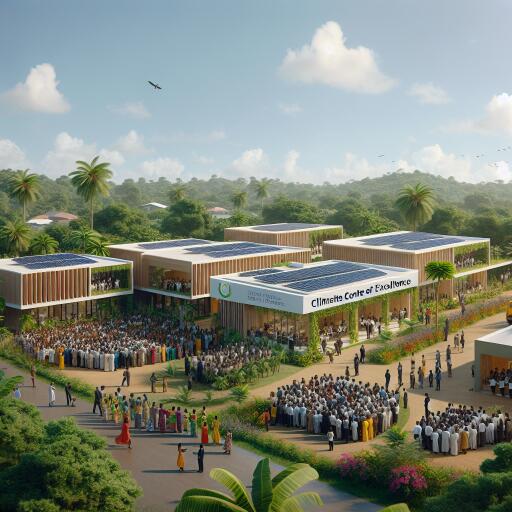
Ghana has inaugurated the Ghana Climate Centre of Excellence (GCCE), a new hub designed to knit together research, policy dialogue and on-the-ground action to accelerate the country’s response to climate change. Conceived as both a national and regional resource, the centre aims to convene government agencies, development partners, academia, civil society and the private sector to fast-track climate resilience and environmental sustainability.
According to the centre’s leadership, GCCE will function as a learning and innovation platform where students, practitioners and public institutions can deepen their understanding of climate risks and turn evidence into solutions that benefit communities. The plan is to make the centre a go-to venue for training, collaborative research and the exchange of best practices across sectors.
A major youth-focused initiative—branded the “Youth Climate Call”—will anchor early programming. It is set to engage young people in practical stewardship, from protecting tree cover and managing fisheries to piloting nature-based approaches that restore ecosystems while supporting local livelihoods. The centre also intends to make inclusion a cornerstone of its work by encouraging women’s leadership in climate advocacy and decision-making, acknowledging that women’s roles in community development and natural resource management are critical to effective climate action.
GCCE’s chief executive, Chauncia Willis Johnson, underscored the need for a strong evidence base to guide interventions. By providing access to climate data, training and applied research, the centre aims to equip stakeholders with the tools required to analyze risks, design responsive programs and track results. The public is being encouraged to take advantage of these resources to better understand how climate change is reshaping local environments and economies—and how communities can adapt.
Government officials framed the launch as both timely and urgent. With heat extremes intensifying, rainfall patterns growing more erratic and flood–drought cycles becoming more frequent, impacts on food systems, public health and the broader economy are already visible across Ghana. In this context, a dedicated coordination node for climate knowledge and capacity building is expected to support more coherent, evidence-based policymaking.
The centre’s role will extend beyond research. It is expected to catalyze practical solutions, help local authorities and community leaders translate climate data into action, and strengthen the pipeline of innovations suited to Ghana’s diverse ecological zones—from coastal fisheries to savannah agriculture. Officials emphasized that national commitments remain firmly aligned with international frameworks such as the Paris Agreement, and highlighted ongoing efforts to expand renewable energy, promote sustainable land use and scale climate-smart agriculture.
Partnerships will be central to GCCE’s approach. Institutions that bring expertise in equity and emergency management—such as the Institute for Diversity and Inclusion in Emergency Management (I-DIEM)—are seen as vital to integrating preparedness and protection for at-risk groups into climate strategies. Ensuring that vulnerable and marginalized communities are included in planning and resourced for adaptation is a key priority.
What the new centre will do
- Serve as a hub for climate research and knowledge exchange, connecting scientists, policymakers and practitioners.
- Offer training and capacity-building for students, public servants and community organizations on climate risk, adaptation and resilience.
- Facilitate policy dialogues to align local and national planning with the latest climate evidence.
- Advance youth engagement through the Youth Climate Call, focusing on tree conservation, fisheries management and nature-based solutions.
- Promote inclusion and women’s leadership in climate governance and advocacy.
By integrating research, education and practice, the GCCE is positioned to become a catalyst for climate action that is locally grounded and nationally coordinated. As Ghana navigates a future of rising climate pressures, the centre’s success will hinge on sustained partnerships, steady investment in skills and data, and a commitment to ensuring that no community is left behind.



Leave a Reply