

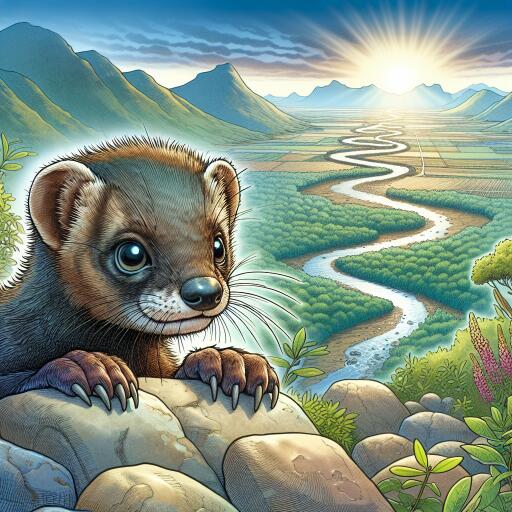
Juvenile Fisher Embarks on Longest Recorded Journey to Establish New Forest
A young female fisher has shattered expectations of her species’ mobility by traveling roughly 118 kilometers (about 73 miles) across New Hampshire—from the coastal town of Durham to the outskirts of Lincoln in the White Mountains. The trek, documented through GPS telemetry, is the longest recorded dispersal for a fisher and redefines what biologists thought possible for this elusive forest carnivore, especially in the dead of winter.
A small predator with outsized ecological impact
Fishers (Pekania pennanti) are mid-sized, tree-savvy hunters that anchor healthy forest food webs. They help regulate rodent populations, limit pest outbreaks that can affect farms and public health, and even influence forest regeneration by aiding in the spread of fungal spores. Unusually among predators, fishers can take on porcupines, whose heavy browsing can damage valuable timber. Understanding how these animals move and settle is central to sustaining resilient forests and the services they provide.
A record-breaking winter journey
The juvenile female—known to researchers as F003—was fitted with a GPS collar while still near her natal range. Her weekly positions traced a bold, persistent line northwest across varied terrain, including deep-snow zones typically thought to slow or halt small carnivores. Instead, F003 pressed on through mid-winter, demonstrating that severe snow conditions may not constrain fishers as much as once believed.
Scientists paired her location data with environmental measures, including snow depth, to analyze when, where, and how quickly she moved. The result is a rare, fine-grained view of dispersal: the life stage when juveniles leave their birth areas to stake out new home ranges. This process is a biological safeguard—reducing inbreeding, spreading genes across the landscape, and helping populations adapt to changing conditions.
Why go so far?
While fishers can be surprisingly flexible, females often steer clear of territories already held by other females. That social reality likely pushed F003 to keep moving until she encountered a suitable, less-contested patch of forest. Her route hints at a calculated search for a sweet spot: adequate prey, denning options, and space to raise future litters with minimal competition.
The discovery adds nuance to long-standing assumptions that winter snowpack fences in small- to mid-sized carnivores. It also suggests that some fishers, at least during dispersal, may be primed for endurance travel—moving quickly through inhospitable areas to reach high-quality habitat instead of settling for marginal patches closer to home.
Connectivity is conservation
F003’s marathon underscores a core principle of modern wildlife management: animals need connected habitats, not just isolated preserves. Forest corridors—riparian buffers, intact ridgelines, underpasses at busy roads, and well-managed working forests—allow individuals to move, mix, and maintain genetic diversity. For species under pressure from multiple fronts, these linkages can keep whole populations viable.
In New Hampshire and across the Northeast, fishers contend with a growing list of stressors: habitat fragmentation, rodenticide exposure, vehicle collisions, legacy impacts from trapping, shifts in predator communities such as rising bobcat numbers, and emerging diseases. Long-distance dispersal is nature’s insurance policy against those threats—but only if suitable habitat is reachable.
Telemetry, data, and a new movement playbook
High-resolution tracking is transforming what we know about animal movement. By logging precise locations and aligning them with weather, terrain, and forest structure, researchers can build predictive models of when and why wildlife travels—and where interventions will matter most. In F003’s case, the merging of GPS telemetry with snowfall records illuminates how a cold-adapted carnivore adjusts behavior across a winter landscape.
These insights ripple far beyond one species. As climate change reshapes snow cover, freeze–thaw cycles, and forest composition, movement ecology becomes a crystal ball for how wildlife will navigate altered habitats. The lesson from this fisher’s journey is clear: preserve permeability across the landscape now, and ecosystems will be better prepared for what comes next.
Implications for land stewards and planners
- Protect and restore forest corridors that link core habitats across jurisdictions and ownerships.
- Design road mitigation—wildlife crossings, fencing, and signage—in known movement bottlenecks.
- Reduce secondary poisoning by curbing the use of long-lasting rodenticides in and near forest edges.
- Incorporate winter mobility into habitat models; deep snow does not necessarily halt dispersal.
- Support long-term telemetry and environmental monitoring to track change and guide adaptive management.
A blueprint for resilience
F003’s odyssey reframes the fisher as not just a stealthy forest hunter, but also a determined pathfinder capable of linking distant woodlands. That capacity is a gift to conservation: long-distance dispersers move genes, recolonize suitable patches, and keep populations knitted together. It is also a challenge to us. To honor the evolutionary strategy these animals rely on, our maps must prioritize connection—across towns, counties, and entire regions.
In an era of shifting climates and fragmented habitats, this juvenile fisher offers a hopeful message. Give wildlife the room to move, and they will do the rest.



Leave a Reply