

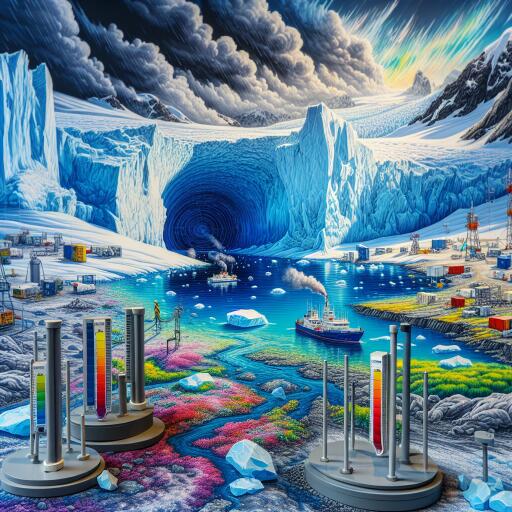
Interior Antarctica Faces Rapid Climate Change Shift
For decades, scientists treated the heart of Antarctica as a climatic constant—fiercely cold, remarkably stable, and largely insulated from the faster warming seen on the fringes of the continent. New research overturns that assumption. Fresh analyses now show that the high, icy plateau at the continent’s core is responding measurably—and rapidly—to a warming world, with changes in temperature, snowfall, and atmospheric patterns that reverberate far beyond the polar latitudes.
A once-frozen constant is changing
While the Antarctic Peninsula and coastal margins have long exhibited sharp warming and ice loss, the interior was considered buffered by elevation, extreme aridity, and persistent cold. Recent findings point to a different reality: summer temperatures across parts of the central plateau are inching upward. In such an ultra-cold environment, “slight” can be significant. Small temperature nudges can disrupt the surface energy balance, provoke episodic melt and refreezing, and steadily reshape how snow and ice retain or shed water. Over time, these seemingly subtle shifts can influence the stability of the ice sheet itself.
Moisture is on the move
The new picture includes an invigorated hydrological cycle deep inside the continent. Warmer air holds more moisture, and interior Antarctica appears to be receiving it at different times and in different amounts than in the past. Evidence points to seasonal changes in snowfall frequency and intensity, hinting at a tilt toward a slightly wetter interior. This matters not only for surface mass balance, but also for how snow layers compact, trap air, and refreeze meltwater—key processes that govern whether the ice sheet thickens, thins, or simply shifts its internal plumbing.
Atmospheric gears are reconfiguring
The shifts inside the continent are closely tied to changes aloft. Variability in the polar vortex and the dominant high-pressure systems over the plateau is allowing intrusions of relatively warmer, moister air to penetrate farther inland. When the vortex weakens or meanders, those air masses can surge into the interior, nudging temperatures upward and altering cloud cover and snowfall. Phases of the Southern Annular Mode are also implicated, with ripple effects on near-surface winds, heat transport, and the delicate dance of moisture across the ice surface.
Ice mechanics: from firn to the bedrock below
Warming within the interior is not just a thermometer story—it’s a structural one. As near-surface layers of compacted snow (firn) warm and densify, they lose some of their capacity to soak up meltwater like a sponge. That can route more liquid water toward the surface or downward through fractures, potentially increasing runoff and changing the lubrication at the base of the ice sheet. Basal melting, already influenced by geothermal heat, may intensify if altered surface conditions propagate through the ice column. Such changes can accelerate ice flow in some regions and, over decades, reshape how and where Antarctica contributes to sea level rise.
Sharper models, stronger signals
A major reason these interior changes are coming into focus is the use of high-resolution regional climate models customized for polar conditions. By tightly coupling atmospheric physics, surface energy balance, and snowpack microphysics—and by cross-checking with satellite and ground observations—researchers are resolving features that coarser models would blur. The result is a more faithful map of how the plateau breathes: when it gains or loses heat, how its snow metamorphoses, and which wind regimes deliver warmth and moisture into the interior.
Global stakes of a shifting interior
What happens in the middle of Antarctica does not stay there. The continent holds a vast reservoir of freshwater locked in ice; even small perturbations to its mass balance have global implications. If the interior proves more responsive to warming than once assumed, projections of future sea level rise may be conservative. Beyond sea level, meltwater fluxes can stratify parts of the Southern Ocean, reshaping nutrient pathways and marine ecosystems. A slightly warmer, moister interior could also awaken overlooked ecological processes—from microbial communities flickering to life in dampened snowpacks to subtle shifts in carbon cycling across the frozen desert.
Outpacing the past
Longer-term reconstructions from ice cores and reanalyses set the present in stark relief: recent changes within the interior stand out from natural variability. The pace and timing of warming align with the global fingerprint of human-driven climate change. That context matters. It strengthens the case that what we’re seeing is not a transient blip, but part of a sustained, externally forced transformation of Earth’s coldest continent.
Uncertainties—and the urgency to close them
Antarctica is a hard place to measure. Instruments fail, storms erase footprints, and distances are punishing. Sparse observations and the complexity of ice–atmosphere–ocean interactions limit precision. Yet the core message is not in doubt: the interior is shifting, and the consequences could be far-reaching. Priorities now include:
- Expanding and hardening inland observation networks to capture year-round conditions.
- Refining polar cloud and snow microphysics in models to better simulate melt, refreezing, and firn evolution.
- Coupling interior climate responses to ocean circulation and ice dynamics for improved sea level forecasts.
- Integrating ecological and biogeochemical monitoring to detect emerging feedbacks.
What this means now
Interior Antarctica is not a static deep-freeze—it is a living part of the climate system, increasingly responsive to the heat our planet is accumulating. Recognizing this shift compels a recalibration of risk, from sea level planning to ecosystem stewardship. It also underscores a broader truth: even the most remote corners of Earth are now participating in the story of rapid climate change. How quickly we translate this knowledge into sharper models, smarter policies, and deeper emissions cuts will help determine the fate of ice that, for millennia, seemed unshakably permanent.



Leave a Reply