

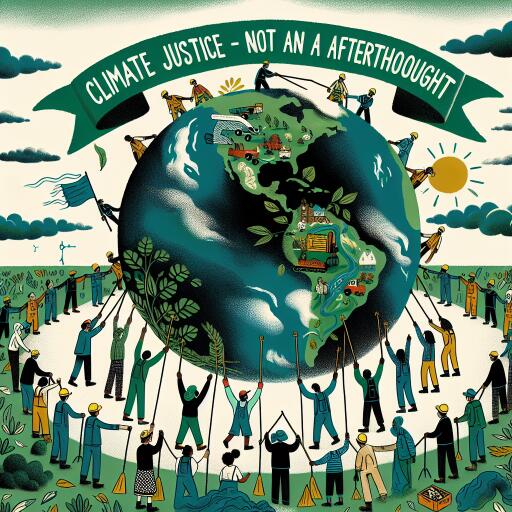
Climate justice cannot be an afterthought
Every headline-grabbing crisis competes for our attention, yet one threat dwarfs them all: a heating planet that is reshaping land, water, and the foundations of daily life. Climate justice cannot sit at the margins of policy debates or budget lines; it must be the starting point for everything we plan and build.
Along the coast and across our riverine heartlands, the future has arrived ahead of schedule. We no longer wait for a once-in-a-decade supercyclone to gauge risk. The past year made that painfully clear: a procession of low-pressure systems, king tides, and swollen rivers gnawed through embankments, pushed families from their homes, and chewed away at livelihoods. Villages were inundated over and over. Saltwater crept into ponds and aquifers, scorched fields, and turned precious drinking water brackish. Crowded shelters overflowed. Waterborne illnesses surged as sanitation systems buckled under the strain.
These are not spectacular, single-day disasters that command global attention. They are quiet, grinding emergencies—salinity intrusion, tidal flooding, waterlogging, and disease outbreaks—that can devastate communities just as profoundly as a cyclone. Because they unfold in slow motion, they rarely trigger the same urgency in disaster planning or political response. That must change.
Bangladesh, a low-lying delta nation on the front line of climate disruption, is among the world’s most exposed countries. Analysts warn that without closing adaptation gaps, annual economic losses could approach 7% of GDP by mid-century. The implications are stark: climate breakdown is not only an environmental problem—it is a humanitarian and economic emergency that undermines food security, forces internal migration, disrupts education, and deepens inequality.
The hidden costs of a slow-burning crisis
Slow-onset impacts demand a different kind of preparedness. When salt contaminates farmland, there is no dramatic footage—but there is a quiet collapse of income, nutrition, and health. When tidal flooding becomes routine, families exhaust savings on repairs that never end. When waterborne diseases spike, clinics are overwhelmed and children miss school. These harms compound over time, especially for women, the elderly, people with disabilities, and those living far from services.
Building resilience requires more than emergency relief. It means investing in durable infrastructure and social systems: raised and reinforced embankments, restored mangroves that buffer storm surges, early warning systems that reach the last mile, safe drinking water solutions, climate-resilient crops, affordable insurance, and reliable social protection that kicks in before people fall into poverty.
Responsibility and fairness in a warming world
Our people contribute little to the cumulative greenhouse gases driving this crisis, yet we bear disproportionate harm from its consequences. That imbalance is not incidental—it is the legacy of centuries of emissions from industrialized economies. The nations that grew wealthy by burning coal, oil, and gas carry a responsibility that goes beyond promises and press releases.
Justice starts with rapid, deep cuts in emissions in the Global North to keep 1.5°C within reach. But mitigation alone will not repair the damage already underway. Justice also means financing adaptation at the scale of reality, not the scale of convenience. Communities facing rising seas, salinized soils, and worsening floods cannot be asked to fund their survival through new debt. Support must be predictable, accessible, and tilted toward grants rather than loans.
There is also a growing bill for unavoidable losses: land, livelihoods, cultural heritage, and biodiversity that cannot be adapted away. Recognizing and resourcing loss-and-damage responses is a moral imperative, not an optional add-on. Technology transfer, capacity building, and debt relief should be part of a coherent package that empowers local solutions instead of imposing one-size-fits-all fixes.
What climate justice looks like on the ground
- Locally led adaptation, where communities design and direct projects, ensuring relevance and accountability.
- Nature-based defenses such as mangrove restoration that protect shorelines while supporting fisheries and biodiversity.
- Resilient infrastructure: elevated roads and homes, climate-proof water systems, and embankments designed for escalating hazards.
- Health and sanitation upgrades that prevent disease outbreaks as flooding and heat intensify.
- Livelihood diversification and training so households are not trapped by failing crops or damaged fisheries.
- Social protection that anticipates shocks—cash transfers, insurance, and contingency funds—so people can act before a crisis becomes catastrophe.
- Planned, dignified relocation where staying is no longer safe, with secure land, services, and jobs in receiving areas.
These measures are not lofty aspirations; they are pragmatic steps that save lives and money. Every taka or dollar invested in preparedness yields multiple times the benefit in avoided losses. But the scale of need outstrips domestic capacity. Expecting low-emitting countries to foot the bill alone is neither fair nor feasible.
From afterthought to blueprint
Climate justice is not charity. It is a duty owed by those who profited from the fuels that now endanger our homes and futures. Meeting that duty means aligning finance, technology, and trade rules with resilience goals; breaking the cycle of pledges that never materialize; and measuring success by whether families can drink safe water, send children to school, and rebuild without sinking into debt after the next flood.
We cannot plan tomorrow’s economy with yesterday’s climate in mind. The test of leadership—at home and abroad—is whether we put justice at the center of climate action. Anything less simply chooses who is left behind.



Leave a Reply