

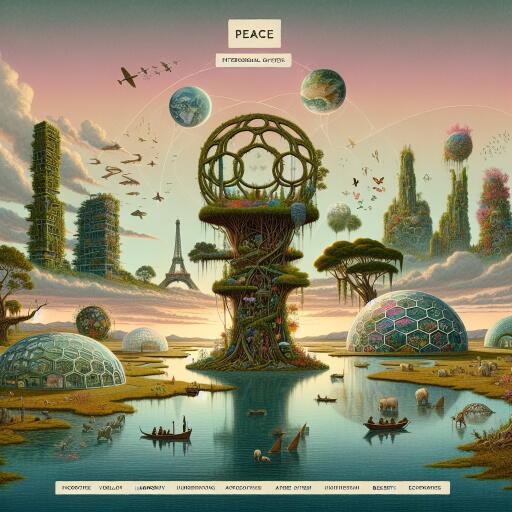
Peace as the Architecture of Living Systems
What if peace isn’t a truce, but a design principle? Across biology, agriculture, cities, and even technology, systems endure not by purging what doesn’t fit, but by choreographing tensions so that differences can coexist. Our crises—from antibiotic resistance to climate instability—share a common root: we’ve mistaken domination for intelligence. It’s time to rebuild around a different blueprint: peace as the operating system of living complexity.
The hidden algorithm of domination
Modern institutions inherited a simple rule: when confronted with a problem, remove the obstacle. Early mechanistic science treated bodies as machines and nature as raw material to be subdued. Industry perfected this stance with the assembly line: standardize, isolate, eliminate error. The rhetoric of war—eradicate, suppress, conquer—leaked into medicine, agriculture, geopolitics, and even our problem-solving language.
The approach delivered fast wins: cleaner surgical theaters, higher crop yields, spectacular industrial output. But the bill came due. Resistance, dependency, and brittleness spread wherever the goal was purity over balance. Systems optimized for victory faltered at longevity. The logic that excels at defeating enemies turns out to be poor at sustaining life.
Ecologies that thrive by design
Human societies have also shown another way. Cosmopolitan centers across history—think of ancient cities that welcomed multiple languages, rituals, and trades—prospered by weaving difference into shared patterns. In these places, no single lineage, doctrine, or market held total power. Their strength resembled a coral reef: many forms, layered functions, and checks against dominance.
Flourishing emerged from interdependence rather than unanimity. The result wasn’t moral harmony so much as structural stability: a political and cultural microbiome where competing currents balanced one another, preventing decay through sameness.
Monocultures and the illusion of control
The twentieth century scaled the domination playbook to global size. Agriculture simplified diverse fields into monocultures; yields jumped, resilience fell. Each season demanded new chemicals to counter pests and weeds that adapted to uniform landscapes. The soil’s microbial communities—engines of fertility—were stripped and weakened.
Medicine marched in parallel. Broad-spectrum antibiotics saved lives yet cast the body as a battlefield. We learned to scorch rather than guide. Meanwhile, international systems chased supremacy, discovering that control does not equal stability.
Traditional polycultures offer a different logic. In milpa-style fields where maize, beans, squash, herbs, and chiles cohabit, diversity is infrastructure. Pests exist but seldom dominate because the field itself is a network of mutual defenses. Productivity arises from designed coexistence, not purity.
The gut, a federation of species
Nowhere is the failure of the war mindset clearer than in the gut. Our microbiota—tens of trillions of organisms—moderates immunity, metabolism, and even mood through negotiated balance. Health is not the absence of microbes; it is the quality of relationships among them.
When broad-spectrum drugs or ultra-processed diets flatten this ecology, resilience collapses: dysbiosis, chronic inflammation, metabolic dysfunction, and drug-resistant pathogens proliferate. The pattern mirrors pesticide cycles in degraded soils. Eradication creates profitable dependencies—on new chemicals, new treatments—while diminishing the system’s inherent capacity to self-stabilize.
The lesson is simple and radical: abundance emerges from coexistence. A robust microbiome limits dominance, sustains diversity, and manages competition by modulation, not annihilation.
Tools that tune rather than trounce
Technology can help pivot from conquest to coordination. Instead of designing weapons against life, we can build instruments that tune living systems toward resilience. Machine-learning models already simulate population dynamics; applied to the microbiome, they can help sequence ecological inputs—fibers, polyphenols, and plant secondary metabolites—to shift microbial communities toward healthier configurations.
The intervention becomes a choreography of signals: diets tailored not to target a single foe, but to restore missing feedback loops; therapeutics that seed and feed consortia rather than wipe slates clean. In this paradigm, the clinician acts less like a general and more like a conductor—arranging conditions for self-organization to reappear.
Economically, value would tilt from patented sledgehammers to precision orchestration—recipes of data-informed inputs that respect biological complexity and evolve with it.
Peace as a technical specification
Reframed structurally, peace becomes a design requirement for any complex system:
- Energy: Overreliance on a single fuel created an “energy monoculture” that magnified risk. Resilience requires a mixed portfolio and flexible grids that distribute power and failure alike.
- Supply chains: Hyper-optimized, single-route logistics were efficient until they weren’t. Redundancy and local diversity are not waste; they are shock absorbers.
- Information ecosystems: When one narrative or one algorithmic style dominates, cognition narrows. Plural models and open interpretability diversify the ways we know.
- Public health: Viruses are not mere enemies; they are participants in broader ecologies. Durable strategies restore ecological balance alongside targeted interventions.
Across domains, the same principle holds: systems collapse when dominance goes unchecked. Peace is not the absence of tension; it is tension organized so that no single force can erase the rest.
From conquest to coordination
The pattern repeats from farms to cities, from guts to grids: diversity sustained, dominance limited, relations designed. Modernity’s fixation on control brought astounding breakthroughs—and cascading fragilities. The task now is not to abandon intervention, but to place it inside a larger mandate: cultivate conditions under which life can do what it does best—self-organize, adapt, and persist.
Peace, understood this way, is the architecture of living systems. Where it weakens, life retreats into dependency and brittleness. Where it strengthens, life multiplies forms, functions, and futures. The choice before us is stark but workable: keep escalating force against the symptoms of imbalance, or learn to design with the grain of life—modulating instead of eradicating, balancing instead of purifying, coordinating instead of conquering.
If we align medicine, agriculture, technology, and governance with the grammar of coexistence, we won’t eliminate conflict—we will render it creative. That is the quiet, rigorous promise of structural peace: not silence, but symphony.



Leave a Reply