

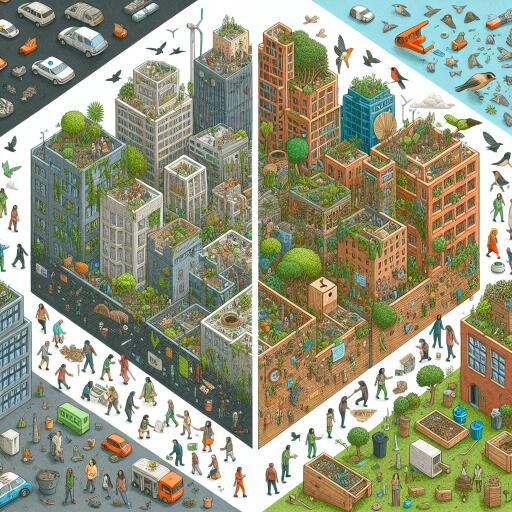
Enhancing Biodiversity: Participatory Urban Interventions Revealed
Across the world’s fast-growing cities, a new generation of urban design is emerging—one that treats streets, rooftops, and vacant lots as living infrastructure. A participatory, AI-guided approach is helping planners and communities co-create interventions that lift biodiversity, buffer climate risks, and improve daily life. The premise is simple: combine local knowledge with data-driven insight to transform overlooked spaces into resilient habitats.
Co-creating the city with nature
Traditional consultation often invites public input late, after key decisions are made. The new approach flips that script. Residents, neighborhood groups, ecologists, and city officials are engaged from the outset to map priorities and define what “success” means—more pollinators, cooler streets, safer play spaces, better stormwater management, or all of the above.
Community insights prove especially valuable in choosing native species, identifying microclimates, and spotting where habitat corridors could stitch together isolated green patches. This early collaboration fosters stewardship, reduces maintenance surprises, and ensures designs reflect cultural and social realities, not just environmental targets.
Where AI makes the difference
Artificial intelligence does not replace human judgment—it scales it. By parsing complex, local datasets, AI tools help teams see patterns that might otherwise stay hidden. Common capabilities include:
- Mapping species suitability by cross-referencing soil, shade, water availability, and existing biodiversity baselines.
- Simulating heat and wind patterns to place shade trees, trellises, or water features for maximum cooling.
- Forecasting stormwater flows under different rainfall scenarios to prioritize permeable surfaces, rain gardens, and bioswales.
- Evaluating design trade-offs—such as maintenance needs versus habitat value—through scenario comparison dashboards.
- Optimizing plant palettes to support pollinators across seasons, ensuring continuous food and shelter.
The result is a transparent planning process where stakeholders can test ideas virtually, compare outcomes, and refine proposals before breaking ground.
What success looks like
Case-based applications show the approach works in diverse urban fabrics:
- A vacant lot becomes a community habitat garden with layered planting—groundcover for soil life, shrubs for nesting, climbers for vertical habitat, and seasonal blooms for pollinators. Residents co-manage composting and seed swaps, and AI-guided species selection boosts survival in the local microclimate.
- Street edges are “rewilded” with curbside bioswales and pocket meadows that capture runoff and cool the block. Traffic-calming planters double as nectar stations, and data loggers track temperature and infiltration improvements over time.
- Rooftops host modular meadows and food forests chosen for drought tolerance and pollinator value. Sensors trigger smart irrigation only when needed, cutting water use while sustaining habitat.
Beyond ecological gains, residents report greater social cohesion and a sense of shared ownership—key ingredients for long-term care.
Resilience built into the blueprint
As extreme heat and intense storms become more frequent, multifunctional green spaces carry heavier workloads. The participatory-AI method emphasizes nature-based solutions that do double or triple duty:
- Stormwater sponges: rain gardens, tree trenches, and permeable paths reduce flood risk and filter pollutants.
- Urban cooling: shade trees, reflective groundcovers, and water features lower heat exposure for vulnerable groups.
- Habitat networks: connected patches and pollinator corridors help wildlife move, feed, and breed within dense neighborhoods.
Crucially, these designs scale. Small pilots on a single block can expand into district-wide networks, guided by real-world performance data.
Closing the engagement gap
Surveys often reveal strong public support for biodiversity—but also uncertainty about how to help. The solution is practical, everyday engagement: plant lists tailored to local conditions; seasonal action calendars; school projects that monitor butterflies, bees, and soil health; and neighborhood stewardship teams that share tools and responsibilities.
When residents see their choices reflected in the design, they’re more likely to water seedlings through heat waves, protect new plantings, and report issues before they escalate. Education becomes part of the infrastructure.
From policy to practice
Policy and procurement can accelerate adoption by making experimentation easy and maintenance predictable. Helpful measures include:
- Micro-grants for community-led pilots and rapid prototyping.
- Regulatory “sandboxes” that allow temporary, testable installations in the public realm.
- Maintenance budgets and training built into project approvals, not treated as afterthoughts.
- Shared metrics—such as canopy cover, pollinator counts, surface temperature, and infiltration rates—to evaluate success.
With clear standards and community oversight, nature-positive design becomes a norm rather than a novelty.
What’s next
The next leap will tie richer datasets to daily management: integrating satellite and street-level imagery, open biodiversity records, sensor feeds, and maintenance logs within easy-to-use planning tools. As projects evolve, AI can learn from outcomes—what survived drought, what drew pollinators, what demanded too much upkeep—and refine recommendations for the next block or the next city.
Equally important is keeping the human loop open. Iterative feedback—from residents, field crews, teachers, and business owners—ensures interventions remain responsive to shifting climates and community needs.
The bottom line
Urban nature isn’t a luxury; it’s life support. By uniting local knowledge with data-savvy design, cities can build landscapes that welcome wildlife, protect people from climate extremes, and create places that feel good to inhabit. Participatory, AI-guided interventions offer a practical roadmap: start small, measure honestly, learn together, and scale what works. The payoff is a city that functions as an ecosystem—resilient, biodiverse, and thriving.


Leave a Reply