

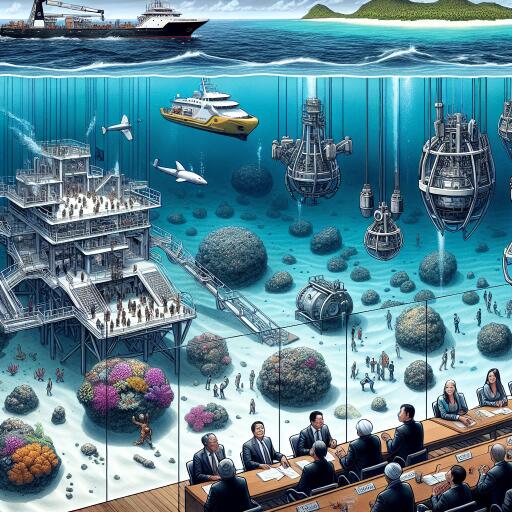
Deep-sea mining proposal around Guam concerns leaders
Federal regulators are weighing whether to open more than 35 million acres of federal waters around the Northern Mariana Islands to potential deep-sea mineral exploration, a move that has set off alarm among island leaders and environmental advocates in Micronesia. The Bureau of Ocean Energy Management (BOEM) describes the effort as an early information-gathering step with no mining leases on the table yet. Still, the prospect alone is reverberating across the region, where ocean health underpins culture, food security, and local economies.
Early stage, big implications
The agency’s request for information targets waters around the Commonwealth of the Northern Mariana Islands (CNMI), not Guam. But draft maps under consideration appear to extend proposed areas up to the edges of Guam’s adjacent waters. That proximity is a flashpoint for Guam’s leaders, who stress that ocean currents, migratory species, and shared cultural ties knit Guam and the CNMI into one ecological and social fabric.
Guam officials caution that even preliminary steps toward seabed extraction demand careful scrutiny. They argue that what happens in CNMI waters could readily affect Guam’s reefs, fisheries, and tourism, and vice versa. As one senior Guam official noted, the islands’ cultural and environmental connections mean any industrial activity must be evaluated beyond political boundaries.
What’s at stake beneath the waves
The deep sea is a realm of slow-growing corals and sponges, bioluminescent life, and species found nowhere else on Earth. Interest in mining arises from deposits such as polymetallic nodules and crusts that contain cobalt, nickel, manganese, and rare earth elements—materials central to batteries and renewable energy technologies. But extracting them could stir sediment plumes, generate continuous low-frequency noise, and release metal-laden particles that travel far beyond the mining site.
Scientists warn that these disturbances could smother filter feeders, disrupt feeding and breeding cues for marine mammals, and degrade critical habitat for tuna and other migratory fish. Many deep-sea communities recover on timescales of centuries, if at all. Because so little baseline data exist for the region’s seafloor habitats, impacts are hard to predict and even harder to reverse. That uncertainty intensifies calls for robust environmental assessments before any green light is given.
Transboundary concerns for Guam and the CNMI
Even if exploratory activity remains just north of Guam, the ocean does not respect jurisdictional lines. Seasonal currents, storms, and eddies can move sediment and sound through the water column, potentially influencing coral reef resilience, subsistence fishing grounds, and nearshore water quality. Guam leaders want assurance that modeling of sediment plumes, underwater noise, and cumulative impacts will be shared publicly and that both territories will be meaningfully consulted.
The social dimension is just as significant. For Chamoru and other Indigenous communities, the ocean is not simply a resource—it is ancestral heritage, a highway of history, and a provider of identity and sustenance. Any industrial footprint on or under the seafloor raises questions about cultural rights, access, and stewardship responsibilities.
The regulatory path ahead
BOEM’s information-gathering phase is typically followed by scoping and environmental reviews under federal law, including comprehensive environmental impact statements if leasing proceeds. That process would require opportunities for public input, scientific evaluation of alternatives, and consultation with territorial governments and Indigenous communities. Guam officials are pressing for a transboundary analysis that explicitly measures risks to Guam’s waters and shores, not solely the footprint within CNMI federal waters.
Key safeguards advocates are calling for include:
- Comprehensive baseline surveys of deep-sea ecosystems before any disturbance
- Independent modeling of sediment plumes and underwater noise with conservative assumptions
- Protections for migratory corridors used by whales, turtles, and pelagic fish
- Binding standards on waste discharge, operational noise, and light pollution
- Clear, enforceable plans for monitoring and adaptive management, including the option to halt operations if harms emerge
A crossroads for the Pacific
The proposal highlights a larger tension felt across the Pacific: the global race for minerals to power clean energy versus the obligation to safeguard ocean ecosystems that millions rely on. Guam and the CNMI sit at the heart of this debate. Leaders are not rejecting clean energy goals; they are urging precaution and genuine partnership, insisting that decisions be informed by rigorous science, transparent governance, and respect for Indigenous knowledge.
As the federal process unfolds, the question is not only whether deep-sea mining should proceed, but how ocean stewardship is defined for a region whose identity and future are inseparable from the sea. For Guam’s decision-makers and community advocates, the message is clear: what happens just beyond the boundary line will still be felt at home.



Leave a Reply