

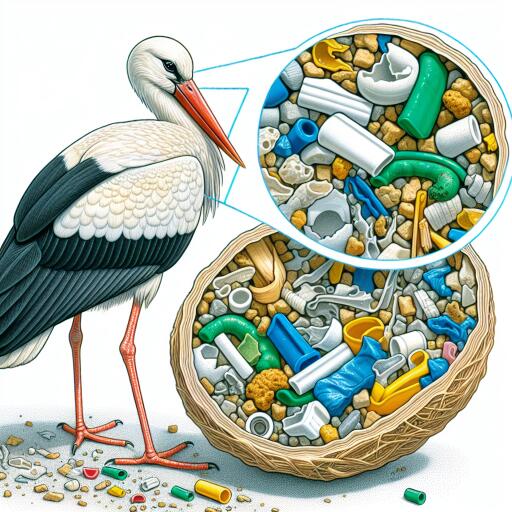
Plastic Ingestion in White Storks: Pellet Analysis
White storks (Ciconia ciconia) have long symbolized renewal, yet their foraging now increasingly intersects with a landscape saturated by plastic. One of the clearest indicators of this shift is found in the regurgitated pellets these birds leave behind. By examining pellets—compact bundles of indigestible material—ecologists can non-invasively trace what storks are consuming and, by extension, how modern waste is altering their diet and health.
Pellets as a window into plastic exposure
Pellet analysis offers a direct, minimally disruptive method to quantify how much plastic storks encounter and ingest. These birds often forage in agricultural fields, wetlands, and near waste sites, where food scraps and plastic debris occur side by side. When storks accidentally swallow fragments—films, fibers, and small rigid pieces—those items can reappear in pellets, providing a ledger of exposure across time and space.
What researchers look for
Collected pellets are typically dried, separated, and examined under magnification. Suspected plastic is sorted by form (e.g., fragments, fibers, foams), color, and size, with microplastics—particles smaller than five millimeters—receiving special attention. While basic visual sorting reveals much, complementary techniques such as microscopy and polymer fingerprinting can confirm whether a particle is plastic and, in some cases, which type (e.g., polyethylene films from packaging or polyester fibers from textiles).
Key signals emerging from pellet studies
- Microplastics are widespread: Tiny fragments and fibers frequently appear in pellets, indicating diffuse contamination well beyond coastlines and marine systems.
- Risk pathways are diverse: Plastics enter storks’ diets when debris clings to food, mimics prey, or is inadvertently scooped up at landfills and feeding grounds.
- Health effects are multifaceted: Ingested plastics can contribute to gut blockages, reduce nutrient uptake, and cause inflammation. Even small, chronic doses may undermine body condition and reproductive success.
- Sentinel value: Because storks use both natural and human-dominated habitats, their pellets act as an early-warning system for terrestrial plastic pollution and its spread through food webs.
Why this matters beyond one species
White storks bridge ecosystems: they feed in fields and wetlands, nest near people, and migrate across continents. Elevated plastic loads in their pellets hint at wider ecological stress. If a large, adaptable bird regularly ingests microplastics, smaller or more specialized species could be at even greater risk. Moreover, the presence of fibers and fragments in pellets points to airborne and soil-borne pathways, emphasizing that plastic is now a pervasive feature of terrestrial environments, not merely a marine issue.
Landfills, fields, and feedback loops
Open or poorly managed waste sites attract opportunistic foragers. Storks associating plastic-littered areas with food can inadvertently increase their exposure and transport debris into nesting areas. Over time, this can normalize plastic presence in breeding habitats, where threads and strips may be woven into nests, adding entanglement risk for chicks and adults alike.
Technology reshaping the response
- Smarter sorting: AI-enabled optical systems in recycling facilities can better identify films and flexible packaging—the items commonly found in pellets—reducing leakage into the environment.
- Polymer detection in the field: Portable spectroscopy helps confirm plastic types during pellet surveys, accelerating data collection and improving accuracy.
- Wildlife tracking: GPS tags and accelerometers reveal when and where storks interact with waste sites, informing targeted mitigation (e.g., fencing, rapid cover practices, and habitat buffers).
- Remote sensing: High-resolution imagery can flag illegal dumping and monitor landfill cover compliance, aligning environmental oversight with wildlife protection.
Policy and practice that make a difference
- Waste-site controls: Regular covering of waste, netting, and deterrents reduce bird access to hazardous materials.
- Source reduction: Phasing out problematic single-use plastics and enforcing extended producer responsibility lowers the volume of lightweight, mobile debris.
- Design for recovery: Standardized materials and clearer labeling improve recycling efficiency and decrease environmental leakage.
- Agricultural interfaces: Better management of plastic mulches, bale wraps, and twines minimizes escape into fields where storks forage.
Community and citizen science
Local monitoring can amplify impact. Structured pellet surveys around roosts and feeding sites—paired with simple classification guides—generate valuable datasets while raising awareness. Cleanups near wetlands, canals, and field margins intercept plastics before wildlife encounters them. Schools and nature groups can contribute observations, turning recurring stork stopovers into living laboratories for environmental stewardship.
What to watch next
- Standardized pellet protocols to compare sites, seasons, and age classes.
- Linking ingestion data to health metrics such as body condition, stress markers, and breeding success.
- Mapping exposure hotspots and testing interventions (e.g., landfill access controls) for measurable reductions in plastic loads.
- Evaluating alternatives: which materials truly degrade without leaving microplastics, and which simply shift the problem?
A clear message from a humble sample
Pellets are small, but their story is large: plastics have become embedded in terrestrial food webs. For a bird that thrives where people and nature meet, that reality is especially stark. Cutting plastic at the source, tightening waste management, and leveraging technology for rapid detection and response can curb exposure for storks and countless other species. Each action—designing better products, securing waste, cleaning local waterways—reduces the odds that the next pellet will tell the same troubling tale.



Leave a Reply