

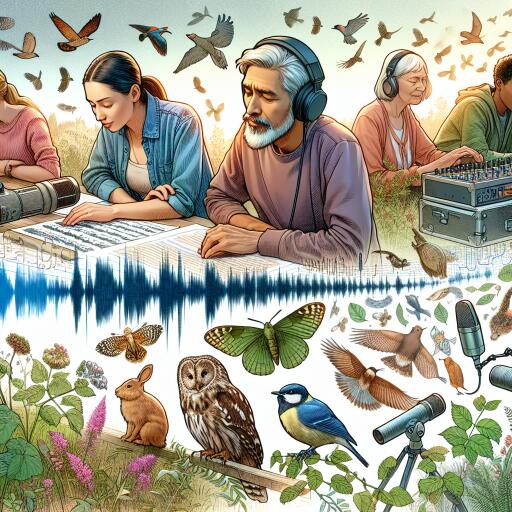
Ecoacoustic Workshop
What does the planet sound like when we truly listen? Ecoacoustics treats sound as data, revealing how landscapes, waters, and wildlife communicate—and how human noise intrudes on that conversation. This hands-on workshop invites participants to explore the science of listening as a powerful tool for environmental monitoring and conservation.
Why sound is a window into ecosystems
Every habitat has an acoustic signature shaped by wind, water, insects, birds, amphibians, and mammals—alongside the hum of human activity. By recording and analyzing these layered soundscapes, researchers can detect species presence, track migration, monitor habitat health, and identify disturbances that might be invisible to the eye. Acoustic methods are particularly effective for elusive or nocturnal species and in areas where visual surveys are impractical.
Ecoacoustic analysis typically distinguishes between three overlapping sources: geophony (natural non-biological sounds like rain and rivers), biophony (animal calls and choruses), and anthropophony (human-made noise such as traffic or machinery). Shifts in their balance can signal stress, fragmentation, or recovery in an ecosystem.
What you’ll learn
- Field recording techniques: deploying handheld recorders, placing autonomous units for long-term monitoring, and using directional microphones to isolate calls.
- Multi-habitat listening: capturing sounds from forest canopies, ground level, aquatic edges, and underwater with hydrophones.
- Soundscape visualization: generating spectrograms to identify patterns, frequency ranges, and temporal rhythms like dawn and dusk choruses.
- Species detection and monitoring: recognizing call signatures, aggregating recordings into biodiversity indices, and noting seasonal changes.
- Noise impact assessment: documenting how human-generated sound masks communication, alters behavior, or fragments acoustic habitats.
Field session at Ellergronn nature reserve
The excursion explores the Ellergronn nature reserve in Esch-sur-Alzette, a mosaic of woodland, open habitat, and water features ideal for soundscape observation. Participants will practice:
- Selecting quiet and noisy transects to compare acoustic conditions.
- Positioning microphones to minimize wind and vibration while maximizing target signals.
- Recording underwater with a hydrophone to reveal fish, invertebrates, and subtle hydrological dynamics.
- Logging metadata: time, weather, habitat type, and observed species to contextualize audio files.
From raw audio to ecological insight
Back from the field, the workshop moves into rapid analysis. You’ll learn to clean recordings, annotate clips, and interpret visualizations. We’ll discuss how large datasets—hours to months of continuous listening—feed into indices such as acoustic complexity and even support automated detection. The session highlights practical workflows for community science and professional monitoring, plus strategies for comparing sites over time.
Human noise and wildlife
Anthropogenic noise can mask mating calls, disrupt foraging, and suppress the intricate timing of choruses. In birds, for example, persistent low-frequency noise from roads can push species to shift pitch or timing, while nighttime noise may interfere with bat navigation. Even subtle increases in background sound can reduce communication range, elevating stress and energy costs. By quantifying noise footprints alongside biophony, ecoacoustic methods help chart effective buffers, quiet corridors, and restoration priorities.
Ethics, access, and good practice
- Minimize disturbance: keep low profiles, remain on paths, and avoid playback unless scientifically justified.
- Data stewardship: label recordings clearly, respect privacy where human voices might be captured, and follow site guidelines.
- Inclusivity and safety: choose stable footing, manage cables carefully, and adapt techniques for varying mobility needs.
Who should attend
Naturalists, educators, park managers, students, and anyone curious about the intersection of ecology and technology. No prior experience is required—just a willingness to listen closely and engage with simple tools that can scale into robust monitoring programs.
What to bring
- Sturdy footwear and weather-appropriate clothing.
- Notebook or mobile device for field notes.
- Optional: headphones and a smartphone or recorder if you have one; some equipment will be demonstrated on site.
Meeting point
Location: Parking at Ellergronn nature reserve, Esch-sur-Alzette (LU)
Join this session to train your ears, sharpen your methods, and uncover the hidden dynamics of living systems through sound.



Leave a Reply