

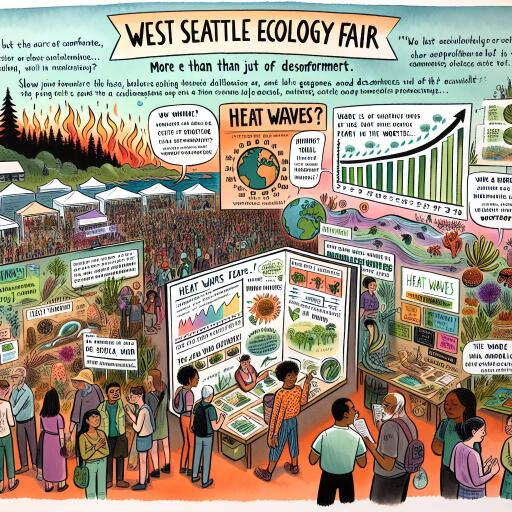
West Seattle Ecology Fair 2025, report #2: Heat waves aren’t just a source of discomfort
At this year’s West Seattle Ecology Fair, the focus pivoted from resource-sharing to the hard realities of climate science. The keynote underscored a simple truth: hotter weather is no longer just a nuisance—it’s a growing public health emergency.
Heat: from discomfort to danger
Organizer Vince Stricherz introduced climatologist Dr. Nick Bond, who has been zeroing in on heat waves and their impacts. His message was direct: prepare for more extreme heat, and keep asking who is most exposed and least protected.
The historic 2021 heat wave served as a warning shot. Records were shattered across the region, and it wasn’t just the daytime highs. Elevated humidity—especially in irrigated zones like the Yakima Valley—pushed the body’s ability to cool itself past safe limits, a severe risk for outdoor workers. A parched spring and record-dry conditions intensified the heat’s punch. While long-term precipitation patterns are complex, recent decades show a notable decline in spring moisture here, raising concerns that this may be more than a blip.
Health impacts are piling up
The human toll from that event was stark: Washington saw an estimated hundreds of excess deaths, British Columbia even more, and emergency departments across the Pacific Northwest were overwhelmed—visits surged to dozens of times the usual levels. Hospitals resorted to extreme measures to drop core temperatures fast.
Nationwide, heat waves are becoming longer, more frequent, and more intense. Nights are warming fastest in our region, with more evenings stuck in the 60s and above—temperatures that deny bodies a chance to recover. When both days and nights heat up, risks snowball: not only heat exhaustion and heat stroke, but also spikes in traumatic injuries, kidney stress, and complications in pregnancy. Farmworkers are especially vulnerable where tasks extend beyond air-conditioned cabs and into open fields.
Oceans without their cool
On the water, a decade-scale shift has delivered persistent marine heat waves—nicknamed “blobs”—with widespread ecological and economic consequences. In 2015, mountain slopes that should have been holding peak snowpack were barren by March. That translated to weak summer streamflows, thermal stress for salmon, and mass die-offs. Warmer seas also fueled long-lasting harmful algal blooms, shuttering shellfish harvests and rippling through coastal communities.
Fire, smoke, and the air we breathe
Western fire seasons have changed character: ignition numbers aren’t necessarily soaring, but the acreage burned and the intensity of fires are. With it comes smoke—days to weeks of unhealthy air—now a recurring feature of late summers. The September 2020 smoke episode was a case in point. Projections indicate higher wildfire emissions across much of the West and beyond, with associated air pollution potentially contributing to thousands of additional deaths per year by mid-century if trends continue.
What the future may bring
Climate models signal continued warming through late summer months. In the near term, declining cold exposure may reduce some winter-related health risks, but those gains are outweighed by rising heat-related illness and mortality. Warmer conditions also favor food-borne pathogens, and Valley Fever—a fungal disease once mostly confined to the Southwest—could advance far northward by century’s end, carried on the wind and enabled by shifting climates.
Other threats remain understudied but worrisome: degraded water quality in small or under-resourced systems; mental health impacts amplified by heat, smoke, and climate anxiety; and infrastructure strained by extremes it was never designed to handle.
Action and agency
Despite the sobering science, the keynote emphasized momentum: state resilience strategies are taking shape; regional partnerships are restoring habitats; community leaders are advancing environmental justice; and faith communities are embracing stewardship as a moral imperative. There is capacity—and responsibility—to invest in health protections and climate readiness. The host community framed the fair within a season of reflection and action that runs through early October.
Community questions, practical realities
- Funding and governance: Recent funding cuts have slowed some climate-impact projects. Meanwhile, water challenges are colliding with outdated systems—21st-century risks managed by 20th-century infrastructure and 19th-century laws. In several regions, groundwater withdrawals aren’t sustainable.
- Migration: Climate-driven relocation is a growing concern, though it spans disciplines beyond climatology; specialists are working to map likely trends and needs.
- Urban trees and equity: Local advocates highlighted tools that quantify tree canopy loss and guide equitable replanting. Mature trees removed for development take generations to replace, making protection and targeted planting critical for cooling neighborhoods and improving air quality.
- AI’s double edge: Artificial intelligence consumes significant energy, yet it’s already improving forecasting and decision support, from fire behavior to heat-health alerts. The challenge is deploying it where benefits outweigh its footprint.
The day’s takeaway was clear: extreme heat is reshaping health, ecosystems, and economies. But the path forward is also clearer than ever—protect those at highest risk, invest in cooling and clean air, modernize water management, safeguard forests and coasts, and build systems that can withstand the next test. The sooner we act, the more control we keep over the climate future our region will inherit.



Leave a Reply