

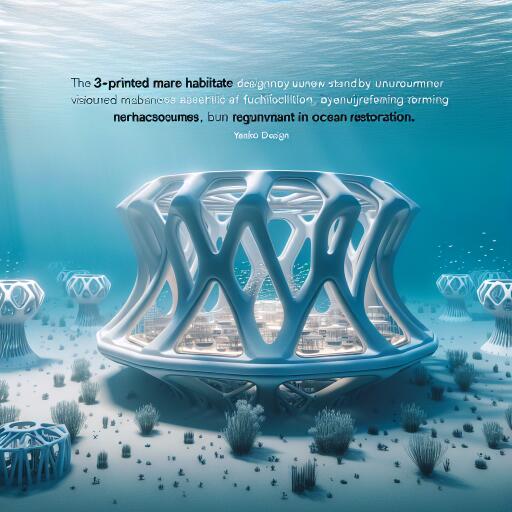
‘Zaha Hadid Architects’ 3D-Printed marine habitat is new standard for ocean restoration – Yanko Design
In the waters off Hong Kong’s North Lantau Marine Park, a new kind of architecture is taking root—one that’s designed not for skylines, but for sea life. Zaha Hadid Architects has developed Nereid, a digitally fabricated marine habitat that uses large-scale 3D printing to recreate the complexity of natural reefs, with the goal of boosting biodiversity and supporting endangered species like the Chinese White (pink) Dolphin.
Architectural intelligence meets marine ecology
Unlike traditional artificial reefs, Nereid is engineered with precision. Advanced additive manufacturing enables the creation of internal voids, overhangs, and textured surfaces that imitate the intricacies of coral assemblages. These features offer refuge, feeding niches, and breeding pockets for fish, crustaceans, and invertebrates—key steps in rebuilding a functioning food web.
The structure is also designed with a pragmatic defense in mind: it can act as a physical deterrent to bottom-trawling, a destructive fishing method that scrapes the seabed and strips ecosystems of life. By occupying critical zones with robust, complex forms, Nereid helps create safe havens where marine communities can re-establish.
Material chemistry tuned for life
At the core of Nereid’s approach is a marine-grade, pH-neutral material formulated to be hospitable to early colonizers. Its surface roughness and microtopography are optimized to encourage biofilm formation and the settlement of algae and filter-feeding organisms such as barnacles, mussels, and oysters. As these foundational species take hold, they provide food and habitat for higher trophic levels, improving water quality and stabilizing local ecosystems.
This bottom-up strategy—starting with phytoplankton, biofilms, and filter feeders—aims to catalyze a cascade of ecological benefits, from increased invertebrate diversity to healthier fish populations, ultimately supporting predators and large mammals that depend on them.
Calibrated by data, shaped by currents
Nereid’s form is the product of computational modeling and close collaboration with marine scientists. The design accounts for local hydrodynamics, sedimentation patterns, and species-specific behaviors. Its apertures and contours are arranged to modulate flow, enhancing nutrient exchange while creating calm zones where larvae can settle and grow. The result is a habitat that doesn’t just sit on the seabed—it interacts with it.
A prototype has been publicly previewed and is slated for installation within the conservation zone at North Lantau Marine Park. Once deployed, it will be monitored to assess colonization rates, species diversity, and water-quality impacts, informing iterative improvements and potential scaling across the region.
A lifeline for Hong Kong’s pink dolphins
Hong Kong’s iconic pink dolphins have suffered from habitat fragmentation and declining prey availability. By rebuilding the base of the marine food web and improving water clarity through natural filtration, Nereid is designed to indirectly support these mammals by making their hunting grounds more productive. Restoring habitat complexity translates into more nurseries for fish and invertebrates—an essential step for long-term recovery.
Design as an ecological tool
Nereid signals a broader shift in what architecture can do. Instead of simply minimizing harm, this project is explicitly restorative. The same parametric thinking and expressive geometry seen in contemporary buildings are redirected underwater to solve environmental challenges. It’s a potent example of how computational design, when paired with ecological insight, can produce habitats that are both performative and deployable at scale.
What sets Nereid apart
- 3D-printed complexity: Internal cavities, branching channels, and textured skins that mimic natural reef heterogeneity.
- Ecology-first materials: Marine-grade, pH-neutral composition tailored to promote early colonizers and long-term stability.
- Anti-trawling function: Forms that help shield sensitive seabeds from destructive fishing gear.
- Site-responsive design: Geometry tuned to local currents and sediment, improving settlement and nutrient exchange.
- Modular scalability: Components that can be replicated, customized, and deployed across varied marine contexts.
From prototype to blueprint
As climate change warms seas and coastal development alters habitats, the need for resilient, nature-positive infrastructure becomes urgent. Nereid offers a replicable model: a habitat that can be engineered for specific locales, fabricated rapidly, and installed with minimal disruption. It is both a scientific instrument—testing how morphology influences biodiversity—and an operational tool for restoration.
If successful, the project could demonstrate a path forward for marine parks and coastal cities worldwide: harness advanced manufacturing to rebuild complexity, seed food webs from the bottom up, and create underwater architecture that actively repairs the ecosystems we rely on.
Architecture has long sculpted the human environment. With Nereid, it’s learning to sculpt the ocean’s, one precisely printed reef at a time.



Leave a Reply