

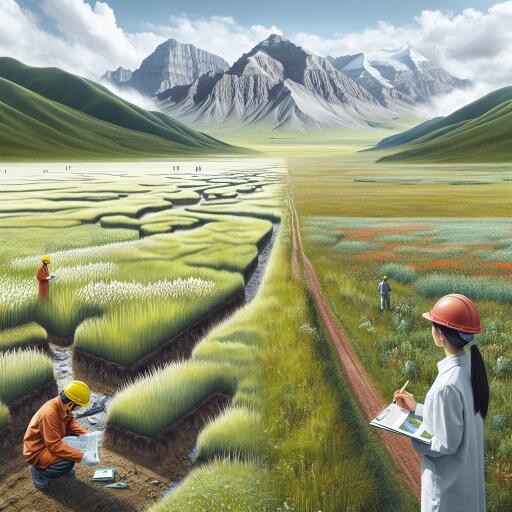
Feature: Decoding the green: China’s living lab for grassland restoration
On the windswept steppe of northern China, a once-remote research outpost has evolved into a high-tech living lab for grassland restoration. What began decades ago as a solitary field station now operates an integrated digital observatory: satellites overhead, drones in the mid-layer, lidar and multispectral sensors at low altitude, and a lattice of ground and subsurface instruments continuously measuring the pulse of the prairie.
A sensor-rich portrait of a shifting ecosystem
At the core of this effort is the Xilingol Grassland Ecosystem National Field Observation and Research Station, a long-running hub for monitoring temperate steppe dynamics. Working closely with the surrounding nature reserve, the station fuses streams of satellite imagery, UAV surveys, automated towers, in-soil probes, and infrared wildlife cameras into a single smart monitoring platform that provides real-time dashboards, trend analyses, and early-warning alerts for ecological risks.
The scale of observation is unprecedented for the region. Infrared cameras alone have logged more than 180,000 images, documenting at least 104 wild species—from elusive lynx and Pallas’s cats to red and roe deer—evidence that biodiversity remains resilient where management is sound. Meanwhile, lidar-equipped drones and on-the-ground surveys are safeguarding rare plants such as Picea mongolica through ultra-detailed, individual-tree 3D atlases used to guide conservation actions.
Data cadence is relentless: some variables update every second, others hourly, all streaming to the station and onward to a national data hub. The result is a living dataset spanning climate, soil, topography, land cover, vegetation traits, and socio-economic context—crucial for understanding how semi-arid grasslands function and fail, and how to prevent the latter.
Decades of evidence on grazing, resilience, and thresholds
The station’s long-term experiments shed rare light on what keeps grasslands healthy. Across 175 plant-diversity plots and wider landscape trials, one lesson is clear: overgrazing degrades, but optimized grazing can maintain or even enhance ecosystem function. Ungrazed sites have shown more than 160 plant species without signs of decline, while two decades of carefully managed grazing trials demonstrate that pressure and timing matter as much as total stocking numbers.
Critical thresholds have emerged. Vegetation cover above 60 percent sharply reduces soil erosion. Maintaining grass height above roughly 12 centimeters preserves winter snowpack and summer moisture, stabilizing productivity and supporting a richer web of species. Ignore these limits and cascading risks emerge—nutrient depletion, disrupted plant communities, and spikes in locust outbreaks.
Long-term carbon accounting is equally revealing. Different land uses and grazing regimes have shifted soil organic carbon stocks in measurable ways over the last 40 years. Interactions with mycorrhizal fungi—symbiotic partners of roots—appear to amplify both plant diversity and carbon storage. A nationwide field analysis of 6,098 plots reinforces the pattern: higher biodiversity correlates with greater productivity and deeper carbon sinks, strengthening the case that ecological integrity and climate benefits are mutually reinforcing.
Engineering with nature: from degradation control to productive pastures
Desertification pressure and climate variability have pushed the research team to develop nature-based solutions that reconcile ecological security with livelihoods. In demonstration zones across Xilingol, scientists have combined wind erosion control, rotational mowing with adaptive grazing, restoration of salinized grasslands, and precision mixed-sowing of forage species. Blending legumes with grasses, pairing deep-rooted with shallow-rooted plants, and matching drought-tolerant with moisture-loving species have yielded cultivated grasslands that produce five to ten times more biomass than adjacent natural pastures—while extending the productive lifespan of the land.
This portfolio approach—prevention, rehabilitation, and optimized use—has scaled beyond small pilots. Over the past twenty years, sustainable management models, biodiversity conservation practices, and rehabilitation techniques have been demonstrated across more than 53,300 hectares. Their impact radiates beyond the station’s borders: the program provides templates for managing semi-arid landscapes that face similar pressures worldwide.
The digital difference: why tech matters on the steppe
While grasslands are ancient systems, the restoration playbook unfolding here is unmistakably modern. By automating measurements and linking them across scales—from soil microbes to satellite pixels—the station can spot tipping points early, test interventions faster, and validate outcomes with statistical power. Lidar scans quantify canopy structure; multispectral sensors flag stress before it’s visible; ground arrays track energy and water fluxes that govern growth. Together, these tools turn complexity into decision-ready insights for herders, reserve managers, and policymakers.
Crucially, the tech is not an end in itself. It underwrites practical guidance: how to set stocking rates, when to rotate grazing or mowing, where to prioritize reseeding or erosion barriers, and which species mixes to deploy for long-term resilience. The result is a feedback loop where science refines practice, practice tests science, and data keep everyone honest.
From local steppe to global playbook
The semi-arid grasslands of northern China share DNA with steppes and rangelands across Eurasia, Africa, Australia, and the Americas. The methods refined here—threshold-based grazing, mixed-species cultivation, mycorrhiza-aware restoration, and sensor-enabled early warning—form a portable toolkit for regions wrestling with drought, land degradation, and carbon loss.
As climate extremes intensify, the lesson from Xilingol is straightforward: when ecosystems are treated as complex, measurable systems—and when management respects the thresholds that sustain them—grasslands can store more carbon, harbor more life, and support people more reliably. The steppe is not just recovering; it is teaching us how to manage the living infrastructure that will define our future on a warmer planet.



Leave a Reply