

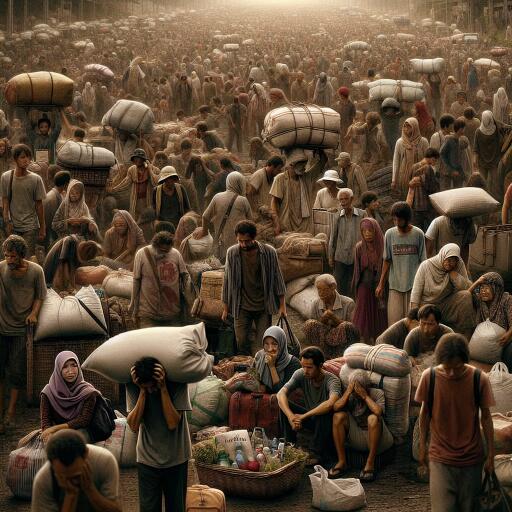
Worsening crisis forces millions of people to pack up and leave their homes: ‘It hurts’
As prolonged droughts tighten their grip on Malawi, families are leaving ancestral homes and fields in growing numbers. With rain patterns increasingly unreliable and temperatures rising, the country’s rural heartland is being reshaped by a relentless search for water. What was once a seasonal hardship has become a grinding new reality: people move, crops fail, and entire communities reorganize themselves around the last reliable sources of water.
On the move for water
In a nation where most households depend on rain-fed farming, the rains no longer come when they should—or in the amounts they once did. Many small-scale farmers describe the heartbreak of watching maize, cassava, and vegetables wither just days before harvest. One farmer, after losing consecutive crops, decided to uproot his family in early 2025—a second move in under a year and a half. He resettled farther north, where irrigation drawn from Lake Malawi now feeds small plots of sugarcane, bananas, and cabbage. The difference a steady water supply makes is stark: steady yields mean school fees paid on time, meals that last, and a sense of dignity returning. Yet the emotional cost of leaving home remains heavy. For those forced to move, the feeling is simple and raw: it hurts.
How a climate-fueled dry spell unravels rural life
Malawi’s food systems are highly exposed to climate shocks. Most farmers still rely on rainfall rather than mechanized or large-scale irrigation. As global temperatures rise, heatwaves and extended dry spells intensify, and El Niño cycles tend to magnify those swings. The result is a threadbare growing season: depleted soil moisture, unpredictable planting windows, and more frequent crop failures. Livestock, too, suffer as watering points shrink, while families sell off animals and tools to get by—eroding their capacity to recover when the next shock hits.
Water scarcity doesn’t just reduce harvests; it erases the social fabric that binds rural life together. Traditional labor exchanges collapse when everyone is struggling at once. Markets thin out, and children miss school to fetch water from ever more distant sources. In places where streams and boreholes have run dry, village population maps change month to month as people head toward wetter river basins, lakeshores, or already crowded towns.
Urban strain and new fault lines
The consequences ripple far beyond the farm. Towns and cities become pressure points, shouldering the arrivals: families seeking casual work, temporary shelter, and access to clinics. Local authorities face tough choices about housing, sanitation, and water distribution. Schools and health centers stretch limited budgets to cover swelling enrollments and patient loads. Without careful planning, these shifts can create new inequalities—between those who can afford to adapt and those who cannot; between host neighborhoods and new arrivals; and between regions blessed with water and those left behind.
A regional and global pattern
Malawi’s experience mirrors a wider trend. Across parts of Asia, the Pacific, Latin America, and the Caribbean, internal migration linked to extreme weather is accelerating. Households tied to agriculture are hit first and hardest, often moving in stages—from village to nearby trading center, then on to larger towns. While migration can be a vital coping strategy, unmanaged movement strains public services and deepens vulnerability among the poorest families.
What’s being done
Efforts to reduce climate risk are gathering pace. National programs are expanding climate-smart agriculture: investing in small-scale irrigation, promoting drought-tolerant seeds, restoring degraded soils, and improving weather information services for farmers. Research institutions and policymakers are working together to update land and water management strategies so communities can plan ahead rather than react to crises. Aid groups are building low-cost irrigation schemes and community water points, helping farmers stretch scarce supplies across longer dry spells. Regionally, governments have begun coordinating on climate-related displacement, seeking shared approaches that uphold dignity and protect livelihoods.
Keeping people rooted—when possible
Not everyone wants to leave home, and with the right support, many won’t have to. Proven practices can stabilize yields even in harsh seasons: mulching to retain soil moisture; intercropping and agroforestry to shade fields and enrich soils; water harvesting from roofs and runoff; and careful rotation to spread risk. Small pumps and gravity-fed systems help farmers bridge dry weeks. Where relocation is unavoidable, planning safe and voluntary movement—linked to housing, jobs, and services—can turn displacement from a desperate last resort into a managed choice.
How readers can help
- Support trusted organizations that fund water access, drought-resilient farming, and social protection for displaced families.
- Advocate for local water stewardship: protect watersheds, invest in storage and distribution, and enforce fair allocation during shortages.
- Adopt water-wise practices at home: efficient fixtures, leak repairs, rainwater harvesting, and climate-conscious landscaping.
- Back policies that cut greenhouse gas emissions and scale up renewable energy—addressing the root cause of intensifying extremes.
Each failed rainy season pushes more people onto the road, carrying what they can and leaving what they love. The pain of moving is real, but so is the power of foresight and investment. With smart water management, resilient agriculture, and humane migration policies, communities can protect their roots—and their future.



Leave a Reply