

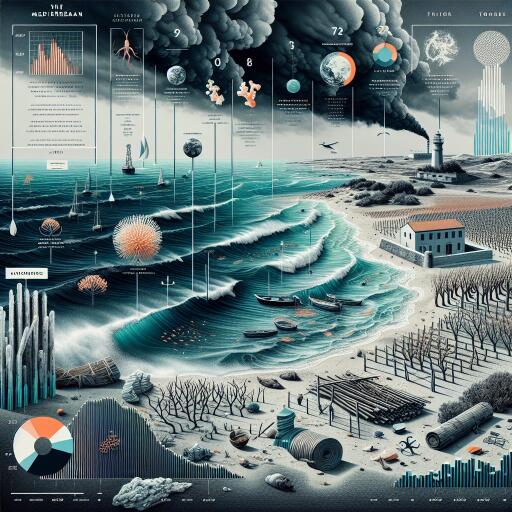
Climate Change Threatens Mediterranean Sea
The Mediterranean is heating faster than most of the global ocean, with surface waters recently reaching record highs and summer averages breaking historic thresholds. This rapid warming, paired with sea-level rise and ocean acidification, is putting marine life and coastlines under mounting pressure—effects that are increasingly visible today rather than distant projections.
A semi-enclosed hotspot warming at speed
Unlike the open ocean, the Mediterranean is a semi-enclosed basin connected to the Atlantic only through a narrow strait. This geography limits water exchange and accelerates change. Between 1982 and 2019, the sea’s surface temperature rose by about 1.3°C—more than double the global average increase over the same period. Recent summers have seen widespread marine heatwaves, with surface waters exceeding 28°C and basin-wide averages near 27°C reported in July 2025.
Because it concentrates multiple stressors—warming, acidification, pollution, overfishing, habitat loss—in a relatively small, well-observed region, the Mediterranean functions as an early-warning system for broader ocean changes. What unfolds here often foreshadows patterns likely to emerge elsewhere.
What future pathways imply
A synthesis of over a hundred scientific studies assessed risks to Mediterranean marine and coastal ecosystems under recognized climate pathways. Even if emissions stabilize in the near term under a medium policy effort, additional warming in the Mediterranean is expected to reach roughly 0.6°C by mid-century and around 1.3°C by 2100 relative to current levels. On a high-emissions trajectory, added warming could approach 2.7°C by 2050 and 3.8°C by century’s end.
These numbers matter. Every fraction of a degree alters physical and biological processes, shaping whether ecosystems degrade, reorganize, or persist. While stronger climate action can restrain the pace and scale of change, even moderate warming carries clear risks that will require adaptation.
Ecosystems under pressure
Warming and acidification are already reordering communities across the basin. Plankton assemblages are shifting, harmful algal blooms are becoming more frequent, and warmer-water species are expanding their ranges.
- Seagrass meadows: Iconic species such as Posidonia oceanica, foundational to biodiversity, carbon storage, and coastal protection, face steep declines with an additional ~0.8°C of warming and could disappear locally by 2100 if pressures persist.
- Macroalgae: Native canopy-forming seaweeds (e.g., Cystoseira) are projected to dwindle, while heat-tolerant and sometimes invasive algae may proliferate, reshaping habitats and food webs.
- Fisheries: Many fish populations are likely to contract by 30–40% under relatively modest additional warming. Stocks are expected to shift northward, opening ecological space for thermophilic newcomers, including invasive predators such as lionfish, with knock-on effects on biodiversity and fisheries livelihoods.
- Coral communities: Some coral assemblages appear comparatively more tolerant than other habitats, yet risks become moderate to high at around +3.1°C of additional warming—thresholds at which mass mortality events and habitat loss become more probable.
Coasts, turtles, and marine megafauna
Rising seas amplify coastal erosion and squeeze beaches, dunes, and low-lying wetlands. This has direct consequences for species that depend on intact shorelines. Nesting habitat for sea turtles could shrink sharply, with more than 60% of suitable sites at risk under strong sea-level rise. Even with roughly +0.8°C additional warming, hazards escalate: sandy shores and dunes are particularly exposed, and while rocky coasts are somewhat more resistant, they too face habitat loss and declining biodiversity.
Data for marine mammals and turtles remain sparse, but shifts in feeding grounds, migration timing, and energy budgets are likely as prey distributions change and thermal stress intensifies. Combined with bycatch, ship traffic, and noise, these climate-driven shifts complicate conservation efforts.
Signals from a “risk map” of the sea
A Mediterranean-wide synthesis has, for the first time, translated ecosystem responses into a visual risk framework similar to those used in global climate assessments. The picture is sobering: many habitats are already at elevated risk, with the severity climbing quickly along higher-warming pathways. Importantly, the analysis underscores that risk is not uniform—local conditions, cumulative stressors, and management quality can either buffer or exacerbate impacts.
Mind the knowledge gaps
Despite intense study, crucial blind spots remain. Projections for deep-sea habitats, salt marshes, several macroalgal groups, and large marine fauna are limited. Geographical coverage is uneven too, with the southern and eastern Mediterranean underrepresented—raising the possibility that risks in those regions are underestimated. Long-term observations capturing multiple stressors simultaneously (warming, acidification, pollution, invasive species, overfishing) are still rare, yet vital for realistic risk assessments.
What can still be done
Reduced emissions can lower the peak and pace of warming, curbing the most extreme outcomes. But mitigation alone will not spare the Mediterranean from profound change. Rapid, coordinated action is needed to:
- Safeguard and restore nature-based buffers such as seagrass meadows, wetlands, and dunes to stabilize coasts and store carbon.
- Strengthen protected areas and fisheries management to enhance ecological resilience and allow species to adapt and shift.
- Monitor hotspots and underrepresented regions with long-term, multi-stressor observing systems.
- Limit local pressures—pollution, habitat destruction, unsustainable extraction—that interact with climate stress to push ecosystems past tipping points.
The Mediterranean’s trajectory is not fixed. The difference between moderate and extreme warming will be measured in living shorelines, functioning food webs, and communities that can continue to draw sustenance, protection, and identity from the sea. Every tenth of a degree, and every year of decisive action, still counts.



Leave a Reply