

Plastic risk maps reveal dangerous hotspots for ocean animals – Earth.com
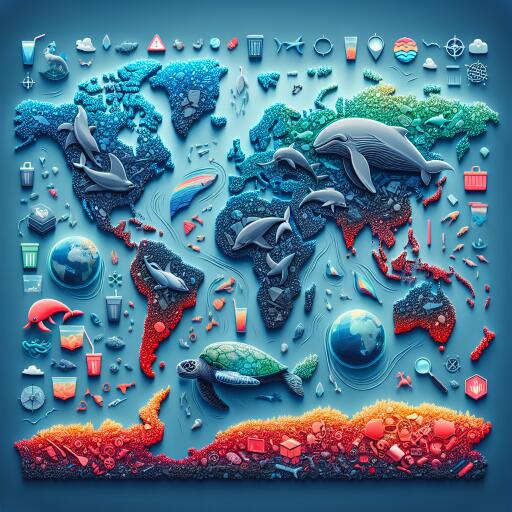
Open water can look deceptively clean, yet the danger from plastic is anything but uniform. A new global analysis shows that the highest ecological risks don’t always coincide with the most visible debris. Instead, peril intensifies where drifting plastics intersect with dense marine life and toxic chemicals, creating stealthy hotspots for harm.
A map built around biology, not just litter
Rather than tallying bottles at the surface, researchers constructed a global risk map that blends models of plastic movement with maps of animal biomass—the total mass of living organisms in a given area. This approach homes in on where contact between wildlife and plastic is most likely and most consequential.
The assessment traces four main pathways through which plastics imperil marine life:
- Ingestion of plastic particles and fragments
- Entanglement in fishing lines, nets, and other debris
- Transport of pollutants that adhere to plastic surfaces
- Leaching of chemicals from plastics into surrounding waters and organisms
Risks were evaluated across ocean layers and animal sizes, emphasizing how exposure differs between epipelagic species that occupy the sunlit surface zone (roughly the top 650 feet) and mesopelagic species that live deeper (about 650 to 3,300 feet). Plastic concentrations and animal densities rarely align in simple patterns, making this layered view essential.
Scale matters. A widely cited estimate suggests that 19 to 23 million metric tons of plastic waste entered aquatic ecosystems in 2016 alone. Without sharply reducing inputs, risk will continue to spread and intensify.
Where the threat peaks
The highest-risk belts emerge in the mid-latitude North Pacific and North Atlantic, parts of the northern Indian Ocean, and along the densely populated coasts of East Asia. These zones are home to abundant wildlife, intense fishing pressure, or both, and they experience repeated contact between animals and plastic.
The results overturn a common assumption: the subtropical “garbage patches” that collect floating debris do not always overlap with the richest marine life. Visible trash is a poor proxy for ecological harm.
Entanglement risk surges along busy coasts and active fishing grounds, where lost and abandoned “ghost gear” ensnares large fish, seabirds, turtles, and marine mammals. Elevated hazards are evident in the Sea of Okhotsk, the Yellow and East China seas, stretches of Southeast Asia, and other high-traffic coastal regions. Because animals and gear occupy the same tight spaces, even short foraging trips can intersect with dense debris fields near ports and fleets.
Chemicals hitchhiking on plastic amplify damage
Many plastics act as rafts for pollutants that cling to their surfaces, moving contaminants across ocean basins. The mapping highlights perfluoroalkyl substances such as PFOS, which persist in the environment, and methylmercury, a potent neurotoxin that bioaccumulates through food webs. When plastic drifts from polluted nearshore waters into productive offshore regions, animals are hit with a double dose: physical ingestion plus a chemical payload.
This conveyor effect stands out in the North Pacific and North Atlantic, and in parts of the Indian Ocean, where plastic-borne contaminants align with high biomass and active feeding zones.
What the future holds
Scenario modeling underscores the stakes. If waste generation continues to rise unchecked, global ingestion risk could more than triple by 2060. Cleaner pathways—cutting plastic use, improving collection, and tightening waste management—reduce multiple risks, including entanglement in open waters. However, gains are uneven; rising emissions in some regions can offset progress elsewhere.
The takeaway is clear: coordinated action matters. Regional improvements help, but global reductions in mismanaged waste deliver the biggest long-term benefits.
Targeting action where it counts
Risk maps can steer resources toward the most consequential interventions. Priority zones include the mid-latitude North Pacific and North Atlantic, the northern Indian Ocean, and key coastlines in East Asia. In these areas, a combination of preventative measures and rapid response can yield outsized returns for wildlife.
Effective steps include:
- Retrieving ghost gear and improving systems to prevent gear loss
- Adopting safer, wildlife-friendly fishing gear and practices
- Reducing plastic production for single-use applications
- Expanding collection, recycling, and responsible disposal to curb leakage
- Monitoring and managing chemical contaminants associated with plastic
Large-scale cleanup technologies may play a role, but they are not a silver bullet. Recent evaluations of open-ocean removal in areas like the Great Pacific Garbage Patch point to ecological side effects and high costs that must be weighed against benefits. The new risk mapping supports a smarter blend: tackle hazards at the source while targeting the worst hotspots for prevention and rescue.
Ocean plastics present a multifaceted challenge—physical, chemical, and ecological. By focusing on where wildlife and plastics most perilously collide, this mapping effort offers a blueprint for policies and practices that protect marine life now, while cutting the flow of waste that would otherwise magnify risks for decades to come.



Leave a Reply