

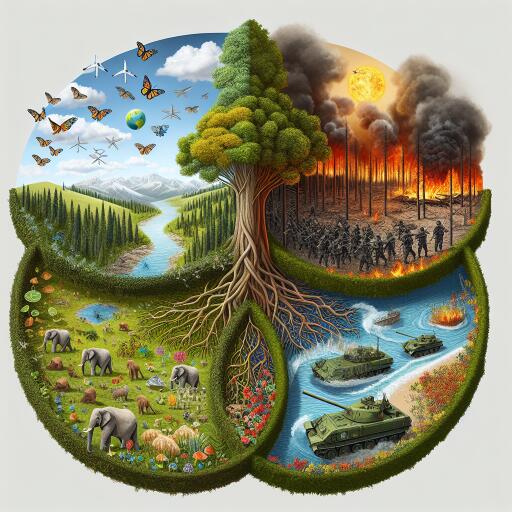
Three reasons why the climate crisis must reshape how we think about war
In 2024, the planet’s average temperature briefly climbed more than 1.5°C above pre-industrial levels—a symbolic and sobering marker of how far the climate has shifted. At the same time, wars in Ukraine, Gaza, Sudan and elsewhere are inflicting vast human suffering. These two realities are not separate stories. Conflict now unfolds in the long shadow of climate breakdown, and that should change how we understand, prepare for and respond to war.
1) War accelerates climate damage
Armed conflict is inherently destructive, and its climatic impacts are increasingly difficult to ignore. Fighting burns fuel at scale, from jets and ships to tanks and supply convoys. Explosions, fires and the disruption of energy infrastructure release greenhouse gases. After the fighting ends, reconstruction—cement, steel, heavy machinery—adds another surge of emissions.
Researchers and civil society groups have begun to quantify this footprint, including emissions from ongoing wars and from routine military activity. Early assessments suggest that, taken together, the world’s militaries likely emit more than many of the largest national economies. Some analyses have estimated that one country’s armed forces alone would rank among the top 50 emitters if counted as a nation. But the true total remains uncertain: data is patchy, reporting is inconsistent, and major powers disclose little or nothing. This opacity hinders accountability and informed debate.
Conflict also undermines the cooperation needed to tackle climate change. Scientific ties severed by war can stall critical monitoring and data-sharing, especially in sensitive regions like the Arctic. Energy security shocks can delay transitions away from fossil fuels, as governments scramble for short-term supplies.
Recognizing the climate costs of war raises hard questions. Is expanding military power compatible with a livable climate? At minimum, states face a moral and practical imperative to impose stricter emissions reporting, set reduction targets for their armed forces and avoid tactics that magnify environmental harm. Some call for sweeping demilitarization; others argue for tighter restraint and greener operations. Either way, pretending war is climate-neutral is no longer credible.
2) Climate shocks are changing what militaries do
Debates about “climate wars” often oversimplify. Climate stress—drought, crop failure, water scarcity—can heighten tensions, but the decision to use violence is always made by people, not weather patterns. What is undeniable, however, is that climate disasters are pulling militaries into far more civilian-facing missions.
From battling mega-wildfires and reinforcing flood defenses to managing evacuations, search-and-rescue and aid delivery, armed forces are increasingly called upon as first responders. As heatwaves intensify, rainfall patterns shift and storms grow more destructive, the frequency and complexity of these operations are rising. This can strain personnel, budgets and equipment originally designed for combat rather than continuous disaster relief.
There is no certainty that climate change will translate into more wars. But it will almost certainly translate into more emergencies. Governments will face difficult choices about priorities: Should defense budgets grow to handle both traditional security threats and escalating climate disasters? Or should more resources flow to civilian agencies better suited to prevention, adaptation and recovery? Without careful planning, militaries risk being stretched thin—asked to do ever more, with tools built for different tasks.
3) Armed forces must adapt to a harsher climate and a new energy system
Even as geopolitical tensions rise, climate change is reshaping the conditions under which militaries operate. Bases face sea-level rise, stronger storms and extreme heat. Training ranges may become unusable during fire seasons. Equipment must function reliably in hotter, wetter, dustier and more volatile environments. Recent storms have already caused billions in damage to military infrastructure, underscoring the urgency of climate-proofing facilities and supply chains.
Energy is the other strategic fault line. Modern militaries are among the heaviest institutional users of fossil fuels. They now face a pivotal choice: remain outliers in a decarbonizing world, or embrace the energy transition in ways that enhance operational effectiveness. Lower-carbon logistics—hybrid and electric vehicles where feasible, advanced batteries, synthetic and sustainable fuels, portable renewables, and more efficient generators—can reduce the vulnerability of long fuel convoys and cut costs while shrinking emissions. In contested environments, resilience often hinges on needing fewer resupplies and producing more power locally.
To get there, defense planners will need to:
- Assess climate risks to bases, personnel and equipment, and invest in adaptation now rather than after disasters hit.
- Integrate climate scenarios into war-gaming and readiness planning.
- Measure and publicly report military emissions with consistent methods, then set and meet reduction targets without compromising core missions.
- Accelerate R&D and procurement for energy-efficient platforms and climate-resilient infrastructure.
- Coordinate with civilian authorities to clarify roles and responsibilities during climate emergencies.
None of this suggests that war’s fundamental nature changes. But its character—the tools used, the theaters contested, the constraints imposed—does evolve. The climate crisis is now a defining force in that evolution. Understanding it will be essential to preventing conflicts where possible, limiting environmental harm when force is used and ensuring that societies can withstand the shocks that are already here.
War used to be imagined as a separate realm, insulated from the natural world. That illusion is gone. Security in the 21st century will be measured not only by deterrence and defense, but by how quickly we cut emissions, how wisely we adapt and how responsibly we use power in a heating world.



Leave a Reply