

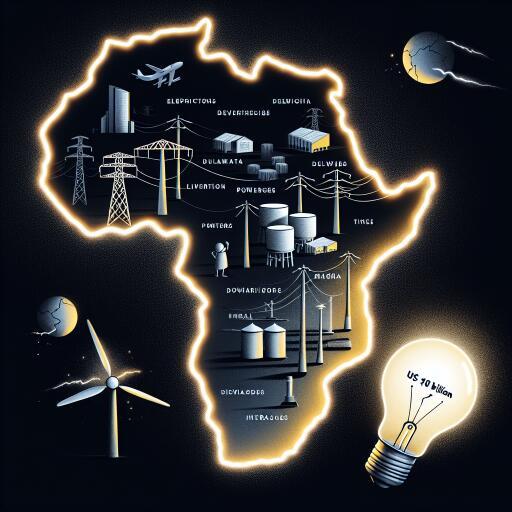
Zim Needs US$10 Billion to Resolve Electricity Challenges
Zimbabwe faces an impending challenge as it requires up to US$10 billion in investment to enhance power production to meet domestic demand. This need comes amidst a grim backdrop where much of the population still lacks adequate access to electricity.
With the country’s debt soaring to US$21.5 billion, nearly half of its US$44 billion GDP, financial hurdles are evident. Zimbabwe’s Finance Minister recently indicated that while small payments to creditors like the World Bank and the Paris Club are ongoing, they are insufficient to encourage new financial inflows to fund infrastructural developments, including power generation facilities.
The nation’s energy difficulties have persisted since 2007, exacerbated by Southern African Power Pool members prioritizing local economies over regional electricity exports. Though Zimbabwe imports electricity from regional suppliers, its power utility, Zesa Holdings, has paradoxically been exporting some of its limited domestically generated power — a vital strategy for servicing international debts, including those accruing from recent Chinese-backed power plant refurbishments.
Looking forward, an estimated US$10 billion will be essential over the next decade to prevent the intensifying energy deficit. This projected expenditure highlights the urgency for a review of Zimbabwe’s energy composition, policy inclusivity, and accelerated energy transition measures.
The current energy demand stands at approximately 4,000 MW, yet local production lingers at nearly 1,400 MW. This shortfall has driven industries and households towards costly alternatives like solar installations and diesel generators. The challenge is most severe for groups unable to afford such measures, resulting in substantial hardship among poorer demographics.
Presently, Zimbabwe’s primary energy production stems from the Kariba South hydropower plant, with a capacity of 1,050 MW, refinanced in 2018 with US$553 million from China. The Hwange thermal station, also recently upgraded with US$1.5 billion in Chinese funds, contributes significantly. However, persistent droughts in the Zambezi River area have impacted Kariba’s output, compelling reliance on 600 MW from the newly refurbished Hwange units, which is still insufficient.
Despite improved water levels this year, electricity from private entities tends to be more expensive, thereby inflating the costs of goods produced using such power. This scenario underscores the inefficiency of depending on expensive private electricity solutions.
The nation also has several small private hydroelectric stations, although these primarily serve their owners, exporting only surplus power to the grid. Other thermal plants in Munyati, Bulawayo, and Harare still require substantial refurbishments to realize meaningful contributions.
The US$200 million Dema diesel plant, launched in 2016, remains idle due to concerns regarding its economic feasibility. Furthermore, while Zimbabwe enjoys ample sunshine, progress in solar power adoption has been slow, with unimplemented plans for solar developments, such as installations at Lake Kariba.
In the private sector, some companies like Centragrid, Zimplats, and Econet’s Distributed Power Africa have initiated solar projects, yet these mostly satisfy their self-consumption needs. Conversely, the Zesa-appointed Gwanda solar farm project by Intratek Zimbabwe faces delays due to litigation, despite having received a US$5 million advance.
Zimbabwe continues to import electricity from the Democratic Republic of Congo, Mozambique, and South Africa, but rising debts and foreign currency shortages limit these imports. Without swift investments in upcoming projects, like the Batoka Gorge hydro initiative, the energy crisis will likely persist.
It is crucial for Zimbabwe to devise a comprehensive energy policy that harmonizes green technologies with its coal reserves, potentially serving as temporary relief amid the growing need for sustainable solutions. Both domestic funding, such as pension funds, and alignment with global climate financing trends could provide viable solutions to Zimbabwe’s energy dilemma and catalyze economic growth.
Additionally, efforts to increase the country’s captive power capacity from renewable sources such as solar energy have helped lessen the burden on the national grid. Ongoing government initiatives to expand electricity access, particularly in underserved rural areas through the national electrification program, demonstrate a commitment to improving energy equity.
To address the entrenched energy issues, Zimbabwe must balance immediate needs with future sustainability, ensuring energy access while securing necessary investments for robust infrastructure development.



Leave a Reply