

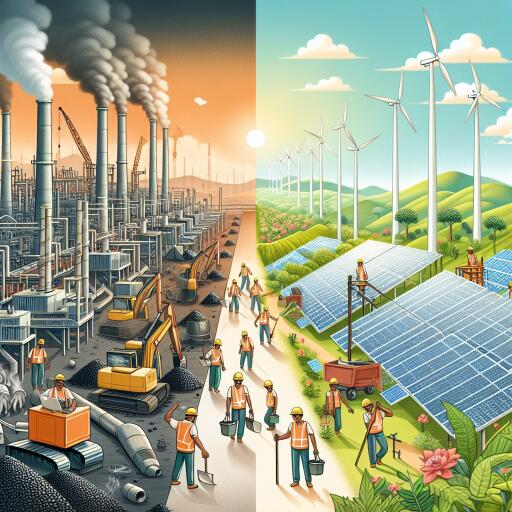
India’s Coal Transition: Navigating Complex Challenges for a Sustainable Future
India is focused on making significant strides towards its renewable energy goals in an effort to tackle climate change. However, transitioning away from coal, a major energy source, presents substantial economic obstacles that cannot be ignored. Beyond the environmental imperative, the macroeconomic ramifications of this shift, particularly those impacting employment and state finances, are critical issues that require the attention of policymakers.
Coal has been the backbone of India’s power generation, currently contributing to over 70% of the nation’s electricity. For states like Jharkhand, Chhattisgarh, and Odisha, coal is not just a resource, but a vital component of their economic frameworks, supporting state budgets, employment, and local development. Jharkhand, for instance, derives almost 30% of its tax revenue from fossil fuel-based royalties and levies. As these states house the bulk of India’s coal reserves and production, the transition bears a unique regional complexity with specific risks and impacts.
The financial demands of moving away from coal are immense. Estimates suggest India will need between $900 billion to $1 trillion over the coming three decades to pivot its power sector entirely away from fossil fuels. Interestingly, nearly half of this estimate is allocated to non-energy needs: reskilling workers, repurposing land, supporting livelihoods, and diversifying local economies.
These factors are not mere side issues but are integral to ensuring the energy transition is both socially and economically viable. Employment represents one of the most immediate concerns in this transition. Currently, over 13 million people depend on the coal industry for their livelihoods, spanning sectors such as mining, transport, thermal power, steel production, and more. Many of these jobs are through contractors or informal arrangements, making workers susceptible to job losses without adequate safety nets.
In Jharkhand, about 300,000 are employed in formal coal-related jobs, with an estimated one million more indirectly reliant on the industry. For these individuals and their families, coal represents more than energy; it is essential for financial stability in regions where alternative opportunities are scarce. An abrupt cessation of coal operations without having transitional employment options can result in economic stagnancy, increased inequality, and prolonged social tensions. The risk extends beyond simply stranded assets to potentially stranded communities left behind on the path towards net-zero emissions.
While renewable energy projects promise job creation—with over a million people employed in India’s renewable sector by 2023 and projections pointing to 3.4 million new jobs by 2030—the shift from coal to clean energy jobs is not straightforward. A significant skills gap exists; solar and wind industries require technical training, digital literacy, and expertise that many coal workers do not possess. There is also a regional imbalance, with renewable energy investments mainly focused in western and southern regions like Gujarat, Rajasthan, Tamil Nadu, and Karnataka, whereas coal jobs predominately exist in central and eastern regions.
Moreover, there are notable differences in job nature. Government jobs in the coal sector often come with better wages and job security compared to many new energy roles, which tend to be more project-based or contractual. To prevent workers from being disadvantaged, planned efforts are necessary to bridge these gaps through training, job matching, and wage support programs.
Fiscal dependency on coal revenues further complicates the transition. Between 2018 and 2023, states like Jharkhand amassed significant revenues from coal royalties, with Chhattisgarh and Odisha accumulating similar figures. These funds are pivotal in financing health, education, infrastructure, and social programs, and losing them could undermine development efforts in the country’s least advantaged districts. Current compensation mechanisms are inadequate; for example, the District Mineral Foundation funds are insufficient for the scale needed, demanding around $420 billion to address non-energy transition elements successfully.
Simultaneously, India’s banking sector remains heavily invested in coal, necessitating a strategic rechanneling of capital flows towards cleaner technologies and transition supports. As India marches towards a net-zero target by 2070, the emergence of new employment opportunities in fields such as solar installation, electric vehicle maintenance, climate-resilient agriculture, and circular economies is anticipated. This opens up avenues for skilling programs that can address unemployment while aligning with climate goals.
Large-scale reskilling initiatives, such as Suryamitra and Jal Urja Mitra for renewable energy technicians, must be expanded and adapted to fit the local needs of coal-dependent areas. Simultaneously, coal-producing states need robust support to diversify their economies, perhaps through green manufacturing or agro-based industries that offer consistent employment prospects.
Social protection structures will also need refinement to support informal workers, offering healthcare, pensions, and income support amidst career transitions. Critically, the government must implement mechanisms to mitigate the fiscal shortfall resulting from declining coal revenues, potentially via compensatory transfers or green revenue-sharing models, to ensure consistent state incomes during this period of change.
Ultimately, this transition should be inclusive and participatory, involving local communities, trade unions, and grassroots leaders in shaping the roadmap forward. Top-down approaches will not suffice when the livelihoods of millions are at stake. Though India’s transition beyond coal is an environmental imperative, it is also a test of the country’s capability to harmonize growth with equity and sustainability. With dedicated planning and financial investment, this transition could become a positive force for economic and social upliftment across the nation, rather than a source of division.



Leave a Reply