

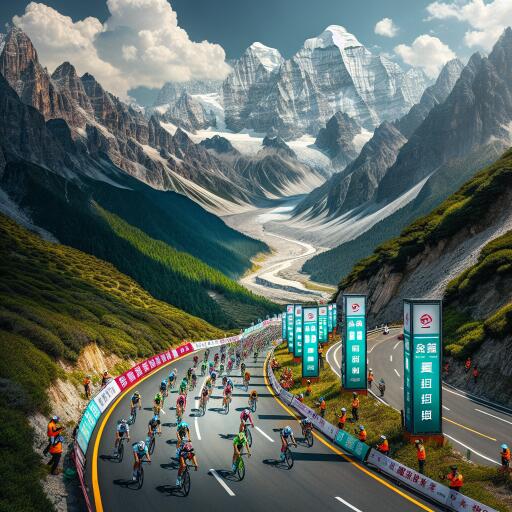
World’s Highest Cycling Race Showcases China’s Eco-Civilization
The 2025 Tour of Magnificent Qinghai isn’t just a remarkable road cycling event; it serves as a prominent platform for Qinghai Province in China to demonstrate its dedication to ecological conservation, cultural tourism, and the revitalization of rural areas.
Visitors and competitors are treated to a stunning tapestry of landscapes and culture, ranging from Menyuan’s canola fields to the majestic Qilian snow-capped mountains and grasslands. The vibrant heritage of the Tu ethnic group in Huzhu and the breathtaking views of nomadic horsemen cheering cyclists illustrate the enriching blend of ecology and tradition on this high-altitude plateau.
High Altitude, Challenging Races, Spectacular Scenery
The race kicked off on the 6th of July in Xining, the ancient plateau city that serves as the capital of Qinghai Province. Having commenced as the Tour of Qinghai Lake in 2002, the event was rebranded in 2025 as the Tour of Magnificent Qinghai. Emerging as one of Asia’s top road cycling races, it is famed for its challenging routes and staggering altitudes averaging 3,000 meters.
The 2025 Tour boasts eight stages stretching across 1,400 kilometers, drawing in 154 professional cyclists from various corners of the globe. This year, the race, peaking at an elevation of 3,869 meters, will close on July 13 in Haiyan County.
Over its 24-year evolution, the Tour of Magnificent Qinghai has transitioned from a modest 2.5-category race to a celebrated fixture on the international cycling calendar, classified now as a UCI ProSeries race.
In his opening remarks, Luo Dongchuan, the Governor of Qinghai Province, highlighted the race’s significance with its challenging nature and breathtaking vistas, presenting it as a premier event in the sport globally. He emphasized the event’s role as a window into China’s sporting aspirations and as a symbol of the people’s dynamic spirit across the Qinghai Plateau.
David Lappartient, the President of the International Cycling Union, also lauded the Tour’s impact on UCI racing history, commending its evolution and its status as a beacon attracting top-tier teams and athletes to Qinghai’s extraordinary landscapes.
Passion and Ecology in Harmony
Home to vital water sources and rich biodiversity, Qinghai Province, often dubbed the “Water Tower of China,” is a testament to eco-civilization. The Tour of Magnificent Qinghai brands itself as a “green calling card,” highlighting the region’s commitment to environmental stewardship.
The 2025 race charts a path through iconic sites such as the Twelve Turns of Huzhu, the picturesque Zhuoer Mountain, and the expansive Jin Yintan, all exemplifying the balance between human activity and natural preservation in Qinghai.
Wang Xia, Director of the Qinghai Provincial Sports Bureau, commented on the race’s emblematic role in Qinghai’s ecological advocacy, underscoring the significance of protecting essential sites such as the Three Rivers Source and Qinghai Lake.
Switzerland’s Simon Pellaud, a participant in this year’s race, marveled at the spectacular vistas, drawing comparisons between Qinghai’s flower-filled landscapes and his own homeland.
In recent years, efforts such as establishing the Qilian Mountains National Park have contributed to marked improvements in the area’s ecological health, supporting enhanced water conservation and increased vegetation absorption of carbon dioxide.
An unforgettable scene unfolds each year between May and August near Qinghai Lake, where masses of naked carp migrate upstream for spawning season. This natural wonder contributes to the ecological vibrancy of China’s largest inland saltwater lake, now also a developing national wetland park.
Qinghai’s push for high-quality development is unmistakable, as it positions itself as a hub for the salt lake industry and renewable energy, a destination for international eco-tourism, and a thriving center for organic agriculture and livestock exports.
Plateau Culture and Development
The wealth of ethnic communities in Qinghai, including Han, Tibetan, Hui, Mongolian, Tu, and Salar peoples, reflects a harmonious tapestry of cultural unity, illustrated beautifully through the Tour of Magnificent Qinghai.
For example, the traditional stilt-walking performance by young locals like 20-year-old Guo Kuanzhang adds a unique cultural flavor to the cycling event, offering audiences a glimpse into Qinghai’s intangible cultural heritage.
Tourism-driven projects, such as the Dongge’er Fish Watching Platform, benefit local economies by fostering cooperative ventures that enable local herders to become entrepreneurs and business owners.
The final stage of the race in Xihai Town on the Jin Yintan Grassland further illustrates the Tour’s value in galvanizing regional economic growth. This momentum is highlighted by an increase in local cycling clubs and infrastructure, with Xinhai Town now housing numerous cycling enthusiasts and resources.
As Qinghai advances ecologically and culturally, it continues to shed its image as a remote region, steadily emerging as a modern model of eco-friendly progress. The region’s embrace of “green” initiatives, from sports to sustainable development, continues to craft an inspiring narrative of harmony between human achievement and the natural world.



Leave a Reply