

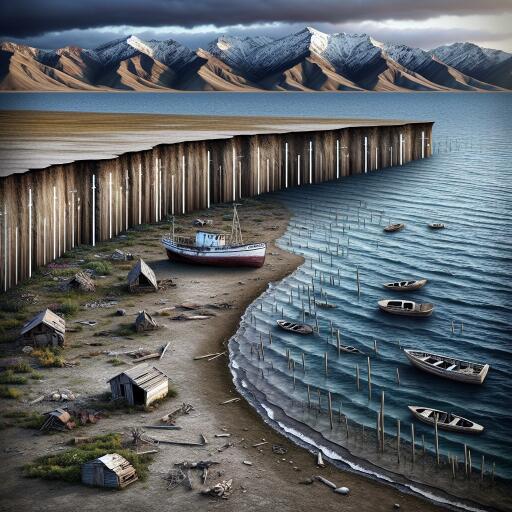
Vanishing Sea: How Caspian Sea is Disappearing Right Before Our Eyes
The city of Aktau, perched on the edge of Kazakhstan’s Caspian Sea coast, has witnessed a dramatic transformation over the years. From a bustling shoreline teeming with life to a barren landscape of cracked earth and empty seabeds, the evolution of this region underscores a growing environmental crisis. Once hosting joyful familial connections amid splashing waters and serene views, Aktau now stands at the forefront of an alarming ecological phenomenon.
The Caspian Sea, the globe’s largest enclosed inland body of water, has long been a cornerstone for communities in Russia, Iran, Azerbaijan, Kazakhstan, and Turkmenistan. Renowned for sustaining life, economic activity, and countless cultural practices, the sea is now shrinking at an alarming rate. From 2006 to 2021, researchers found its levels receded by 10 centimeters annually, resulting in a colossal 15,000 square kilometers retreat. Some estimates even suggest potential losses reaching up to 22,000 square kilometers.
What drives this regression? Over-extraction of oil and gas — key drivers of regional economies — has taken a toll, exacerbated by burgeoning populations flocking to cities like Aktau. The city’s population surged from around 200,000 to 270,000 in just a year. With this growth, demand rises for precious local resources. Desalination plants strive to meet water needs, but at great environmental expense and risk of further imbalance.
Mainly fueled by the Volga River, which accounts for roughly 80% of the Caspian’s inflow, the sea endures immediate threats from human infrastructure. A network of approximately 40 dams along this crucial river impacts water levels, with more constructions underway. Following geopolitical tensions and the pivot toward domestic agricultural practices, water from the Volga is drawn heavily for irrigation, reducing the inflow to the Caspian Sea.
Climate change compounds these challenges, driving erratic weather patterns that accelerate evaporation while decreasing rainfall, further destabilizing the sea’s delicate environmental balance. This predicament is indicative of a global trend threatening landlocked water bodies, demanding immediate attention and action.
The environmental repercussions are stark. The Caspian seals, endemic to this region and critically endangered, have experienced a catastrophic population collapse — from over a million to estimates between 75,000 to 270,000 today. Factors such as offshore drilling, pollution, and seismic activities are primary culprits in pushing the seals toward extinction.
Observations from 2022 reported staggering mortality rates, with over 250,000 seal carcasses appearing along Russia’s Dagestan coastline. Viral pneumonia, perhaps induced by weakened immunity linked to environmental stresses, was identified as the cause. Decreasing ice coverage in northern basins, vital for seal breeding, only exacerbates these challenges.
Despite growing awareness, initiatives remain scarce and inadequate. Projections signal that the Caspian Sea may recede further by 9 to 18 meters before the century’s end. This troubling outlook emerges even as Kazakhstan aims to bolster its maritime trade through Aktau. As water recedes, commerce, infrastructure, livelihoods, and biodiversity face existential threats.
The Caspian Sea is on the brink of a dramatic decline, reminiscent of the fate that befell the Aral Sea. Urgent collaborative efforts by regional governments and international bodies are imperative to halt this environmental descent and preserve what remains of this vital water body.



Leave a Reply