

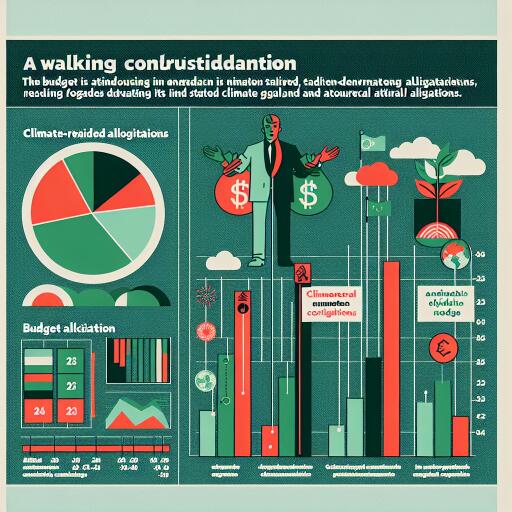
Analysis: Budget 2025-26 — Climate budget a ‘walking contradiction’
The recent budget announcement has placed significant emphasis on climate-resilient initiatives, but scrutiny reveals inconsistencies hindering its effectiveness. Despite the hefty allocation for climate concerns, conflicting priorities and unclear policies cast doubt on their practical implementation.
One of the budget’s notable elements is the introduction of the ‘Climate Budget Tagging’ (CBT) tool, designed to classify climate-related expenditures in harmony with the National Climate Change Policy. This tool, prompted by conditions attached to an IMF Resilience and Sustainability Facility, aims to systematically track and categorize climate-focused financial activities.
The government has designated funds amounting to Rs85.43bn for adaptation, Rs603bn for mitigation initiatives, including clean energy projects, and Rs28.33bn for supporting areas such as capacity building and research. However, the bulk of the funds are diverted towards mitigation efforts, despite the finance minister’s repeated acknowledgment of adaptation as a pressing need.
This seeming contradiction extends to the subsidization approach. While there’s notable investment in clean energy and mitigation, the allocations for adaptation, such as in food and agriculture sectors, appear disproportionately limited. Earlier this year, policymakers underscored adaptation as a major challenge yet the current budget suggests otherwise.
Former ministers and climate experts have criticized these misalignments. One suggests that a reevaluation of the economic growth model, with a focus on climate-compatible strategies, is necessary. Innovations like drought-resistant crops and robust early warning systems for climate events are conspicuously absent from the budget plan.
Additionally, it’s argued that while the climate tagging is a progressive step, it fundamentally rebrands existing projects rather than initiating new resilience-oriented ventures. There’s a pronounced lack of transparency in how allocated funds will be practically utilized.
Contradictions are further highlighted by the financial maneuvers that seem to counteract climate-friendly policies. For instance, while imposing levies to curtail fossil fuel reliance, duties on solar imports and adjustments in net metering create conflicting incentives. The stance on electric vehicles, similarly, introduces another layer of inconsistency.
Moreover, the budget has imposed significant funding cuts on the Ministry of Climate Change, dropping from Rs3.5bn to Rs2.7bn. This reduction could potentially inhibit the ongoing research and technical capacity-building crucial for tackling climate-related challenges. Experts fear this may thwart “project-isation” efforts crucial for enhancing climate resilience.
Given these drawbacks, the budget under the environmental protection category has also been reduced. This decrease impacts several critical areas including pollution abatement funding and wastewater management, though the latter receives a slight increase.
These fiscal decisions unfold against a worrying backdrop, with the nation facing annual climate-related losses estimated at Rs400bn. The current budget framework prompts questions about its readiness to address the multifaceted issues presented by climate change effectively.



Leave a Reply