

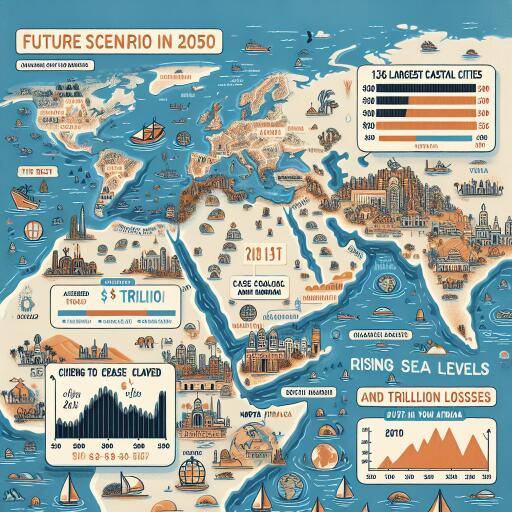
The 136 Largest Coastal Cities, including Egypt’s Alexandria, Face $1 Trillion Losses per Year from Sea Level Rise by 2050
Recent scientific research suggests that our planet’s fate is more precarious than previously believed. The global community is currently on a path that may see a significant rise in sea levels due to the melting of the world’s major ice sheets in Greenland, East Antarctica, and West Antarctica. Even a modest increase in global temperatures, as low as 1.5º C. above pre-industrial levels, could initiate catastrophic ice melt, which was earlier believed to occur only at a rise of 3º C.
The implications of this finding are dire. With the world already nearing that 1.5º C. increase, the risks we face are substantial. The melting ice contributes to rising sea levels, compounded by melting glaciers and the thermal expansion of warming water. This progressive rise in sea level spells disaster for low-lying coastal regions and cities, potentially forcing hundreds of millions to relocate inland.
The collapse of these ice sheets, as highlighted by the latest data from the United Nations Climate Science Panel (IPCC), paints a grim picture. Significantly reduced emissions may still lead to rising sea levels by a foot and two inches by 2100. Failure to reduce emissions could result in sea levels rising by nearly two feet. Considerably higher projections suggest a worst-case scenario of a massive 50-foot rise by 2300, which could overwhelm many of the world’s coastal cities.
With over a billion people living less than 30 feet above sea level, the potential for displacement is vast. Areas like Alexandria in Egypt already face challenges from increasing sea levels. Should projections bear out, damages amounting to $1 trillion annually by 2050 might ravage the world’s 136 largest coastal cities. Not only the ultimate rise in sea levels but also the speed of this change will be challenging for municipalities to manage, making constant adaptation a necessity.
Looking to historical geological eras, evidence shows sea levels much higher than today’s, even with lower atmospheric carbon concentrations than currently observed. This reality indicates previous climate models might have underestimated the impact, with feedback loops responsible for accelerated changes still not fully understood.
Consider Egypt, particularly the Nile Delta region — a vast and highly fertile tract of land stretching from north of Cairo to Alexandria. Here, continuous sea-level rise has already affected urban infrastructure. Since the turn of the millennium, Alexandria has seen a 40% reduction in beach area, with rising waters undermining the foundations of numerous buildings, leading to more frequent collapses since 2015.
The situation in Egypt’s Kafr al-Sheikh province exemplifies the broader issue faced by many coastal areas around the globe. Here, the effects of erosion and surging sea levels are compounded by saltwater intrusion from storm surges, which salinize farmlands that once supported substantial agricultural yields. Residents such as Saeed Umair recount personal losses of fertile lands to the encroaching sea, describing once-productive terrain that now sits barren.
With an estimated 60 million residents currently in the Egyptian Delta, the question of potential mass displacements arises. Where would they relocate? Upper Egypt lacks sufficient resources and infrastructure to sustain such a significant population influx. Similarly, migration into neighboring Sudan, with its own socio-political challenges, seems implausible.
The threat to coastal populations worldwide is symptomatic of our collective carbon dependency. This looming crisis demands an urgent transition away from fossil fuels and a pivot towards sustainable energy solutions. Global leadership and community actions are critical to managing emissions and safeguarding the future of our coastal cities against the formidable challenges posed by global warming and its effects.



Leave a Reply